 de


 Produktleitfaden
How to give receptionists a private place for sensitive calls
Give receptionists a private place for sensitive calls by pairing an enclosed call space with an agreed front-desk cover arrangement and a clear way to transfer the conversation. The space must work with reception duties, not require the receptionist to choose between a private conversation and an unattended desk.
- A private call space for reception needs front-desk cover, call transfer and speech privacy—not just a quiet corner.
- Soundbox Store acoustic phone booths suit receptionists who need a separate space for individual calls.
- Choose a single-person booth for calls; consider a two-person booth when a colleague must join.
- Check the complete journey from answering at reception to returning to the desk before using sensitive information.
Why this matters
Receptionists need to answer incoming calls and welcome people who arrive in person. When a conversation becomes sensitive, those duties need a planned handover rather than an improvised search for somewhere else to talk.
Separate the operating question from the buying question. This guide focuses on desk cover, moving the call and returning to reception; the guide to telephone booths for office reception areas addresses the reception-specific product choice.
A private room does not solve the problem if nobody can cover the desk or the receptionist cannot continue the call there. Plan the handover before choosing the enclosure. That gives you a useful brief rather than a booth with no agreed role.
How do you give receptionists a private place for sensitive calls?
Use the following sequence to connect the reception desk, the call space and the person providing cover. Assign responsibility for each stage so staff know what to do without explaining the caller's circumstances in front of visitors.
1. Define when the conversation moves away from reception
Agree which conversations should leave the public-facing desk. Examples to include in your own procedure are discussions involving personal circumstances, a detailed complaint or information the caller does not want others nearby to hear.
The receptionist should not need to collect the sensitive details before deciding to move. Give staff permission to pause the conversation and arrange a private continuation as soon as the need becomes clear.
Keep the trigger simple: if continuing requires discussing information that should not be spoken across reception, move the conversation. Routine directions and general enquiries can remain at the desk.
2. Assign front-desk cover
Name the colleague or team responsible for covering reception during a private call. Include a backup arrangement for times when that person is unavailable, rather than leaving the receptionist to find help while the caller waits.
The handover only needs to explain that reception cover is required. Do not make the cover request depend on repeating the subject of the call to everyone nearby.
Where immediate cover is unavailable, agree how staff will arrange a callback or pass the conversation to an appropriate colleague. A private call space is not a substitute for reception cover.
3. Confirm how the call continues in the private space
Check the actual telephone arrangement with whoever manages your systems. Establish whether the receptionist will transfer the call, continue on an approved portable device or arrange a callback from the private space.
Do not assume that a call answered at the desk can follow the receptionist into another room. Confirm the process using the equipment and accounts staff already use, including who retrieves a call if the transfer does not complete.
Write down the fallback. The caller should not have to repeat sensitive information at the public desk because the intended transfer route failed.
4. Choose a space for the people involved
Start with who needs to be physically present. A receptionist speaking to a caller remotely needs a different arrangement from a receptionist and colleague handling the same conversation together.
Choose a single-person booth for individual calls. Consider a two-person meeting booth when a second staff member regularly needs to join in person, rather than choosing extra capacity without a defined use.
An existing enclosed room is another option to assess, but include its competing uses in the plan. A room that is routinely booked for meetings needs an agreed alternative for unplanned sensitive calls.
5. Rehearse the complete handover
Walk through the process using a fictional enquiry, not a genuine caller's details. Start at the reception desk, request cover, move the call, continue the conversation and return responsibility to the receptionist afterwards.
Include the waiting area in your assessment. Ask a colleague outside the proposed call space whether ordinary speech is intelligible, without treating that informal check as a product test or a guarantee of confidentiality.
Also check whether people outside can read the screen or paperwork used during the call. Speaking privately and working out of view are separate requirements.
6. Give staff a short written procedure
Record the trigger for moving a call, the cover contact, the transfer method and the fallback. Keep the instructions where reception staff can find them without searching through a wider office manual.
Explain how staff should leave the space after use. Remove working notes and personal items, end the call fully and make the space ready for the next person.
Review the arrangement when reception responsibilities or telephone systems change. A procedure that names the wrong cover contact is not ready for an unexpected call.
Match the booth to the reception task
Soundbox Store acoustic phone booths are best for reception teams seeking a separate enclosure for individual calls. The supplied product descriptions distinguish single-person call booths from a two-person enclosure for private meetings; they do not establish how either will perform in your particular reception layout.
Use capacity to narrow the choice, then assess the complete working arrangement. None of the options below removes the need for desk cover, call continuity or a check of speech privacy in the intended setting.
| Product | Stated capacity | Best for | Practical advantage | Limitation for reception |
|---|---|---|---|---|
| Quell Office Pod Solo | 1 person | A receptionist taking a call alone | Designed for private calls | Not the choice when a colleague needs to join inside |
| Office Phone Booth Folio | 1 person | Individual calls and video meetings | Its stated uses include private calls and focused work | Shared focus-work use needs a priority rule for reception calls |
| Office Phone Booth Quell - 2 Person | 2 people | A receptionist and colleague handling a conversation together | Designed for private meetings between two people | Its additional capacity serves no defined purpose for solo-only calls |
Single-person booths: individual reception calls
A single-person booth matches the task when only the receptionist needs to step away. Keep the brief centred on answering and continuing calls rather than turning the space into an overflow meeting room.
Both single-person products in the table are described as spaces for private calls. The Folio description also includes video meetings and focused work, so decide whether those uses can share the same space without displacing reception's needs.
The trade-off is clear: a single-person space supports an individual caller, but not an in-person discussion with a colleague. Choose it for solo use, not as a compromise meeting room.
Two-person booths: supported conversations
A two-person booth fits a different workflow: the receptionist needs another staff member present during the call, or the conversation moves into a private discussion between colleagues. Make that use explicit in the brief.
Do not confuse the number of people on the telephone with the number inside the enclosure. A remote caller does not need a seat in the booth; a colleague joining the receptionist does.
The extra capacity is useful only when that second place has a purpose. For solo reception calls, prioritise the handover and access arrangements rather than selecting a larger enclosure simply because it accommodates more people.
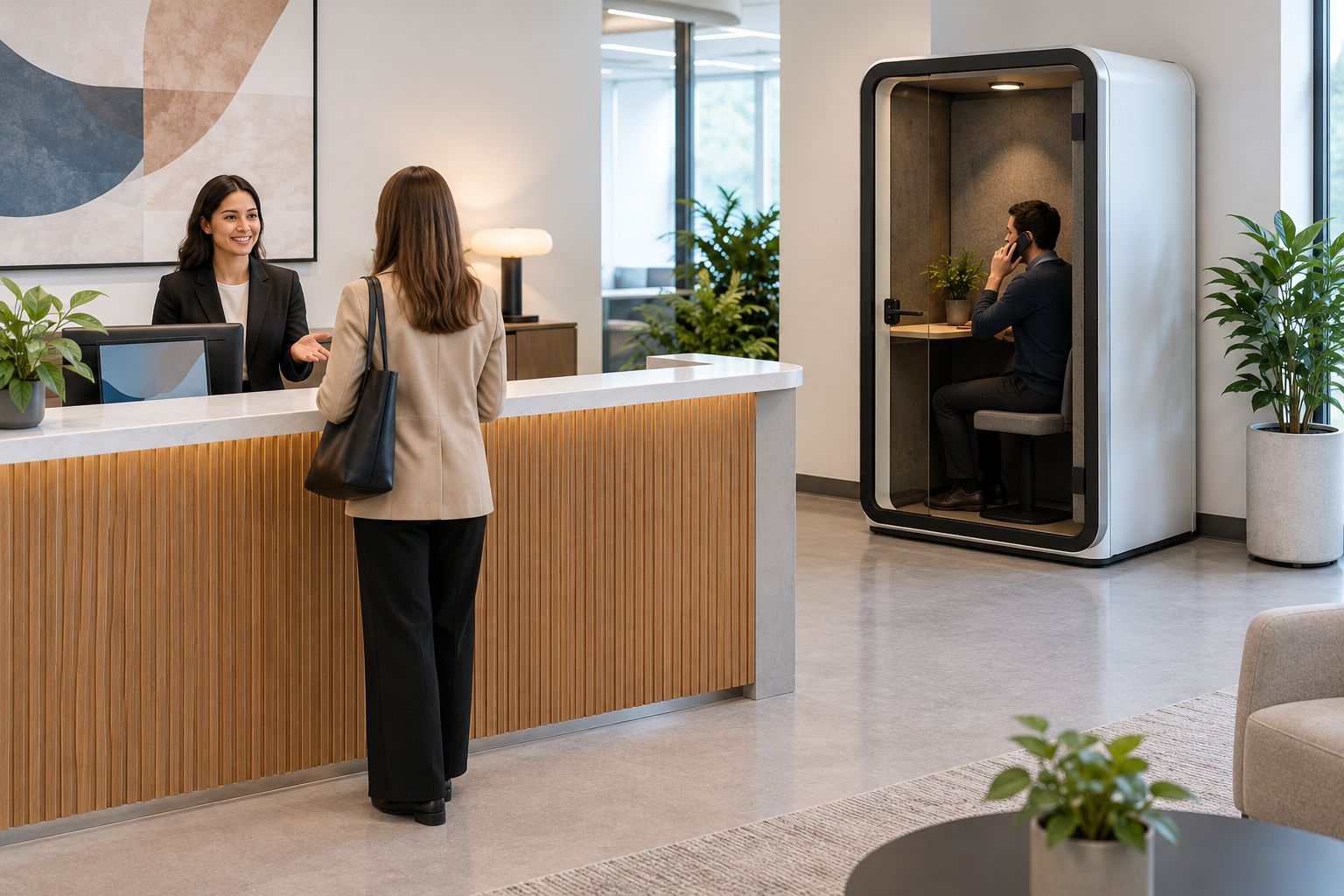
Why the right reception call arrangement varies
The right choice depends on how the conversation leaves reception and what happens while the receptionist is away. Use these factors to write the brief before comparing finishes or optional extras.
- People inside: distinguish an individual call from a conversation requiring a colleague in the same enclosure.
- Front-desk cover: identify who takes responsibility for arriving visitors and incoming enquiries during the call.
- Call continuity: confirm how the existing telephone arrangement supports moving or restarting the conversation privately.
- Competing uses: decide whether general meetings, video calls or focused work can occupy the space when reception needs it.
- Visual privacy: assess what people outside can see on screens and documents, separately from what they can hear.
- Fallback space: name the alternative when the preferred enclosure is occupied or the call cannot be transferred as intended.
These are operating decisions, not extra product specifications. They help you choose between the stated uses of Soundbox Store acoustic office pods without assuming that an enclosure includes a particular telephone system, booking arrangement or furniture configuration.
Keep unplanned calls from becoming a booking problem
Give reception a clear priority rule if the call space is shared with the wider office. Decide whether staff can reserve it for focused work and what happens when a sensitive reception call arrives during that reservation.
Avoid calendar entries that reveal the reason for a private conversation. A neutral booking description is enough to communicate that the space is in use; staff do not need the caller's circumstances to respect the reservation.
Do not make every reception call compete with lengthy general meetings. If shared use prevents access when needed, revise the allocation rule or identify a separate room for those meetings.
Treat immediate access as part of the brief, not something to resolve after purchase. The same applies to the fallback: it should be an agreed destination or callback process, not a vague instruction to find somewhere quiet.
Check speech privacy and visual privacy separately
A space can feel removed from the reception desk while still leaving practical privacy questions unanswered. Assess what is intelligible outside during ordinary speech and what is visible through the enclosure during the intended task.
Use fictional names and made-up enquiry details for this exercise. Listen from places people actually occupy, including the waiting area, rather than judging the space only from inside it.
For visual privacy, consider the working position of the screen and any documents used during the call. An acoustic enclosure does not remove the need to think about sightlines.
Soundbox Store lists privacy film as an optional extra for its pods. Consider that option only against the visual requirement: it does not replace an assessment of whether conversations can be understood outside the space.
FAQ
What's the first step in creating a private call space for reception?
Agree who covers the reception desk when the receptionist needs to take a sensitive call elsewhere. Then confirm how the call continues in the private space and what happens if that space is occupied.
Should a receptionist use a single-person or two-person booth?
Choose a single-person booth when the receptionist takes the call alone, and consider a two-person booth when a colleague needs to join inside. Count the people physically using the enclosure, not the people participating remotely.
What should happen if the receptionist works alone?
Set an agreed callback or colleague-transfer process for times when reception cannot be covered. Do not make moving a sensitive call depend on leaving the desk without an agreed arrangement.
Can a reception call booth also be used for focused work?
A shared booth needs a priority rule that keeps it usable for reception calls. Decide how reservations work and name a fallback when the booth is occupied.
How do we check the arrangement before using it for sensitive calls?
Rehearse the full process with a fictional enquiry, from requesting desk cover to returning after the call. Check call continuity, intelligible speech outside and views of screens or paperwork without using genuine personal details.
Does privacy film stop people overhearing a reception call?
Privacy film addresses a visual requirement, not whether speech is intelligible outside the booth. Assess visual privacy and speech privacy separately rather than treating one as evidence of the other.
One last thing
Rehearse the return to reception, not just the move into the booth. Specify who tells the covering colleague that the call has ended, how responsibility returns and where any follow-up notes belong.
That final handover completes the arrangement. A private call space should let the receptionist resume the front-desk role without leaving the next caller, visitor or colleague unsure who is responsible.


