 en/at
en/at



















 Product guide
Connect a Soundproof Booth to Office HVAC: 2026 Guide
Connecting a soundproof booth to office HVAC almost never means running ductwork into the pod. Most enclosed booths, including the Quell range at Soundbox Store, use a standalone dual silent ventilation system rather than a hard tie-in to the building's air handling — so the real project is placement and airflow planning with facilities, not a mechanical connection after delivery.
- Most soundproof booths run standalone ventilation, so connecting a soundproof booth to office HVAC directly is rarely the right approach in 2026.
- Facilities teams handle any building HVAC coordination; buyers choose capacity and airflow spec, not duct routing.
- A 1-person phone booth and a 6-person meeting booth carry different ventilation loads and need separate airflow plans.
- Gotcha: blocking the intake grille with furniture or a wall gap makes a pod feel stuffy on back-to-back calls, even with ventilation running.
- Verdict: treat this as a placement-and-capacity decision first, a contractor conversation second.
Why this matters
Teams search for "connect soundproof booth to office HVAC" after a pod already feels stale on long calls, and the instinct is to assume the booth needs to be wired into the building's central air. In practice, the pods sold through the Quell Office Pod Solo line and larger meeting booths are built to run their own air exchange independent of the office system.
That changes what "setup" actually looks like. Instead of scheduling ductwork, you're deciding where the pod sits relative to existing airflow, how many people will use it per day, and when to bring facilities into the conversation. Get that sequence backwards and you end up paying for HVAC work a pod with 30-35 dB of noise reduction and its own ventilation loop didn't need in the first place.
Before you start
- Floor plan and power access: know where the pod will sit, whether there's a wall outlet nearby, and whether the space has an existing supply or return vent close by.
- Facilities or building management contact: any conversation about tying into central HVAC, even to confirm you don't need to, goes through whoever manages the building's mechanical systems — not the pod vendor.
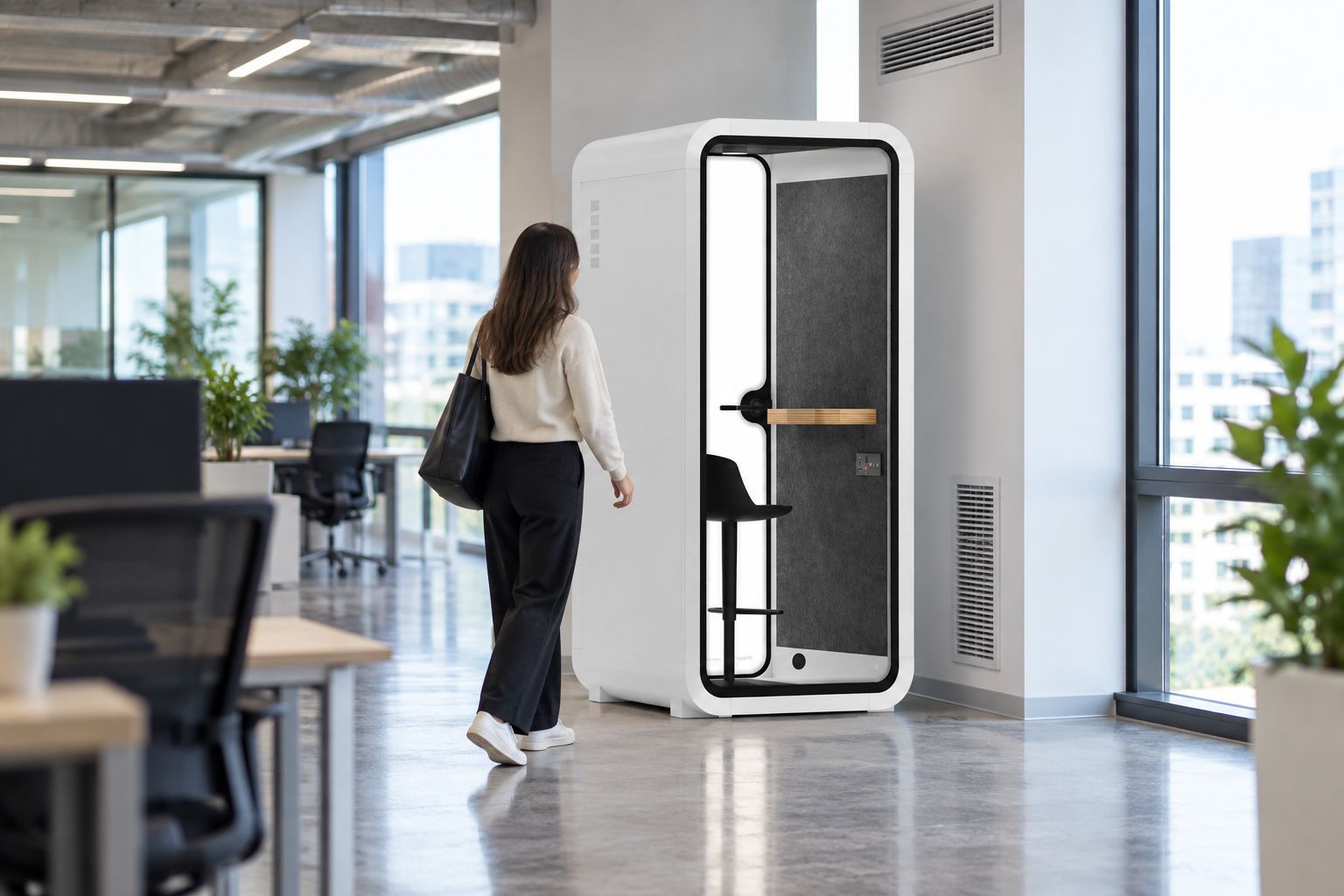
- The gotcha: placing a booth flush against a wall or inside a tight alcove can block its own ventilation grille even when the internal system is working exactly as designed. Airflow clearance matters more than proximity to a vent.
Decide whether your booth needs a building HVAC connection
Start here, because most of the time the answer is no. Soundbox Store's meeting booths — the 4-person and 6-person Quell models — run what the product spec calls a dual silent ventilation system, built to exchange air inside a sealed acoustic shell without a duct connection to the building.
That's the default assumption for 2026 pod installs: standalone first, tie-in only if a specific building code or landlord requirement forces it. If your facilities team hasn't raised a requirement, don't create one.
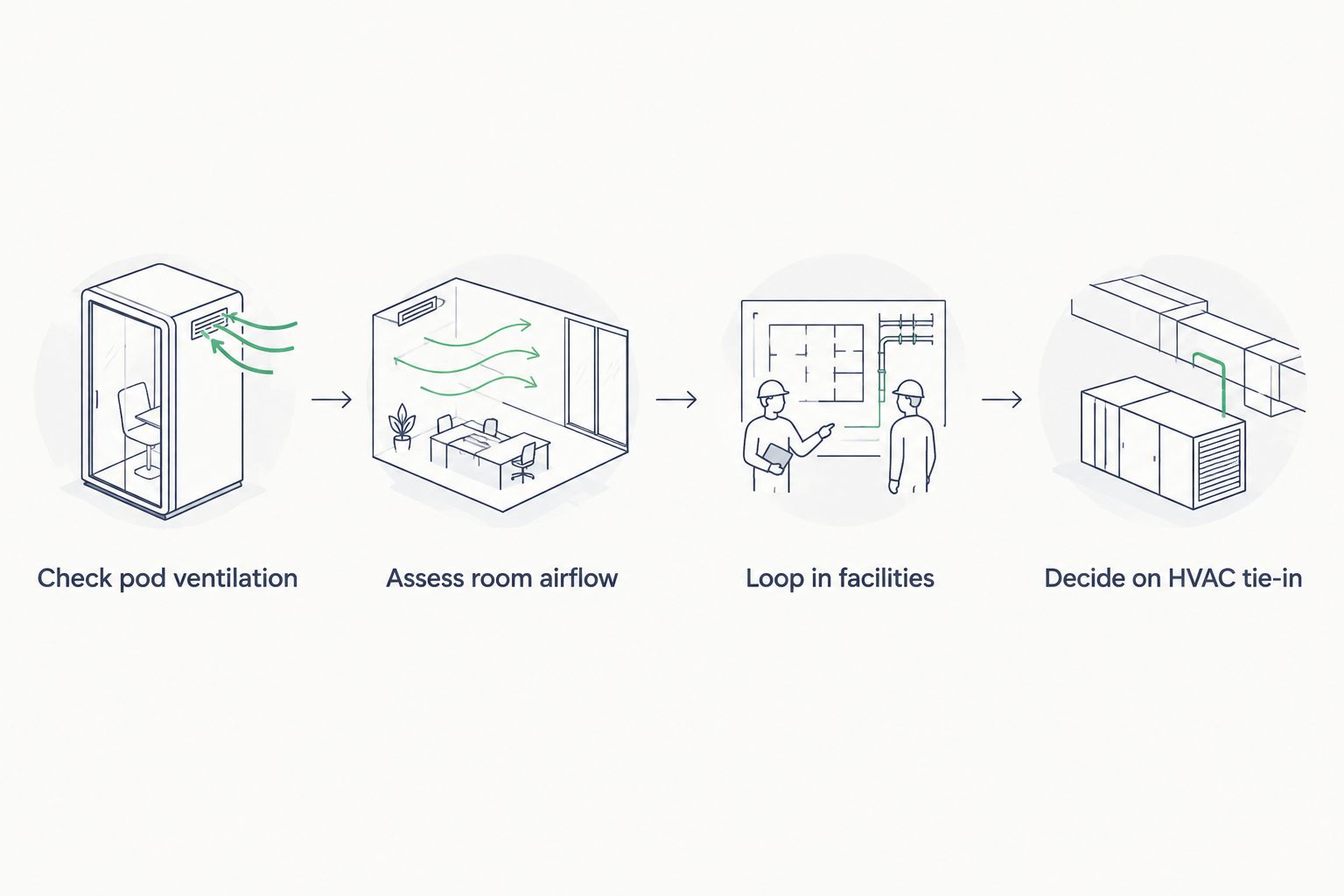
Expected result: you can state, in one sentence, whether your booth needs a building tie-in or not, before anyone picks up a phone to call a contractor.
Plan airflow, placement and power before you call anyone
- Map the room's existing air paths. Note where supply and return vents already sit in the room so the booth isn't placed directly in a dead-air corner.
- Check clearance around the booth's own vents. Leave open space around the pod's ventilation grille — furniture, partitions or a tight corner placement can choke airflow that would otherwise work fine.
- Confirm power location. The ventilation system and any internal lighting need a nearby outlet; plan the pod's position around that before anything else.
- Estimate daily usage. A booth used for back-to-back 45-minute calls all day needs more airflow margin than one used for occasional quick calls.
Expected result: a marked floor position with confirmed power access and clear ventilation clearance, ready to hand to facilities.
Loop in facilities or an HVAC contractor early
Once placement and power are settled, bring in whoever manages the building's mechanical systems — even just to confirm the standalone ventilation is sufficient for the room. This is the step that prevents a pod from arriving to a space nobody checked against.
Soundbox Store's guide on briefing a facilities manager on office pod installation covers what to hand them: floor plan, pod dimensions, and the usage estimate from step four above. Bringing facilities in at the planning stage, not after delivery, is what separates a smooth setup from a pod sitting in a hallway for two weeks.
Match pod capacity and ventilation spec to your team size
A 1-person phone booth and a 6-person meeting booth aren't interchangeable on ventilation load. More people in a sealed shell means more air exchange needed per hour of use, so capacity planning is really ventilation planning in disguise.
Soundbox Store's pod ventilation options guide breaks down which configurations suit which room sizes and usage patterns in more detail than this guide can.


If the issue is HVAC noise bleeding in, not a connection
Some teams land on this topic for the opposite reason: the building's HVAC is loud enough to bleed through a pod's shell during calls. That's a different problem from ventilation capacity — it's about acoustic sealing around wall panels and vent gaps rather than airflow volume, and it calls for a different checklist than the one above.
It's also a separate wiring question from power and data: if you're running cabling into the booth alongside any HVAC coordination, plan both at the same time so facilities isn't making two site visits instead of one.
Troubleshooting common ventilation problems
- Booth feels stuffy after 30+ minutes of use: check that nothing is blocking the ventilation grille and that the pod isn't wedged into a dead-air corner.
- Airflow feels fine solo but weak with 4-6 people inside: the room's ambient air exchange may need a second look from facilities, since larger booths carry a heavier ventilation load per hour.
- Facilities insists on a building HVAC tie-in you weren't expecting: this is usually a landlord or building-code requirement specific to that property, not a standard requirement for the pod itself — confirm the reason before booking contractor time.
- Pod placed near a vent still feels warm: proximity to an existing vent doesn't guarantee airflow reaches the booth's own intake; clearance around the pod's grille matters more than distance to the wall vent.
- Power outlet is on the wrong side of the planned position: resolve this before the pod arrives — repositioning after delivery costs more time than planning power location up front.
Customize your setup for the next phase
Once placement, ventilation and facilities sign-off are settled, the next planning step is usually wiring power and data into the booth itself, so calls and video meetings work the day it lands. Treat that as a follow-on project rather than bundling it into the HVAC conversation — two separate site visits from facilities, planned back to back, is faster than one visit trying to solve both at once.
If ventilation planning changes the pod size you're considering, revisit capacity before finalizing placement — a 6-person booth and a solo phone booth have very different footprints and airflow needs, and it's cheaper to change the choice on paper than after delivery.
FAQ
Do soundproof office pods need to be connected to the building HVAC?
No, most soundproof pods including Soundbox Store's Quell range run a standalone ventilation system rather than a duct connection to the building's HVAC. A tie-in is only needed if a specific landlord or building code requires it, which is uncommon.
How does a soundproof booth get fresh air if it's not wired into office HVAC?
Larger meeting booths use a dual silent ventilation system built into the pod shell to exchange air without an external connection. Airflow depends on clearance around the pod's own vent grille, not on the building's central system.
Why does a soundproof booth feel stuffy after a long call?
This is usually a placement issue, not a missing HVAC connection. Furniture or a tight corner blocking the pod's ventilation grille reduces airflow even when the internal system is working correctly.
Who should I talk to about connecting a soundproof pod to office HVAC?
Loop in your facilities manager or building management contact before ordering, even if the answer turns out to be that no connection is needed. They also confirm power location and floor placement.
Does pod size change ventilation requirements?
Yes. A 1-person phone booth and a 6-person meeting booth carry different airflow loads, since more occupants means more air exchange needed per hour of use.
Is HVAC noise coming through a pod a ventilation problem?
No, that's an acoustic sealing issue around wall panels and vent gaps rather than an airflow capacity problem, and it needs a different fix than adjusting ventilation.
One last thing
The question worth asking before any HVAC conversation isn't "how do we connect this," it's "does this room already have enough clearance around where the pod's vent will sit." Most stuffy-booth complaints in 2026 trace back to placement against a wall or in a tight alcove, not a missing mechanical connection — solve the clearance problem first and the HVAC question usually answers itself.

