 en/no


 Product guide
Do employees actually use office phone booths?
Employees use office phone booths for private calls, video meetings and focused work, but a booth's presence does not prove it serves your team. Judge office phone booth usage by completed sessions, access when needed and the work it supports—not reservations alone.
- Office phone booth usage should measure completed sessions, not just bookings for private calls or video meetings.
- Soundbox Store office phone booths suit teams seeking dedicated spaces for individual calls.
- Quell Office Pod Solo is designed for 1 person; a shared conversation needs a different format.
- Record unsuccessful attempts alongside occupied time before deciding whether you need more booths.
Do employees actually use office phone booths?
Phone booths have defined workplace uses: individual calls, remote meetings and work that needs separation from the surrounding office. The useful question is whether those tasks happen in your booth, at the times employees need it.
The product format matters before you interpret attendance. Soundbox Store describes these options for different working arrangements:
| Product | Best for | Supported use | Limitation for your decision |
|---|---|---|---|
| Quell Office Pod Solo | Individual private calls | A 1-person phone booth designed for private calls | Not a shared-meeting format |
| Office Phone Booth Folio | Individual calls, Zoom meetings and focus | A phone booth designed for one person | Its intended uses do not establish employee uptake |
| Office Phone Booth Quell - 2 Person | Face-to-face private meetings | An acoustic enclosure designed for two people | A different use case from an individual call booth |
These descriptions establish intended use, not utilisation results. Match the format to a named task, then check whether employees complete that task there.
Why this matters
A busy booth and a useful booth are not automatically the same thing. Occupied time tells you that someone is inside; it does not tell you whether other employees can get the private call space they need.
Equally, an empty booth at one moment does not establish poor adoption. Compare use with office attendance, call schedules and the purpose you assigned to the space.
Your decision should distinguish between three outcomes:
- Useful access: employees complete the intended work and can find space when needed.
- Unmet demand: employees want the booth but cannot get it at the relevant time.
- Weak adoption: the booth remains unused while the intended tasks happen elsewhere.
Each outcome calls for a different response. Adding another booth is not a substitute for finding out which problem you have.
Measure actual use before changing the workspace
Use a simple observation log rather than relying on impressions. The steps below are a proposed measurement process, not a claim about typical employee behaviour or a benchmark your office must reach.
Define the job the booth should do
Write down the primary task before collecting occupancy figures. For a customer-support team, that might be individual escalation calls; for a hybrid team, it might be joining remote meetings without speaking across shared desks.
Keep the objective specific. If you intend the booth for calls, a full day of silent laptop work is occupancy, but it is not evidence that the call-space objective is being met.
Record sessions, not just reservations
Record when a session starts and ends, whether it was booked and its broad purpose. Keep the categories functional: private call, video meeting or focused work.
Do not record conversation content. You need to understand how the space functions, not what employees discuss inside it.
A reservation confirms that someone intended to use the booth. A completed session confirms that use happened; keep those records separate so unused bookings do not inflate the result.
Record unsuccessful attempts
Give employees a straightforward way to report that they needed a booth but could not use one. Record the time and the obstacle, such as an occupied booth, an unused reservation or uncertainty about access.
This reveals demand that occupied-time figures leave out. A person who returns to a desk because the booth is taken contributes no booth session, despite having a clear need.
Compare like with like
Compare working periods with similar office attendance and team activity. Keep quiet attendance days separate from days when teams gather for scheduled calls or collaborative work.
Use the same definitions throughout the review. Changing what counts as a session halfway through makes the comparison less useful.
Change one operating rule and review again
Choose the change that addresses the recorded obstacle. That might mean explaining walk-in access, asking employees to release unused bookings or clarifying whether focused work has the same priority as calls.
Keep the measurement method unchanged during the next review. You can then judge the change against the same evidence rather than a new set of assumptions.
Read the results without rewarding the wrong behaviour
An occupancy figure is a starting point, not a verdict. Pair occupied time with completed sessions, unsuccessful attempts and employee feedback about the intended task.
| Measure | What it tells you | What it leaves out |
|---|---|---|
| Occupied time | How long the booth was in use | Whether that use matched its purpose |
| Completed sessions | How often employees used the booth | Whether others were unable to get access |
| Unused reservations | Where booking records differ from actual use | Why the reservation was not used |
| Unsuccessful attempts | When recorded demand was not met | Unreported attempts |
| Task feedback | Whether the space supported the work | The experience of employees who did not respond |
Calculate utilisation as occupied time divided by the time the booth was available, using matching units. State which periods you include and exclude so the result remains comparable.
Do not set a universal utilisation target without a reason tied to your office. A booth reserved for occasional private calls serves a different objective from one intended for frequent remote meetings.
Also distinguish high demand from concentrated use. If a small group occupies most sessions, check whether that reflects their work or whether other employees struggle to access the space.
Why office phone booth usage varies
Use these factors as questions to investigate locally, not as assumed explanations for low uptake:
- Task fit: does the booth support the work employees need to do, such as individual calls rather than shared meetings?
- Person capacity: are employees seeking a 1-person call space or a 2-person discussion space?
- Access rules: do employees know whether they can enter immediately or need a reservation?
- Booking accuracy: do reservations reflect occupied sessions, or do unused bookings block access?
- Office attendance: are you comparing periods with similar numbers of people working on site?
- Competing uses: does focused work occupy the booth when another employee needs it for a call?
Ask employees to describe the obstacle rather than simply rating the booth. A comment such as difficulty finding an unbooked slot points to a different action from a request for somewhere to meet a colleague.
Then check the comment against the log. Feedback gives you a question to investigate; repeated observations establish whether it is a recurring issue.
Choose the format around the task
Soundbox Store office phone booths are best for teams seeking dedicated spaces for individual calls. The supplied descriptions identify both Quell Office Pod Solo and Office Phone Booth Folio as individual-use formats, with Folio also described for Zoom meetings and focus.
That is a clear use case, not proof of adoption. Neither description tells you how often your employees will enter, how long they will stay or whether they will prefer an existing room.
If your recorded demand concerns two colleagues talking together, review the 2-person meeting format instead. For a larger discussion, the supplied Quell - 4 Person Meeting Booth description identifies a booth designed to seat four people; that is a different requirement again.
Do not treat a larger format as an automatic upgrade. Start with the task you cannot currently accommodate, rather than selecting capacity without evidence of a need.
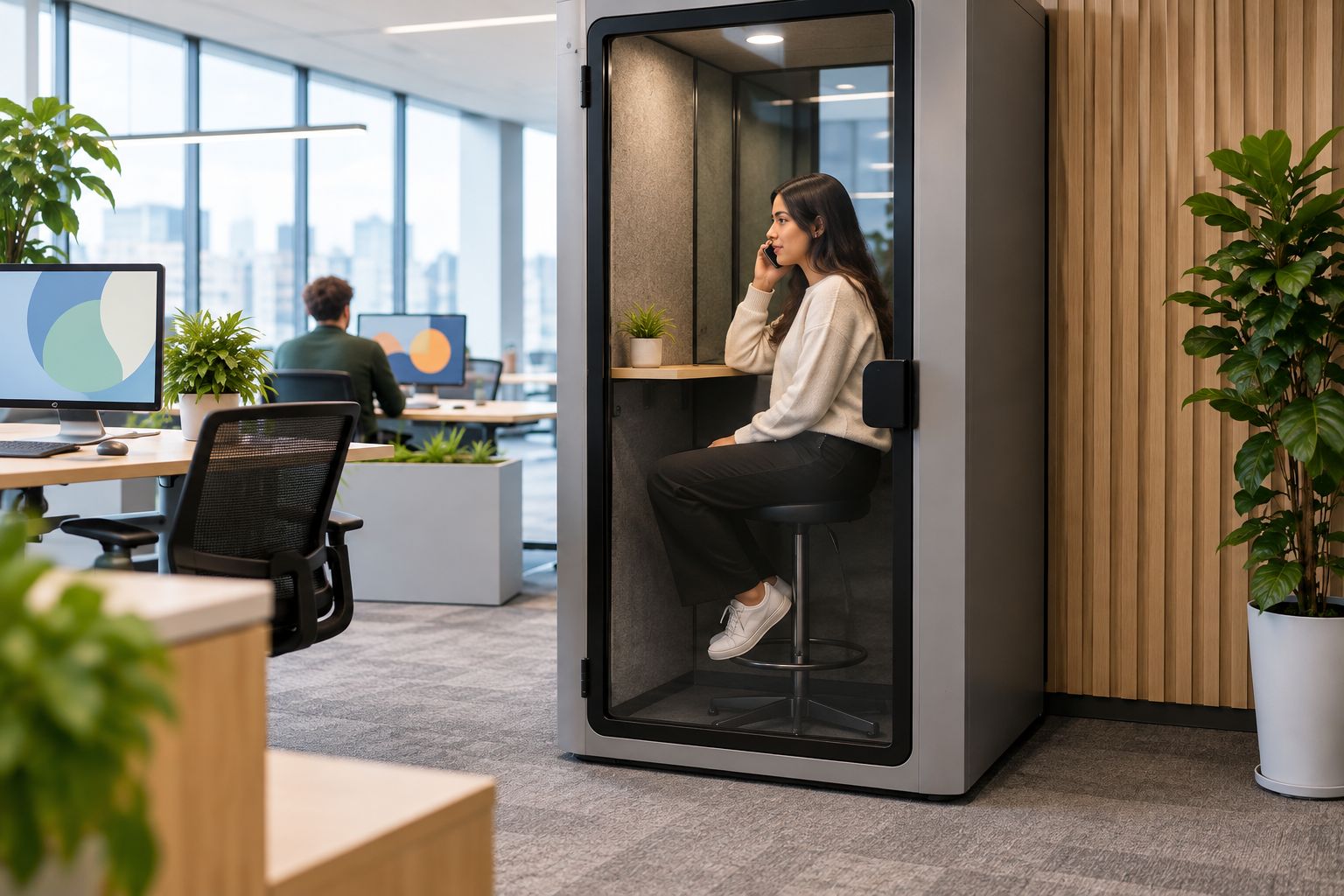
Before shortlisting, write a brief that names the users, the task and the access model. Keep product selection separate from the adoption review: the right intended use is necessary, but actual use still needs measuring.
The following individual-call options match that brief when your requirement is a dedicated space for one employee rather than a shared meeting enclosure.


Respond to the pattern you observe
When reservations exceed actual sessions, address booking accuracy first. Explain how employees should release reservations they no longer need, then check whether access improves before making a capacity decision.
When the booth is occupied and unsuccessful attempts recur at the same times, investigate overlapping demand. Separate the tasks involved: individual calls, shared discussions and focused work do not necessarily need the same response.
When the booth stays empty while calls continue at desks, ask employees why they chose the desk. Test the explanation against access records and the stated purpose of the booth rather than assuming resistance to a new workspace.
When employees complete the intended work and report no access difficulty, preserve what works. More occupancy is not automatically a better outcome if it removes the spare capacity employees need for unplanned calls.
Keep the decision proportionate to the evidence. A repeated access problem supports a change; an isolated complaint calls for investigation, not an immediate expansion.
FAQ
How can I tell whether employees actually use our office phone booth?
Record completed sessions and their broad purpose, then compare them with reservations. Include unsuccessful attempts so your review captures employees who needed the booth but could not use it.
Does a fully booked phone booth mean we need another one?
A fully booked phone booth does not establish a need for another one. Check whether reservations become occupied sessions and whether employees repeatedly fail to get access for the intended work.
Should employees use a phone booth for focused work as well as calls?
Allow focused work when it matches the purpose you have assigned to the booth. If calls and focused work compete for access, set a clear priority and review the effect on completed sessions and unsuccessful attempts.
Is a solo phone booth the right choice for employee one-to-ones?
A solo phone booth is an individual-use format, not the right format for a face-to-face one-to-one. The supplied Office Phone Booth Quell - 2 Person description identifies an enclosure designed for two people to hold private meetings.
What should we check if nobody uses the booth?
Check task fit, access rules and booking accuracy before changing the product. Ask employees what stopped them using the booth and compare their answers with observed use.
What office phone booth usage rate should we aim for?
Set an office phone booth usage target around the work you need it to support, rather than applying a universal percentage. Review occupied time alongside successful access and the completion of intended tasks.
One last thing
An empty booth can be serving your access objective: it is ready for the next unplanned call. That does not make persistent non-use acceptable; it means you should distinguish useful spare capacity from a space employees avoid.
Before ordering another Soundbox Store booth, ask what happened the last time an employee needed privacy and could not find it. The reason for that failed attempt is more actionable than a photograph of an empty booth.


