 fi/pt
fi/pt




















 Tuoteopas
Can an office pod fit through a standard doorway? Check 2026
An office pod can fit through a standard doorway if its delivered unit, or every component supplied for it, clears the doorway and the rest of the route. You cannot confirm the fit from the pod’s seating capacity or a nominal door size alone. For a 2026 purchase, get the delivery-format and component dimensions for the exact model before deciding it will reach the intended room.
- Can an office pod fit through a standard doorway? Only a model-specific delivery and route check can answer.
- Soundbox Store offers single-person and two-person pods, but their doorway clearance cannot be verified from the supplied specifications.
- Check the largest delivered piece against the clear opening and every turn on the route.
- Do not treat the pod’s assembled footprint as its delivery dimensions.
Can an office pod fit through a standard doorway?
Sometimes, but there is no reliable yes-or-no answer without the exact model’s delivery dimensions and a measured route. A door is only one point in that route. The delivered piece must also pass any corridor turns, lift openings and access points between the building entrance and the intended room.
Soundbox Store sells both the Quell Office Pod Solo for one person and the Office Phone Booth Quell - 2 Person for private meetings. Their stated capacities tell you what each pod is for, not whether either model fits through your doorway.
| Option | Best for | What the listing establishes | What you still need for a doorway decision |
|---|---|---|---|
| Quell Office Pod Solo | One person taking private calls or working alone | It is a single-person pod | Delivery format and dimensions of the largest delivered piece |
| Office Phone Booth Quell - 2 Person | Two people meeting privately | It is a two-person booth | Delivery format and dimensions of the largest delivered piece |
Neither capacity is a substitute for a fit check. The first move is to request the exact model’s delivery specification, not to assume a solo pod passes because it seats fewer people.
Why this matters
The question sounds like a comparison between two widths: pod and doorway. That comparison works only if the pod arrives as one complete unit and its stated width matches the orientation in which it travels. If it arrives in components, the assembled pod’s external width is not the dimension you need. The relevant measurement is the largest delivered component in the orientation required along the route.
A doorway can also be wider than a piece that still cannot make the next turn. The space immediately before and after an opening matters because the piece has to approach, pass through and leave it. In 2026, a floor plan showing a pod in its final position is useful for room planning, but it does not establish that the delivery route works.
The practical distinction is between room fit and route fit. Room fit asks whether the finished pod belongs in the intended space. Route fit asks whether what is delivered can reach that space. Keep both questions open until you have model-specific information; answering one does not answer the other.
Compare the delivered format with the clear opening
Ask the seller how the exact pod is supplied. Do not infer delivery format from a product photograph, an assembled footprint or the word pod in a listing. The answer determines which dimensions belong in your comparison.
| Delivery format to confirm | Dimension to request | Benefit for planning | Limitation |
|---|---|---|---|
| Complete unit | External dimensions in its transport orientation | Gives you the piece that must pass through the route | A matching doorway width does not establish clearance at turns |
| Separate components | Dimensions of the largest components in their transport orientation | Lets you assess the pieces that actually travel through the building | You still need to establish whether every component clears the route |
| Unconfirmed format | Written delivery specification for the exact model | Prevents a decision based on the assembled footprint | You cannot confirm doorway fit yet |
This is a comparison of information needed, not a claim that a particular Soundbox Store pod arrives in any one format. The supplied product information does not establish delivered dimensions or delivery format for the models above. That is why a 2026 fit decision needs a direct, model-specific answer rather than a general rule about office pods.
What does clear opening mean?
Use the space that is actually unobstructed when the door is open, not a nominal door description or a measurement across its frame. Record the clear width and height at the relevant opening. If the route includes several doors, record each one: the entrance to the destination room is not necessarily the tightest point.
Compare those opening measurements with the dimensions supplied for the delivered unit or components. If a dimension is missing, the comparison is incomplete. Do not replace a missing figure with the pod’s seating capacity or an estimate taken from an image.
Why does the transport orientation matter?
The same rectangular piece presents different dimensions depending on how it travels. A width printed for the finished pod therefore answers a different question from a width specified for a delivered component in its transport orientation. Ask for the dimensions in the orientation relevant to the route so you are comparing like with like.
The aim is not to work out a handling method from a product page. It is to give the supplier an accurate route and obtain a clear answer for that model. A 2026 product listing without the relevant transport dimensions cannot settle whether the doorway works.
Check the whole route, not just the last door
Make a route record from the building entrance to the planned position. Measure the clear openings along it and identify the points where direction changes. A sketch with the narrow sections marked is more useful than a single doorway figure because it shows where the delivered piece would have to turn.
- Building entrance: Record the clear opening used for delivery, not only the entrance’s nominal size.
- Internal doorways: Note each clear opening on the route, including doors before the destination room.
- Corridors: Mark narrow sections and where the route changes direction.
- Tight turns: Show the space on both sides of the turn; passing the opening alone is not the full test.
- Lift openings: If a lift is part of the route, include its entrance and internal space in the route record.
- Final position: Distinguish the route into the room from the space the assembled pod is meant to occupy.
Send that route record with the exact model name when requesting confirmation. If the response addresses only the final room dimensions, it has not answered the doorway question. In 2026, the dependable decision is the one tied to both a specific pod and a specific route.
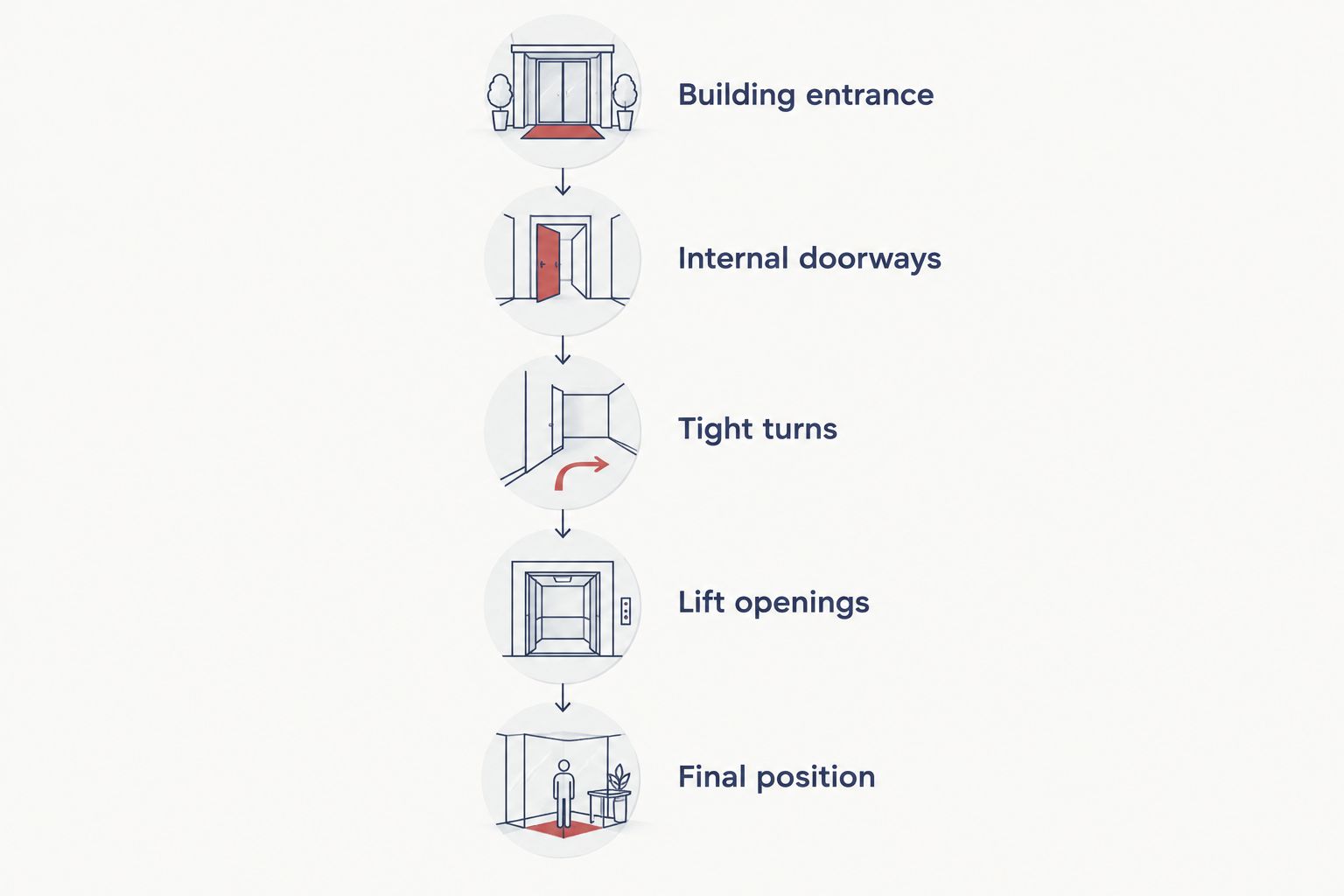
A route sketch also makes an unanswered question visible. You might have every door measurement but no dimensions for the largest delivered piece. Or you might have the product dimensions but no clear measurement at a corridor turn. Either gap prevents a confirmed fit; neither is resolved by choosing a smaller seating capacity on its own.
Why doorway fit varies
The answer changes with the exact pod and the building route. These are the factors you can check without assuming how any particular model is supplied:
- Delivery format. A complete unit and separate components create different dimension checks. Confirm the format for the model you intend to order.
- Largest delivered piece. The finished pod’s footprint does not identify the largest piece that must travel through the doorway.
- Clear opening. Compare against the unobstructed opening, rather than a nominal door description.
- Route turns. A piece must clear the space before and after a change of direction, not merely the straight opening.
- Other access points. An entrance, lift or earlier internal door can determine the result before the piece reaches the destination room.
- Final room position. Space for the completed pod is a separate check from access to that space.
This list is a way to find the missing information, not a promise that every route issue has a simple workaround. If a dimension or delivery detail is unavailable, keep the fit decision open and ask for it. Do not convert an unverified route into a yes by relying on the word “standard.”
Can a single-person pod fit when a meeting booth cannot?
A single-person pod has a different intended capacity from a meeting booth, but capacity does not tell you the size of its delivered pieces. Soundbox Store’s solo and two-person listings establish those use cases; they do not establish a doorway-fit ranking. Compare the delivery specification for each exact model with the same measured route before choosing between them on access grounds.
The question becomes useful once you have the missing figures. If one model’s delivered pieces clear the route and another model’s do not, access can inform the choice. Without those figures, selecting the solo model solely because it seats one person is an assumption, not a measurement.
Will an office pod fit if its finished width is narrower than the door?
Not necessarily. The finished width does not establish the delivered format or the dimensions presented while the pod travels through the building. It also says nothing about a corridor turn after the door. For a 2026 order, treat the finished width as a room-planning figure unless the seller confirms it is the relevant transport dimension.
The reverse assumption is just as weak: a finished pod wider than an opening does not, by itself, establish that its delivered pieces cannot pass. You need the actual delivery specification. This distinction is the reason the same doorway can produce different answers for different pod models.
What should you ask before choosing a pod?
Ask for the delivery format and the dimensions of the complete unit or largest components for the exact model under consideration. Provide the route sketch and ask for a response that addresses its narrow openings and turns. Keep the pod’s assembled footprint in the room plan, but do not use it as a replacement for transport dimensions.
Soundbox Store is best for workplaces comparing single-person phone booths with multi-person meeting pods; doorway fit still requires model-specific delivery dimensions. That is the honest limit of the product information supplied here. If access is your deciding factor, obtain that answer before treating either format as the right one for your room.
FAQ
Is there one standard doorway size that guarantees an office pod will fit?
No single nominal doorway size guarantees that an office pod will fit. Compare the clear opening and full route with the delivered dimensions of the exact model.
Can I use an office pod’s assembled footprint to check delivery access?
No, an assembled footprint answers whether the finished pod fits the room, not necessarily whether its delivered pieces clear the route. Request the delivery format and relevant transport dimensions.
Do corridor turns matter if the pod clears the doorway?
Yes. The delivered unit or component must pass through the opening and negotiate the route beyond it, so record the space around each turn.
Does a one-person pod always need a smaller doorway than a two-person booth?
No. Seating capacity does not establish the size or format of the delivered pieces. Check the specifications for both exact models against your route.
What measurements should I send when asking about pod access?
Send the clear dimensions of each opening and a route sketch showing narrow sections and turns. Identify the exact pod model so the answer addresses its delivery specification.
What if the product listing does not give component dimensions?
Ask for the missing delivery dimensions before deciding the pod will fit. A photograph or assembled width cannot replace the dimensions of what must travel through the building.
One last thing
The last doorway is not automatically the deciding doorway. In 2026, the useful question is whether the largest delivered piece clears every point from entrance to final room. Measure the route first, then request the exact model’s delivery dimensions; only those two sets of information produce a defensible answer.

