 fi/gb


 Tuoteopas
Can a phone booth work as a study space for students?
Yes—a phone booth can work as a study space for students doing individual reading, laptop work or online tutorials, provided its furniture supports the task. It is not a replacement for a full study desk or group room: a booth designed for calls still needs to work with the books, notes and equipment you actually use. Choose a phone booth for a defined study activity, not simply because it is enclosed.
- A phone booth study space suits individual work; shared revision needs a meeting booth.
- Soundbox Store’s Office Phone Booth Folio is designed for one-person calls, video meetings and focused work.
- Check the working position with your laptop, books and notes before choosing a booth.
- Keep quiet study and spoken tutorials distinct when setting shared-space booking rules.
Why this matters
A student working through a reading list needs something different from a student joining a spoken tutorial. Treating both activities as generic quiet study misses the practical distinction: one needs somewhere to concentrate; the other needs somewhere to speak.
Soundbox Store office phone booths provide enclosed spaces for individual calls and focused work. For student use, the useful question is whether the particular booth and furniture support the learning activity—not whether an office product has been renamed a study pod.
Can a phone booth work as a study space for students?
A phone booth works as a student study space when the task, person capacity and working position match. Use the comparison below to distinguish individual study from work that needs another person in the room.
| Product | Stated person capacity | Best for | Relevant strength | Limitation for study use |
|---|---|---|---|---|
| Quell Office Pod Solo | 1 person | Individual private calls | Designed as a one-person phone booth | Call-focused use does not establish suitability for spreading out study materials |
| Office Phone Booth Folio | 1 person | Individual online tutorials and focused work | Description includes private calls, video meetings and focus | Not a shared study space for classmates |
| Office Phone Booth Quell - 2 Person | 2 people | Face-to-face tutoring or paired discussion | Designed for private meetings between two people | The meeting layout still needs to match your study materials |
| Quell - 4 Person Meeting Booth | 4 people | Small-group revision discussions | Designed to seat four people for meetings | Group seating capacity alone does not establish individual desk space |
The capacities and intended functions above come from Soundbox Store’s product descriptions. The study applications are task-based recommendations, not claims of measured improvements in learning or examination results.
Start with what you need to do inside. If the answer is a laptop-based tutorial, an individual booth is relevant; if it is discussing a project with classmates, compare meeting booths instead.
Individual study: 1-person phone booths
Best for: a student working alone on a clearly defined task. A one-person booth is the relevant format for a private online tutorial, spoken presentation practice or individual laptop work.
The Office Phone Booth Folio description explicitly includes focused work alongside private calls and video meetings. That makes it a relevant option to assess for individual study, rather than assuming that every call booth serves the same purpose.
The limitation is the working arrangement. Reading from a laptop is different from writing in a notebook while consulting an open textbook, and neither task is described adequately by a person-capacity label.
Take your usual materials into the assessment. Check whether you can keep the items you need in use together, rather than repeatedly packing one away to make room for another. Choose the working position first; treat enclosure as a separate benefit.
Paired study: 2-person meeting booths
Best for: a student and tutor, or classmates discussing work face to face. A two-person meeting booth addresses a different requirement from individual focus: both people need to participate in the same conversation.
Office Phone Booth Quell - 2 Person is described as a freestanding acoustic enclosure for private meetings between two people. Its stated purpose supports a paired-discussion shortlist without implying any particular teaching outcome.
The trade-off is that a meeting arrangement is not automatically a shared desk. If you need to annotate separate documents or compare written calculations, assess that activity with both sets of materials present.
Do not choose a two-person booth solely to give a solo student an unspecified amount of extra workspace. Person capacity tells you the intended number of occupants; it does not tell you how a particular study task fits.
Group revision: 4-person meeting booths
Best for: a small group discussing a shared assignment or revision topic. A four-person meeting booth is the relevant format when several students need to talk together rather than study independently.
Quell - 4 Person Meeting Booth is described as a freestanding enclosure designed to seat four people for meetings. That is a useful starting point for discussion-led revision, with the actual furniture arrangement deciding how well it supports the session.
The limitation appears when a group needs separate working areas. A conversation around shared notes and simultaneous individual writing are different uses, even when the same number of students attend.
Choose the group format for the activity it supports. Do not treat it as interchangeable with several individual study places: a discussion booth and a quiet reading area serve different purposes.
Why suitability varies between study tasks
A phone booth study space succeeds or fails on the relationship between the task and the interior. These factors give you a practical way to assess that relationship without relying on a generic promise of better concentration.
- Study activity: Silent reading, spoken tutorials and group discussion place different demands on the space. Decide which activity the booth is meant to serve.
- Person capacity: The supplied range includes 1-person, 2-person and 4-person options. Match the format to the people participating in the session.
- Materials in use: A laptop-only task differs from one involving books and handwritten notes. Assess the actual combination you need rather than an empty interior.
- Furniture arrangement: A booth enclosure and its furniture are separate parts of the decision. Confirm the exact arrangement for the product you are considering.
- Spoken participation: Online tutorials and presentation practice involve speech. Make that use explicit when deciding how the booth fits within a shared study setting.
- Shared access: A booth intended for calls and one intended for reading need clear booking descriptions. Users should know which activity takes priority before entering.
Do not ask one booth to solve every study-space problem. A narrower purpose makes the choice easier to assess and gives students a clearer reason to use it.
Assess the booth with a real study task
An empty booth tells you little about studying. Use a representative activity to decide whether the space supports your work; this is a practical selection process, not a claim that any product has passed a student-use test.
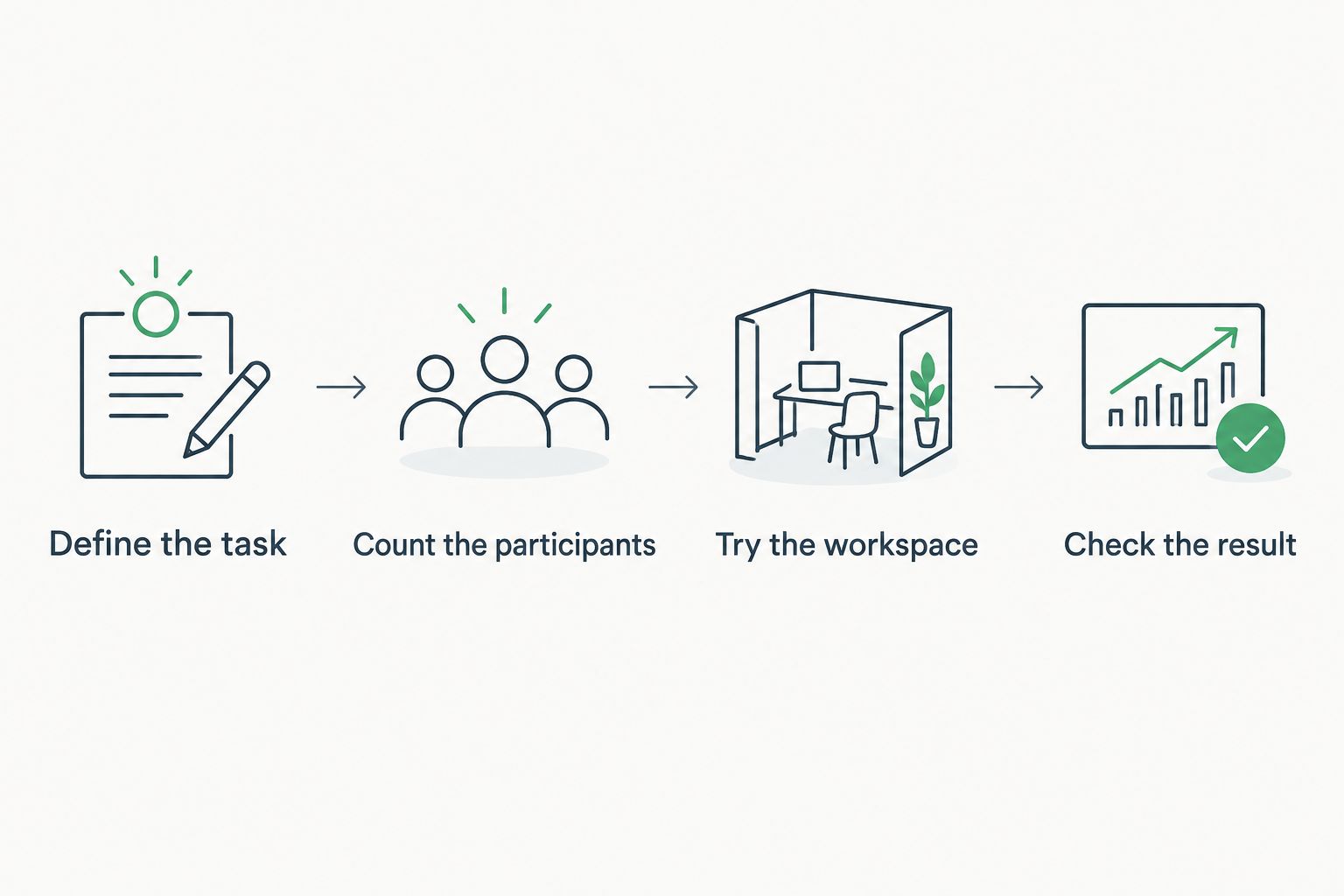
1. Define the task
Write down the activity in plain language: reading a digital paper, discussing coursework online or reviewing notes with a tutor. Avoid a brief as broad as somewhere quiet, because it does not tell you what the interior must support.
Keep the task specific enough to reproduce. If you usually switch between a textbook, notebook and laptop, include that whole sequence rather than testing only the laptop.
2. Count the participants
Decide who needs to be physically present. A remote tutor does not require a second place inside the booth, while an in-person tutor does.
Use the stated product capacity to choose the format. Keep this decision separate from questions about work surfaces or furniture: extra places do not establish a particular amount of desk space.
3. Try the workspace
Use the actual furniture arrangement under consideration, with the materials needed for the task. Work through the transitions: reading, typing, making notes and referring back to a source.
Notice where the arrangement interrupts the activity. If you must keep moving essential materials out of the way, the booth is not the right match for that task, regardless of how suitable it looks when empty.
4. Check the result
For spoken work, assess the complete activity rather than assuming that an enclosure guarantees the result. Join the intended video-call service and check the experience from both sides of the conversation.
For silent work, focus on whether the interior supports reading and writing as intended. Keep the conclusion narrow: a successful laptop session does not establish that the same setup suits group revision.
Relevant individual booths to assess
Soundbox Store office phone booths are best for students seeking an enclosed setting for individual calls and focused work. The Office Phone Booth Folio has the clearest stated connection to both activities; Quell Office Pod Solo is explicitly designed for individual private calls.
Both belong on a task-specific shortlist, not a claim that either replaces every kind of student desk. The decision remains the same: assess the exact furniture and the work you intend to complete inside.


Make the study purpose clear in shared spaces
If you manage a shared study area, describe what the booth is for before introducing it. A sign-up entry that says individual online tutorials gives users more useful information than an unexplained pod name.
Separate quiet work from spoken work in the booking description. Students should not have to guess whether they can read aloud, rehearse a presentation or join a conversation inside the space.
Set booking and release rules that reflect the purpose you have chosen. Explain how users reserve the booth, what to do when they finish and how to report an arrangement that does not support the advertised activity.
Keep ordinary study seating in the plan. A booth adds a specific enclosed workspace; it does not remove the need for other ways to study. Assess its contribution by whether students can complete the intended task, not simply whether the booth is occupied.
FAQ
Can I use a phone booth to study with a laptop and textbooks?
Yes, if the actual furniture arrangement supports your laptop, textbooks and notes together. Assess that combination before choosing a booth; a one-person capacity does not establish the working surface you need.
Is a phone booth a good place for an online tutorial?
A phone booth is a relevant option for an individual online tutorial because the activity combines private conversation with laptop work. Check the complete call experience in the exact setup rather than assuming the enclosure guarantees it.
Which phone booth should I consider for individual focused work?
Office Phone Booth Folio is a relevant option because its product description explicitly includes focused work, private calls and video meetings. Its one-person format does not suit a classmate joining you inside.
What should I choose for face-to-face tutoring?
Choose a two-person meeting format for a student and an in-person tutor. Office Phone Booth Quell - 2 Person is designed for private meetings between two people; assess the furniture with the materials used in the tutorial.
Will a study booth improve my grades?
A study booth does not establish a guaranteed improvement in grades. Judge it by whether it supports a particular learning activity, rather than treating an enclosed space as evidence of better academic results.
Can a phone booth replace my normal study desk?
A phone booth can support selected study tasks, but it is not automatically a replacement for your normal desk. Keep a desk-based option for work that does not fit the booth’s furniture or intended use.
One last thing
Before choosing a booth, rehearse the least tidy part of your study routine—not just the opening laptop screen. Open the reference material, write the notes and switch between them as you normally would.
That is where the useful distinction appears. If the enclosure suits the task but the workspace does not, choose a different arrangement rather than changing the task to justify the booth.


