 fi/gb


 Tuoteopas
How to write a usage policy for shared office phone booths
Write a phone booth usage policy that states who can use each booth, how to reserve it, when to leave, and who resolves exceptions. Give employees clear rules for cancellations, overruns, privacy and handover, then publish the same instructions beside the booth and wherever bookings are managed.
- A phone booth usage policy needs clear booking, handover and exception rules—not just a request to be considerate.
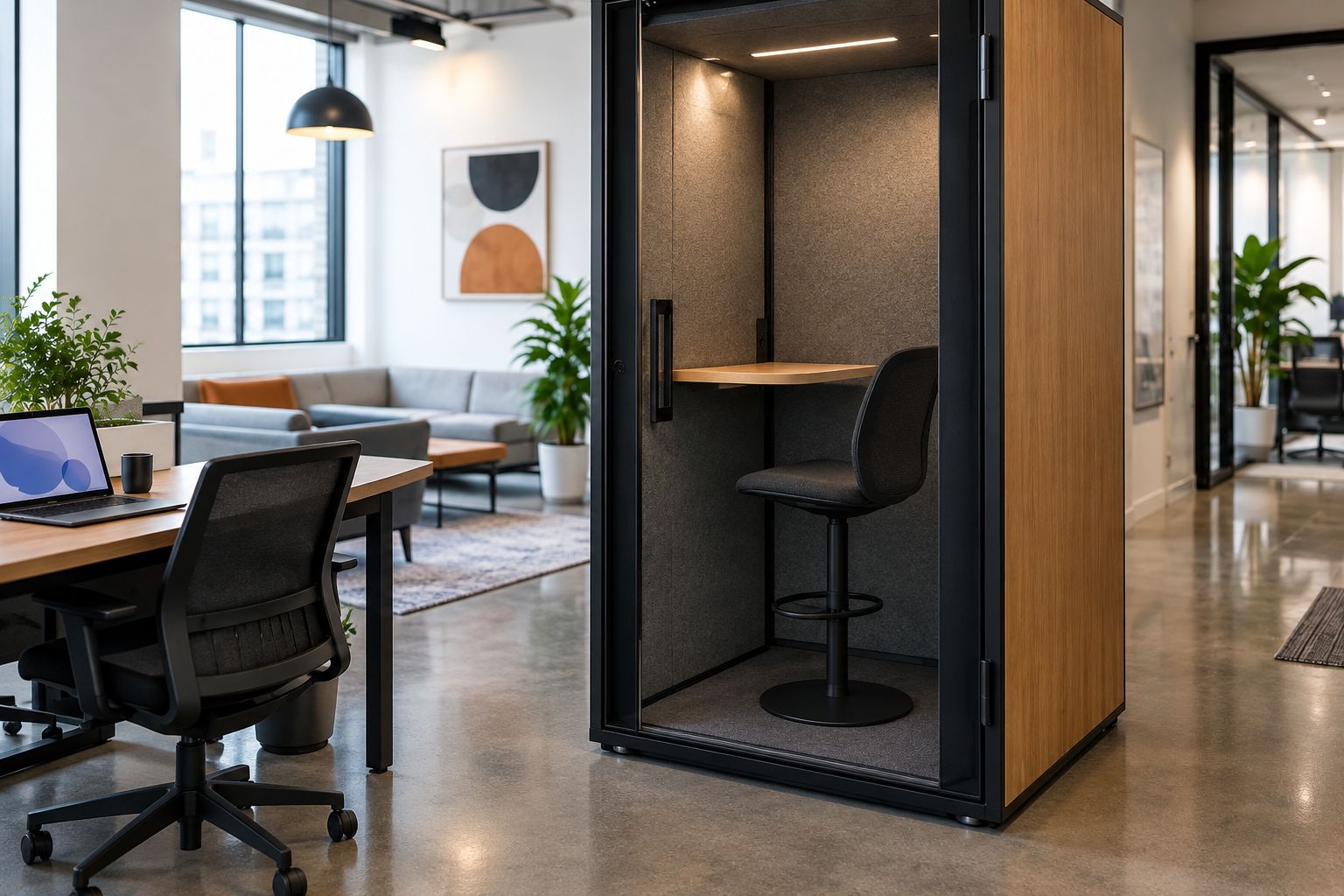
- Soundbox Store’s Office Phone Booth Folio is designed for individual calls, video meetings and focused work.
- Choose a booking method your workplace can administer, and explain its limitations.
- Assign a policy owner so employees know where to take booking disputes and requests.
Why this matters
A shared booth needs an agreed purpose. If you intend it for calls but also allow unrestricted desk work, your policy must explain which activity takes priority when someone is waiting.
Soundbox Store’s Office Phone Booth Folio is best suited to individual calls, video meetings and focused work. That describes the workspace, not its allocation rules: you still need to decide how employees share it. The Office Phone Booth Folio is designed for one person, so write its usage policy around individual sessions rather than team meetings.
Keep workplace rules separate from product instructions. Your policy should explain access and behaviour; it should not invent cleaning methods, equipment functions or acoustic guarantees.
How do you write a usage policy for shared office phone booths?
Start with decisions, then turn each decision into an instruction employees can follow. Use the steps below to draft the policy before writing a shorter door notice.
1. Define the booth’s purpose
Name the activities you want the booth to support: telephone calls, video meetings or individual focused work. State whether all permitted activities have equal priority or whether you reserve the space primarily for calls.
Avoid instructions such as use appropriately. They leave employees to interpret the rule differently. Write what is permitted and explain what happens when permitted uses compete.
If you allow focused work only when call demand permits, say how someone checks that condition. Do not expect an employee already inside to judge an unseen queue.
2. Choose the booking method
Decide whether employees reserve the booth, use it without reservations, or follow a clearly defined combination. The method must match what your workplace actually operates; a policy cannot create a booking system that does not exist.
| Booking approach | Best for | Advantage | Limitation to address |
|---|---|---|---|
| Advance reservations | Scheduled calls and video meetings | Gives employees a planned session | Cancelled sessions need to be released |
| Walk-in use | Unscheduled calls | Avoids a reservation step | Does not reserve space for a future call |
| Combined approach | Workplaces supporting scheduled and spontaneous calls | Allows both types of use | Needs an explicit rule for the next reservation |
Use one authoritative booking record. If you accept bookings through a shared calendar, do not also treat informal messages as reservations unless someone updates that calendar.
For combined use, explain whether a walk-in user must record their session and how they check the next booking. Keep those instructions consistent with the booking method your office has chosen.
3. Write the start and finish rules
Specify what employees must do before entering and when leaving. Cover checking the booking record, starting within the reserved session, releasing unused time and leaving by the recorded finish.
Choose any session limit from your workplace’s actual needs rather than copying an unsupported universal duration. State whether the limit applies to every session, consecutive bookings or only periods when others are waiting.
Do not publish short calls only without explaining what that means locally. A usable policy names the limit your organisation has selected and the route for requesting a longer session.
4. Define exceptions and ownership
Name the role responsible for the policy, booking conflicts and approved exceptions. Use a role employees recognise, such as the workplace or facilities contact, rather than an unnamed administrator.
Explain how an employee requests an exception before a session. Keep the request focused on the scheduling need; employees should not have to disclose a sensitive conversation in a shared booking record.
Give the owner responsibility for publishing changes. An exception agreed privately should not quietly become a different rule for everyone else.
5. Publish and maintain the instructions
Put the full policy where employees already find workplace guidance. Place a short summary beside the booth and include the relevant rules in booking instructions.
Check that these versions agree. A door notice that says walk-in use is permitted cannot sit alongside a booking policy that requires every session to be reserved.
Review the wording when employees repeatedly ask the same question. Clarify the decision that is missing rather than adding another general reminder to be considerate.
A phone booth usage policy you can adapt
The following draft uses advance reservations as its default. Adapt the booking wording to your actual process, add your chosen duration and cancellation rules, and identify the responsible workplace contact before publishing.
Purpose and permitted use
Use shared office phone booths for individual telephone calls, video meetings and focused work permitted by the workplace booking rules. A booth is a shared resource, not a permanently assigned desk or personal storage space.
Choose a space intended for your activity. Follow the stated purpose of each booth rather than assuming every enclosed workspace has the same use.
Reservations and arrival
Reserve the booth through the workplace’s designated booking record before using it. Check the booth identifier, session start and session finish when making the reservation.
Use a neutral booking title. Do not put client names, personnel matters or sensitive discussion details into a calendar visible to colleagues.
Arrive ready to begin within your reserved session. If you no longer need the booth, cancel the reservation so someone else can use it.
Session length and extensions
Follow the session limit and consecutive-booking rule published with the booking instructions. Request any exception through the designated workplace contact rather than creating overlapping or repeated reservations to bypass the rule.
Finish and leave by your recorded end time. Extend only through the booking process and only when the extension does not conflict with another reservation.
Privacy and consideration
Respect an occupied booth and do not interrupt a session to negotiate extra time. Raise booking conflicts through the designated workplace contact.
Use headphones for calls and keep your speaking volume considerate. Follow your organisation’s information-handling rules, and do not assume that an enclosed booth guarantees confidentiality.
Leaving the booth
Take your belongings, papers and waste with you. Leave the workspace ready for the next person rather than using personal items to hold it between sessions.
Follow the product care instructions and the workplace’s cleaning arrangements. Report equipment or cleanliness problems through the designated workplace channel; do not improvise repairs or cleaning treatments.
Conflicts and exceptions
Use the shared booking record to establish whose session is scheduled. Do not extend a reservation into another person’s booking without an agreed change.
Ask the designated workplace contact to resolve disputed bookings, repeated overruns and exception requests. Describe the scheduling issue without sharing the content of someone else’s conversation.
Write the handover rule as an action
A booking ends when the booth is ready for the next user, not when the call ends. Tell employees to allow for gathering their belongings within the reserved session rather than treating the finish time as a signal to begin packing up.
The same distinction applies when a session ends early. Ask employees to release unused reserved time through the agreed process, not merely leave an empty booth that still appears booked.
Do not use a bag, coat or laptop as an informal reservation. If employees can leave and return during a session, explain whether the original booking remains valid and whether unused time should be released.
For no-shows, choose an explicit release process before publishing the policy. State who can release an unused reservation and how the booking record changes; an empty booth alone should not leave employees guessing whether they can enter.
Why phone booth usage policies vary
Your policy should reflect the way you intend to share the space. Keep these decisions explicit rather than presenting a single booking model as suitable for every office.
- Permitted activities: Decide whether calls, video meetings and focused work receive equal access or different priority.
- Booking approach: Reservations, walk-in use and combined access need different arrival and handover instructions.
- Session needs: Define how employees request longer sessions without quietly bypassing the shared rules.
- Privacy expectations: Keep booking information separate from the content of private conversations.
- Administration: Choose rules that a named workplace contact can explain and maintain.
Keep policy requirements separate from buying criteria. Soundbox Store phone booths provide a physical workspace; reservation priority and exception handling remain workplace decisions.
A policy should not imply that a booth includes booking software, automatic reservation release or occupancy reporting unless those functions are confirmed for the equipment and systems you actually use.
Test the wording against everyday situations
Before publishing, read the draft as an employee trying to use the booth. Check whether it gives a clear next action in each situation below.
- A call is cancelled: The employee knows where to release the reservation.
- A session finishes early: The employee knows whether and how to make the remaining time available.
- A call runs over: The employee knows that another booking takes precedence and where to request help.
- A booth looks empty but remains booked: The employee knows the release process rather than assuming access.
- Someone needs a longer session: The employee knows the exception route before making the reservation.
- The booth needs attention: The employee knows where to report the issue without describing it in a public booking title.
These are checks on your wording, not reasons to add complicated procedures. If the answer requires several conflicting documents, simplify the rule and point employees to a single authoritative version.
Keep the door notice shorter than the full policy
Use the door notice for immediate actions, not every exception. Include the booth identifier, booking method, finish-time rule, handover instruction and route to the full policy.
Avoid putting a separate set of rules on the door. The notice should summarise the published policy, with the same wording for reservations and walk-in access.
A useful notice tells an arriving employee what to do next. Detailed dispute handling, policy ownership and exception requests belong in the full guidance, where employees can read them without standing outside an occupied booth.
FAQ
What should a shared office phone booth policy include?
A shared office phone booth policy should cover permitted activities, booking, session limits, cancellations, handover and exception handling. Name the workplace contact responsible for resolving conflicts and maintaining the rules.
Should office phone booths be bookable or walk-in?
Choose reservations for planned sessions, walk-in access for unscheduled use, or a clearly defined combination. Combined access needs a rule explaining how walk-in users check and respect the next reservation.
How long should employees be allowed to use a phone booth?
Set the session limit around the activities your workplace permits and the access employees need. Publish the chosen limit alongside a process for requesting longer sessions; there is no duration specified in this guide.
What should happen when someone does not attend their booking?
Follow a published no-show release process that identifies who can cancel the unused reservation and update the booking record. Do not leave employees to infer permission from an empty booth.
Can employees use a phone booth for focused work?
Allow focused work only if your policy lists it as a permitted activity. State whether calls take priority and how employees check availability before starting a focus session.
Who should resolve phone booth booking disputes?
The designated workplace contact should resolve booking disputes using the published policy and booking record. Employees should report scheduling facts without disclosing the content of private conversations.
One last thing
Define what an empty booth means. Distinguish between unoccupied, reserved but not yet started, and released for another user; those conditions need different actions.
For Soundbox Store phone booths, keep product information in the equipment guidance and sharing rules in the usage policy. Employees should be able to find both without mistaking an office rule for a product feature.


