 fi/gb


 Tuoteopas
Office pods for property management companies: complete guide
Property management office pods are enclosed acoustic workspaces with the aim of separating tenant calls, landlord discussions and focused administration from a shared office. This guide explains how to match a booth to the work: start with private calls, compare options such as the Quell Office Pod Solo, and add meeting capacity only when your daily workload justifies it.
- Choose office pods for property management companies by tenant-call demand, landlord meetings and overlapping conversations, not total headcount.
- Soundbox Store office pods suit property management teams seeking dedicated spaces for private calls and small meetings.
- A single-person phone booth separates calls; a two-person meeting booth accommodates an in-person discussion.
- Keep reception cover, booking rules and screen privacy in the brief alongside acoustic performance.
Why office pods matter for property management companies
A property management office needs to handle conversations without losing its ability to respond. A tenant reporting a repair, a landlord discussing an account and a contractor confirming access arrangements require different levels of attention. If those conversations happen beside each other, staff must compete with nearby speech while continuing their own work.
Choose the workspace around the conversation, not the employee’s job title. A property manager needs somewhere to make a call, but that same person also needs space to review documents with a colleague. One enclosure does not automatically suit both tasks.
Start by distinguishing acoustic separation from complete confidentiality. Soundbox Store describes its acoustic pod range with 30–35 dB noise reduction; that range-level figure is not a guarantee that every conversation becomes inaudible in every office. Match the acoustic information for the selected model to the intended use, and assess visual privacy separately.
Soundbox Store office pods suit property management teams seeking dedicated spaces for private calls and small meetings. Their limitation is equally practical: a booth provides a workspace, but your team still needs reception cover, sensible booking and a clear handover process.
Plan office pods around your property management workload
Map the conversations that need separation
Use a shared spreadsheet before choosing products. Record the task, how many people are physically present, whether the discussion is scheduled and what interrupts it. Keep the log about workspace demand rather than the substance of tenant or landlord conversations.
Separate routine calls from conversations that need supporting documents or another employee. A contractor confirmation call and a landlord account review both involve speech, but they place different demands on the workspace. Recording them under one broad label hides the distinction.
Your first decision is whether the problem is noise, insufficient meeting space or both. That answer determines the shortlist more accurately than the number of properties you manage.
- List tenant calls, landlord updates, contractor discussions and internal reviews separately.
- Record how many colleagues need private space at the same time.
- Note when a call requires a laptop, paperwork or a second participant.
- Identify tasks already served adequately by an existing room.
- Record missed opportunities to use private space without recording personal details.
Separate private-call demand from meeting demand
Try reserving an existing room for calls and another available space for scheduled discussions. This manual approach tests whether clearer room allocation solves the problem before you add a pod. It also exposes conflicts between spontaneous calls and pre-booked meetings.
Count people inside the enclosure, not people on the call. A property manager speaking remotely with several landlords still needs a single-person workspace if nobody else is physically present. A manager discussing an issue face to face with a colleague needs a different format.
Do not buy meeting capacity to solve a queue of individual calls. A two-person booth can host a solo caller, but it cannot serve two unrelated conversations simultaneously. Separate enclosures serve a different need from additional seats in one enclosure.
- Group solo calls separately from face-to-face discussions.
- Mark scheduled landlord reviews separately from unscheduled tenant calls.
- Record clashes between callers rather than only total call activity.
- Keep group briefings in an existing meeting room when that arrangement works.
- Decide which task deserves priority when demand overlaps.
Match the pod format to the recurring task
Once the workload is clear, compare formats. Soundbox Store offers single-person phone booths and meeting booths; use that distinction to build a task-led shortlist rather than selecting the largest enclosure first.
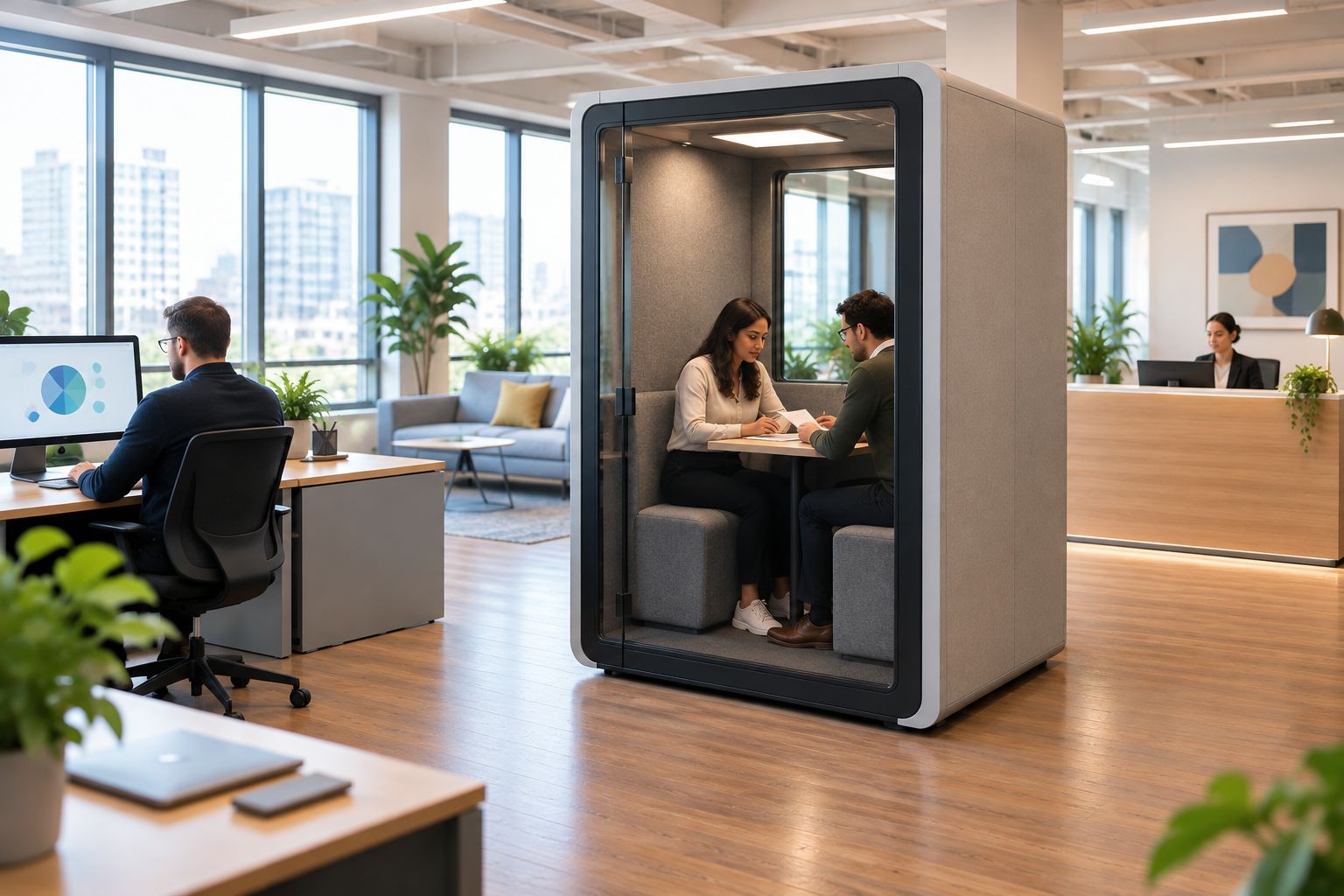
The Quell Office Pod Solo is a 1-person booth described for private calls. The Office Phone Booth Quell - 2 Person is described as a freestanding acoustic enclosure for 2 people to hold private meetings. These are different tools: the first addresses individual calls, while the second accommodates an in-person conversation.
A 4-person meeting format is relevant only when your recurring discussions actually include that many people in the room. Do not treat extra capacity as a substitute for separate spaces when colleagues need to hold unrelated calls.
- Match single-person booths to individual tenant and landlord calls.
- Match two-person booths to manager–colleague or manager–visitor discussions.
- Consider larger meeting formats for recurring group discussions, not occasional attendance peaks.
- Check the selected model’s current description before assuming any feature is included.
- Keep a separate requirement list for call work and meeting work.
Plan how staff and visitors will use the space
Draw the working arrangement on your existing floor plan before committing to a product. This is an operational exercise: identify reception, shared desks, document storage and the proposed private workspace. Leave technical placement and installation requirements to the product-specific planning process.
A member of staff taking a tenant call still needs someone to handle incoming visitors and other enquiries. Write down the handover rather than assuming colleagues will notice an empty desk. For visitor meetings, agree who welcomes the visitor and who remains responsible for the reception area.
Treat speech privacy and screen privacy as separate questions. An acoustic enclosure does not by itself establish what a passer-by can see, so include ordinary working habits such as closing unrelated account windows and removing paperwork after use.
- Name the colleague responsible for reception during private conversations.
- Define how an incoming call is transferred to someone using the booth.
- Decide whether visitors use the space or it remains staff-only.
- Review screen visibility and paperwork handling separately from sound reduction.
- Include actual call equipment in the workspace brief without assuming compatibility.
Set booking rules that protect the intended use
Start with a shared calendar or a simple booking sheet. A pod does not need a complicated scheduling process to become useful, but everyone needs to know whether spontaneous calls or booked meetings take priority.
Use neutral booking labels. An entry such as landlord review identifies the task without placing names, addresses or account information in a calendar visible to colleagues. Keep detailed case information in the systems your team already uses for that work.
Reserve the booth for the problem it was chosen to solve. If tenant calls are the priority, allowing uninterrupted desk work to occupy it throughout the day defeats the brief. Conversely, a visitor meeting space needs predictable reservations rather than constant interruption.
- Use a shared calendar with clear task labels.
- Define priority between booked discussions and incoming calls.
- Require staff to release cancelled reservations.
- Keep property addresses and personal details out of booking titles.
- Agree how colleagues request an available space without interrupting its occupant.
- Assign someone to resolve recurring booking conflicts.
Measure use before expanding the provision
Keep the same task log after the booth enters regular use. Compare waiting for private space, overlapping requests and room bookings before and after the change. These are observations your own team can make without attributing every improvement to the pod.
Separate occupancy from usefulness. A booth occupied continuously by focused administration might look successful while tenant callers still have nowhere to go. Record whether the intended task received the space when it was needed.
Expansion should answer a specific remaining problem. More seats address larger discussions; another enclosure addresses simultaneous conversations. If the issue is abandoned reservations or poor reception cover, correct the process rather than adding another product.
- Record requests that could not be accommodated.
- Compare intended tasks with actual use.
- Note bookings that prevent priority calls from using the space.
- Ask staff whether calls and document work fit the chosen format.
- Distinguish demand for another enclosure from demand for more meeting seats.
- Update the operating rules before changing the product mix.
Compare options for property management work
The right option depends on the task you need to accommodate. Single-person booths are best for individual calls; two-person meeting booths are best for face-to-face discussions. An existing room remains a valid option when scheduling already gives your team the separation it needs.
| Option | Best for | Practical advantage | Key limitation |
|---|---|---|---|
| Existing enclosed office or meeting room | Testing private-call and meeting demand | Lets you test allocation with space you already have | Competes with the room’s other uses |
| Quell Office Pod Solo | Individual tenant or landlord calls | A dedicated single-person format described for private calls | Does not accommodate an in-person meeting with a colleague |
| Office Phone Booth Folio | Solo calls, video meetings and focused administration | Its description explicitly covers those individual tasks | Call access and longer focus bookings need separate priorities |
| Office Pod Quell+ Acoustic | Individual work requiring a solo enclosure | A single-person acoustic pod option | Does not add face-to-face meeting capacity |
| Office Phone Booth Quell - 2 Person | In-person landlord reviews or colleague discussions | A two-person format described for private meetings | One enclosure cannot host unrelated calls simultaneously |
Do not assume a named product includes every feature in your brief. Use the current model information to confirm what you are selecting, then keep the purchasing decision separate from your booking and reception arrangements.


Common mistakes property management teams make
Choosing by portfolio size rather than simultaneous conversations
The number of managed properties does not tell you how many private workspaces your office needs. Build the brief from overlapping calls and meetings instead. A larger portfolio is not, by itself, evidence that a larger meeting enclosure is the right choice.
Mixing visitor meetings with unrestricted solo bookings
A landlord arriving for a scheduled review needs a predictable space. If staff also use that enclosure for spontaneous calls, define the handover and reservation rules before opening it to both tasks. Otherwise, the conflict remains even though the office has another enclosed workspace.
Treating sound reduction as complete privacy
Noise reduction describes an acoustic function, not every aspect of a private conversation. Review surrounding speech, visible screens and document handling separately. Do not replace those checks with a broad description such as soundproof.
Moving a caller without arranging reception cover
Private space is useful only if the rest of the office continues to function. Assign cover for visitors and incoming enquiries before someone begins a longer call. That simple operating rule belongs in the pod brief, not as an afterthought once it is in use.
Expanding before correcting booking behaviour
Unused reservations and long focus bookings can block the tasks the booth was meant to support. Review those patterns before deciding that capacity is insufficient. Add space when the task log shows unmet demand, not merely because colleagues describe the booth as busy.
FAQ
What are the best office pods for property management companies?
The best office pods for property management companies match the recurring task: single-person booths for individual calls and meeting booths for face-to-face discussions. Soundbox Store offers both formats; compare them against simultaneous demand rather than total staff numbers.
Should a property manager choose a single-person or two-person booth?
Choose a single-person booth for calls taken alone and a two-person booth when a colleague or visitor joins the discussion in person. Count people physically inside the enclosure, not remote participants.
Can an office pod replace our existing meeting room?
An office pod replaces a meeting room only for tasks that fit the selected format. Keep the existing room for discussions that need more participants or a working arrangement the chosen booth does not provide.
Does a soundproof phone booth guarantee confidential tenant calls?
A soundproof phone booth does not by itself guarantee complete confidentiality. Assess the selected model’s acoustic information alongside surrounding speech, screen visibility and your team’s document-handling practices.
How do we decide how many pods our office needs?
Decide how many pods you need by recording simultaneous requests for private space and the tasks behind them. Separate demand for unrelated calls from demand for additional seats in one meeting.
How should we book a pod used for tenant calls and landlord meetings?
Use a shared calendar with explicit priority rules for spontaneous calls and scheduled meetings. Keep booking titles neutral, release cancelled reservations and arrange reception cover before a colleague enters the booth.
One last thing
The useful distinction is more conversations versus more participants. Another seat helps a shared discussion; another enclosure helps unrelated calls happen at the same time. Put that distinction at the top of your purchasing brief, and use it to reject options that solve the wrong problem.


