 fr/gb
fr/gb



















 Guide produit
Best soundproof pods for public library quiet rooms
Best default for individual calls: Quell Office Pod Solo. Best for librarian–visitor appointments: Quell Plus 2-Person Pod. Best for collaborative sessions: Quell 4-Person Soundproof Office Pod. Choose soundproof pods for public libraries by the activity you need to separate from quiet reading, not by the largest enclosure you can purchase.
- For soundproof pods for public libraries, Quell Office Pod Solo is the default for individual calls.
- Quell Plus 2-Person Pod suits librarian–visitor appointments rather than group study.
- Quell 4-Person Soundproof Office Pod suits collaborative sessions, not a queue of separate callers.
- Soundbox Store acoustic pods should be shortlisted by use case; acoustic privacy is not a promise of absolute silence.
Why this matters
A public library quiet room can serve conflicting purposes: silent reading, spoken tutoring, online interviews and help with digital services. Those activities need different booking rules. Calling every enclosed space a quiet room leaves visitors guessing whether conversation is permitted.
Separate individual calls, assisted appointments and group discussion in your purchasing brief. A pod reserved for spoken activity has a clearer purpose than an enclosure expected to serve every visitor equally. Keep silent reading provision distinct from spaces where people need to speak.
This guide compares three Soundbox Store acoustic pods by their named formats and proposed library uses. The recommendations concern service fit, not a claim that any model has been tested in a public library.
What makes the best pod for a public library quiet room?
Use these criteria before comparing products:
- Activity match: Decide whether the enclosure serves individual calls, assisted appointments or collaborative discussion.
- Person capacity: Match a 1-person format to individual use, a 2-person format to paired appointments and a 4-person format to small groups.
- Acoustic expectations: Distinguish reduced sound transmission from absolute silence. Do not interpret the word soundproof as a confidentiality guarantee.
- Booking purpose: Give each pod a clear role so visitors know whether speaking is permitted.
- Furniture requirements: Identify whether the activity involves reading, typing, shared documents or a conversation. Check the selected configuration rather than assuming furniture is included.
Capacity is a useful first filter because it changes which services you can offer. It does not establish acoustic performance, comfort or suitability for every visitor. Keep those questions separate from the shortlist.
Public library pods at a glance
| Product | Best for | Standout format | Key limitation |
|---|---|---|---|
| Quell Office Pod Solo | Individual online interviews and calls | Solo office pod | Does not provide a paired appointment space |
| Quell Plus 2-Person Pod | Librarian–visitor digital help appointments | 2-person pod | Not the choice for a larger discussion group |
| Quell 4-Person Soundproof Office Pod | Collaborative study and facilitated discussion | 4-person meeting format | One enclosure does not provide separate spaces for independent callers |
The table describes different service roles, not a descending acoustic ranking. A solo pod can be the right purchase even when a larger meeting pod is offered. Conversely, a solo format is the wrong starting point when the task requires a librarian and visitor to work together.
1. Quell Office Pod Solo: best library pod for individual calls
Quell Office Pod Solo is a solo office pod. Shortlist it when you want to give an individual visitor a designated place for a spoken online interview, telephone appointment or remote meeting.
Quell Office Pod Solo is the best Soundbox Store acoustic pod shortlist choice for public libraries prioritising individual calls. Its role is specific: separate a caller from the library's silent reading activity. Do not position it as a replacement for every kind of study room.
Quell Office Pod Solo pros
- Gives individual spoken activity a clearly defined booking destination.
- Matches a service brief centred on one visitor rather than a group.
- Keeps paired appointments and collaborative study out of the same booking category.
Quell Office Pod Solo cons
- The solo format does not address appointments involving a visitor and librarian together.
- A single enclosure cannot serve several independent callers simultaneously.
- A call-focused booking policy also needs to account for visitors seeking silent individual study.
Best for: Libraries that want a dedicated place for individual video interviews, remote appointments and calls.
Before choosing a configuration, describe the actual task. An online interview involves a different working setup from a short telephone call. Ask about the selected product's furniture and features against that task without assuming that a desk, chair or particular connection is included.
Keep the service name equally precise. An individual call pod tells visitors what to expect; a quiet room does not tell them whether talking is acceptable. If you also want silent study bookings, define how those bookings share the space with calls.
Verdict: Buy Quell Office Pod Solo when individual spoken appointments are the service you need to provide.
2. Quell Plus 2-Person Pod: best library pod for assisted appointments
Quell Plus 2-Person Pod is a 2-person pod. Its strongest library use is a planned appointment between a visitor and a librarian, tutor or digital support volunteer.
The distinction from a solo pod is practical: both participants need to be present. Examples include discussing a research question, working through an online form or explaining a digital resource. These are proposed service uses, not claims about included equipment.
Quell Plus 2-Person Pod pros
- Matches the participant count of a paired appointment.
- Provides a separate booking category for assistance rather than individual calls.
- Gives spoken support sessions a defined destination away from silent reading activity.
Quell Plus 2-Person Pod cons
- The named format does not address larger group discussion.
- A paired appointment occupies the enclosure as a shared session, not as separate individual spaces.
- It is unnecessary for a brief that only requires individual call provision.
Best for: Libraries offering scheduled librarian–visitor support, paired tutoring or digital help conversations.
Decide whether this is an appointment resource or a general bookable room. If staff-led support has priority, make that priority explicit. Otherwise, an individual study booking can occupy the enclosure when a paired appointment needs it.
Write the task into the enquiry: both participants need to discuss the same material, and the chosen furniture configuration needs to support that activity. Do not assume that a 2-person label establishes the arrangement of seats or work surfaces.
Verdict: Hold Quell Plus 2-Person Pod until paired appointments have a defined place in your service plan; choose it when that is the requirement.
3. Quell 4-Person Soundproof Office Pod: best library pod for collaborative study
Quell 4-Person Soundproof Office Pod is a 4-person meeting format. Shortlist it for a collaborative session in which participants need to talk together rather than work independently in silence.
A small research discussion, facilitated learning session or group planning appointment is a more relevant brief than general quiet reading. The value of this format is its shared-session role, not an assumed acoustic advantage over smaller pods.
Quell 4-Person Soundproof Office Pod pros
- Matches a small-group service brief.
- Gives collaborative discussion its own booking category.
- Separates group needs from individual calls and paired assistance.
Quell 4-Person Soundproof Office Pod cons
- One shared enclosure is not several independent call spaces.
- It does not resolve demand for silent communal reading provision.
- Choosing it for occasional groups does not establish that it is the right default for everyday individual use.
Best for: Libraries that already intend to offer bookable collaborative study or facilitated small-group sessions.
Describe the session before specifying furniture. Participants discussing a document need a different arrangement from visitors joining a remote meeting together. Confirm the proposed configuration against the activity rather than inferring a layout from person capacity alone.
A group booking also needs a different service description. State that conversation is expected and identify which activities the library intends to accommodate. Do not promise that every group activity, particularly amplified audio or music, belongs in an acoustic meeting pod.
Verdict: Skip Quell 4-Person Soundproof Office Pod for individual-call demand; shortlist it for a defined collaborative service.
What soundproof means for a library shortlist
The phrase soundproof pods for public libraries describes a search category, not a promise that no sound will enter or leave an enclosure. Sound isolation and sound absorption are different: isolation concerns sound passing between spaces, while absorption concerns reflected sound within a space.
Keep the distinction in your brief. A visitor can need reduced distraction from surrounding activity, while nearby readers need less disturbance from the visitor's conversation. Those are related goals, but they are not interchangeable claims.
Do not turn an acoustic product description into a confidentiality promise. A conversation about personal information needs more than a product name containing soundproof. Ask for the selected model's acoustic information and assess whether its documented scope matches the intended task.
Compare like with like. A specification referring to speech reduction should not be treated as proof of equivalent performance against every sound source. Keep the decision tied to ordinary spoken library activities rather than adding unsupported claims about music, traffic or equipment noise.
Define the library service before selecting a configuration
A useful purchasing brief connects each enclosure to a named activity. Start with the service you want visitors to use, then identify the participant format and booking category. Do not start with accessories and work backwards.
Individual calls
Describe whether the intended use is an online interview, remote meeting or telephone appointment. Specify the working arrangement you need and ask which configuration supports it. Avoid treating an office pod label as confirmation of included furniture or technology.
Assisted appointments
Identify who attends and what they do together. A librarian helping a visitor with a digital resource needs a shared interaction, not simply adjacent individual working places. Explain the task clearly when checking configuration details.
Collaborative study
Describe whether participants discuss printed material, use laptops independently or join a remote session together. Person capacity narrows the options; the activity determines which arrangement you need to investigate next.
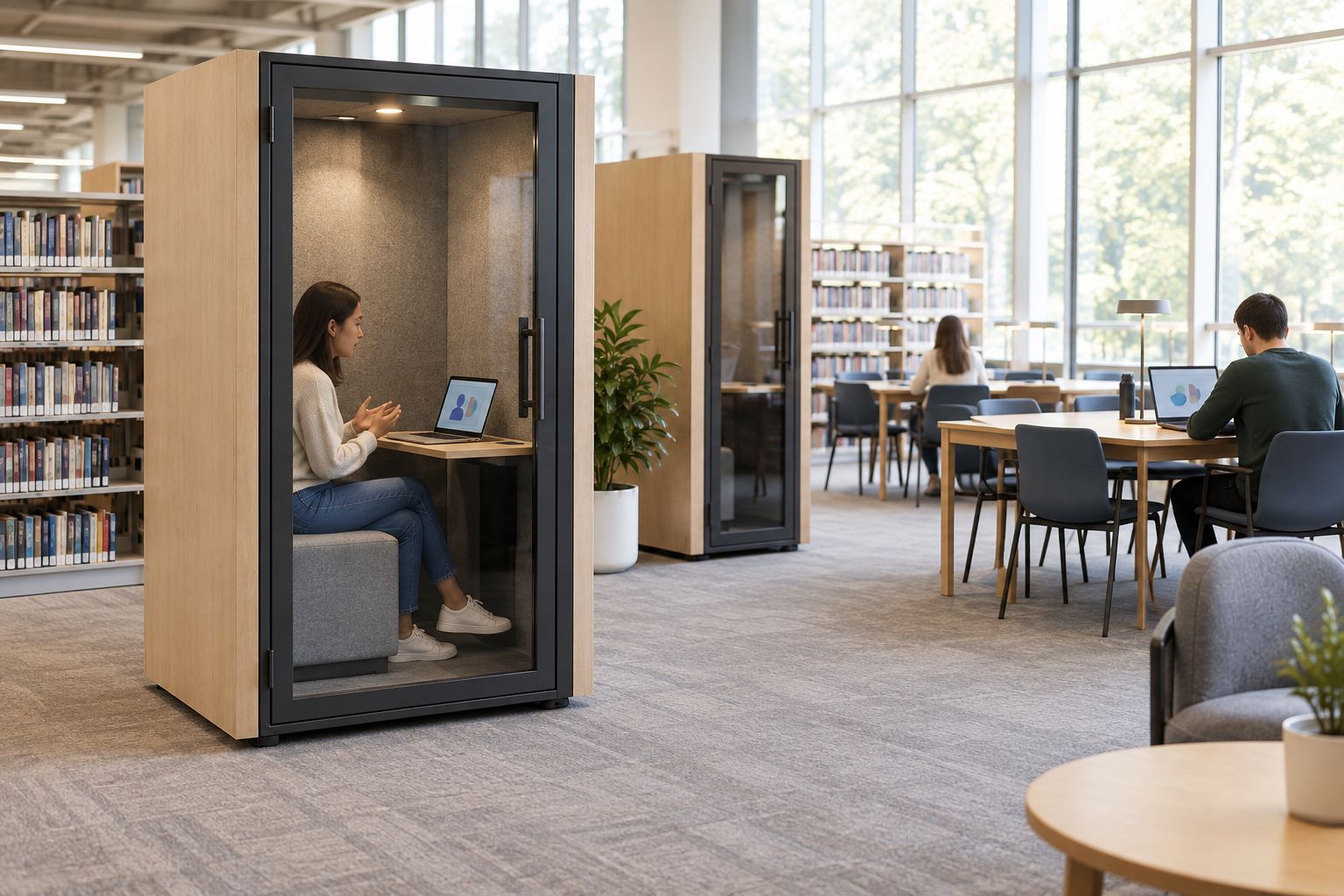
The following scene illustrates the separation between shared reading space and a spoken appointment enclosure. It is a generic library setting, not a depiction of a particular product or a proposed installation layout.
Booking rules are part of the decision
A product shortlist does not decide how visitors share the resource. Set the purpose first, then write booking rules that protect that purpose. Keep the language understandable without knowledge of office pod terminology.
Your service brief should answer:
- Is speaking expected, permitted or excluded during the booking?
- Is the space for an individual, a paired appointment or a group?
- Do staff-led sessions take priority over general reservations?
- Can visitors book silent study in the same space?
- Who handles booking changes and explains the room's purpose?
These questions prevent a mismatch between the purchase and the service. For example, an enclosure bought for assisted appointments needs a way to remain usable for those appointments. Leaving it under an unrestricted quiet-room label creates an avoidable conflict of purpose.
If existing library meeting rooms already serve group discussion, assess the unmet individual-call requirement separately. A larger pod does not automatically add the service you lack.
How these recommendations are organised
The order follows the criteria above: activity match, named person capacity, acoustic expectations, booking purpose and furniture requirements. The default is individual calls; the alternatives address paired assistance and collaborative sessions.
This is a use-case shortlist, not a measured performance league table. The named product formats support the distinctions. No position in the list establishes better sound reduction, more comfortable furniture or suitability for every visitor.
Which public library pod should you choose?
Choose Quell Office Pod Solo if your priority is an individual place for calls and online interviews. Keep Quell Plus 2-Person Pod for a planned assisted-appointment service. Choose Quell 4-Person Soundproof Office Pod only when collaborative sessions are the requirement.
For Soundbox Store acoustic pods, the next move is to turn that service choice into a configuration enquiry. State the activity, participant format and furniture needs. Keep model-specific acoustic questions separate from capacity so neither becomes a substitute for the other.
Do not buy the largest format simply to keep options open. A shared enclosure and independent call provision are different services.
FAQ
What's the best pod for individual calls in a public library?
Quell Office Pod Solo is the default shortlist choice for individual calls and online interviews. Its solo format matches an individual spoken appointment rather than paired assistance or group discussion.
Which pod should a library consider for digital help appointments?
Quell Plus 2-Person Pod is the relevant shortlist choice for a visitor working with a librarian or support volunteer. Define the shared task and check the selected furniture configuration before choosing it.
Is a larger meeting pod better than a solo pod for a library?
A larger meeting pod is better for a shared group session, not automatically for individual calls. Quell 4-Person Soundproof Office Pod addresses collaborative use; Quell Office Pod Solo addresses individual use.
Do soundproof library pods guarantee complete silence?
No, a soundproof product description does not guarantee complete silence. Check the selected model's acoustic information against the intended spoken activity rather than assuming every sound source is covered.
Can a library use the same pod for calls and silent study?
A library can designate the same pod for different activities through its booking policy. State clearly which activity applies to each booking so visitors do not confuse a call space with silent reading provision.
What should a library include in an acoustic pod enquiry?
Include the intended activity, participant format, booking purpose and furniture needs. Request model-specific acoustic information and confirmation of the selected configuration rather than assuming features are included.
One last thing
Name the service before naming the room. Individual call space, assisted appointment space and collaborative study space tell visitors how to use an enclosure. Quiet room leaves the central question unanswered: is this somewhere to avoid conversation, or somewhere to have one?

