 nl/be
nl/be



















 Productgids
Finance an office pod: confirm terms before buying
You can finance an office pod instead of paying upfront if a business lender approves funding for the purchase; a seller-provided payment plan needs separate confirmation. Repayments spread the cash outflow, but interest, fees and any initial payment remain part of the decision. Choose the pod for the work it needs to support, then compare funding arrangements against the same written purchase quotation.
- To finance an office pod, confirm lender approval rather than assuming the retailer offers instalments.
- Compare business finance using total repayments, initial payments and ownership terms—not the monthly payment alone.
- Soundbox Store office pods suit businesses creating private spaces for calls and small meetings.
- Keep the pod specification identical when comparing funding proposals.
Can you finance an office pod instead of paying upfront?
Yes, subject to an approved funding arrangement. Financing the purchase and obtaining instalments directly from the retailer are different routes: a lender can fund a business purchase without the retailer operating its own finance programme.
Start with an identifiable product, such as the Quell Office Pod Solo, rather than a general request for workspace funding. A specific product and written quotation give the lender a defined purchase to assess. They also prevent your team from comparing proposals that fund different equipment.
| Payment route | Best for | Main advantage | Main drawback | What to confirm |
|---|---|---|---|---|
| Upfront purchase | Businesses prioritising a direct purchase without borrowing | No loan repayment schedule | Cash leaves the business at purchase | Complete quotation and payment terms |
| Business borrowing to purchase | Businesses seeking to spread the purchase outflow | Separates the funding decision from the product choice | Creates a repayment commitment, with borrowing costs where applicable | Approval, repayment schedule and all charges |
| Seller-arranged finance, if offered | Businesses wanting funding connected to the order | Can bring the quotation and funding process together | Depends on a confirmed offer and its conditions | Who provides funding and which purchases qualify |
| Rental or leasing, if offered | Businesses prioritising use rather than an immediate outright purchase | Provides a different way to obtain use of equipment | Ownership and end-of-agreement arrangements differ from purchase | What happens when the agreement ends |
These are funding structures to discuss, not a list of payment services offered by Soundbox Store. A product listing is not a finance offer, and a finance enquiry is not an approval.
Why this matters
An office manager can choose the right booth while a finance lead chooses the wrong payment structure. The reverse is equally possible: manageable repayments attached to equipment that does not solve the team's workspace problem.
Keep those decisions separate. Your facilities brief should explain who needs the space and what they will do inside it; your funding brief should explain how the business will meet the commitment. Neither document replaces the other.
For a sales team, the need might be private customer calls. For a manager, it might be employee conversations. Finance changes when the business pays, not whether the selected pod supports those activities.
Business borrowing: assess the commitment, not just repayments
Business borrowing provides funds that the business uses for a purchase. The lender's proposal determines the repayment commitment; the supplier's quotation determines what equipment you receive. Treat both documents as necessary parts of the decision.
Best for: businesses with a defined purchase and a clear reason to retain cash for other operations. The advantage is the ability to consider funding separately from the retailer. The disadvantage is that repayment obligations remain even when your team's workspace needs change.
Ask the lender to identify the initial payment, repayment frequency, agreement duration, interest and fees. Ask whether the payment changes during the agreement and what happens if you want to repay earlier. Read the answers together rather than judging each term in isolation.
Do not treat approval for a borrowing limit as approval for the whole project. Match the amount funded to the final quotation and identify any purchase elements that remain outside it. Your internal approval should show how those elements will be paid.
Seller-arranged finance: confirm the actual offer
Seller-arranged finance connects a purchase to a funding proposal presented through the seller. It does not mean that every product, buyer or order qualifies, and it does not remove the need to understand the lender's terms.
Best for: businesses that receive a confirmed funding proposal tied to their chosen equipment. Bringing the purchase and funding discussions together can simplify coordination. The drawback is that an enquiry still requires a decision from the funding provider.
Ask who provides the finance, who receives your application and which quotation the proposal covers. Confirm whether you are discussing an approved agreement, an indicative illustration or an invitation to apply. Those stages are not interchangeable.
Keep the purchase decision independent of the presentation. A convenient application process does not tell you whether the pod is suitable or whether the funding commitment fits your business. Evaluate the equipment and the agreement on their own merits.
Rental or leasing: establish what you are obtaining
Rental and leasing are alternatives to paying for an outright purchase, but they are not interchangeable with borrowing money to buy equipment. The agreement determines your use of the pod, any ownership arrangements and what happens at the end.
Best for: businesses whose priority is access to equipment rather than immediate ownership. The attraction is a different purchasing structure. The limitation is that your business must understand the end-of-agreement position before treating the pod as a permanent asset.
Ask whether the equipment is returned, retained, renewed or subject to a separate purchase arrangement. Also ask who is responsible for upkeep and how a change of premises affects the agreement. Do not assume those answers from the word lease.
Availability needs confirmation from the provider. The fact that a pod is sold online does not establish that the same product is offered for rental or leasing.
Match the funded pod to a named workplace use
Set the workplace brief before requesting funding. If the recurring problem is individual video calls, begin with a single-person booth. If the recurring problem is conversations between colleagues, assess a meeting booth rather than stretching a solo brief to cover both tasks.
Soundbox Store office pods suit businesses buying private spaces for calls and small meetings. Their role in this decision is the equipment choice; the finance proposal must be confirmed separately.
| Product | Supplied capacity | Best for | Strength for this brief | Limitation for this brief |
|---|---|---|---|---|
| Office Phone Booth Folio | 1 person | Individual calls, Zoom meetings and focused work | Its supplied description names those activities | A single-person brief does not cover meetings between colleagues |
| Quell Office Pod Solo | 1 person | Private individual calls | Its supplied description identifies it as a single-person phone booth | It does not replace a two-person meeting space |
| Office Phone Booth Quell - 2 Person | 2 people | Private meetings between colleagues | Its supplied description identifies a booth designed for two people | It is not the same capacity brief as a solo call booth |
Use the selected product name consistently across the supplier quotation, lender enquiry and internal approval. A switch from a 1-person booth to a 2-person meeting booth changes the purchase brief; it should trigger a fresh comparison, not disappear inside revised paperwork.
Why office pod finance proposals vary
Funding proposals differ because the purchase and repayment arrangements differ. These are the points to compare in the written documents, rather than assumptions about a standard office pod finance package.
- Purchase scope: the selected pod and any separately quoted furniture or accessories determine what you are asking to fund.
- Initial payment: identify what your business pays before scheduled repayments begin.
- Repayment duration: the schedule determines how long the commitment remains in your budget.
- Interest and fees: read every stated charge alongside the repayment amount.
- Ownership structure: distinguish funding a purchase from an agreement primarily granting use.
- End-of-agreement terms: establish what happens when scheduled payments finish or the business wants to end the arrangement earlier.
Compare identical purchase scopes first. Otherwise, a difference in repayments can reflect different equipment or exclusions rather than a better funding arrangement.
How to prepare an office pod finance enquiry
A useful enquiry gives the supplier and lender a clear decision to respond to. It should describe the equipment, the workplace need and the funding request without promising productivity gains that your business has not measured.
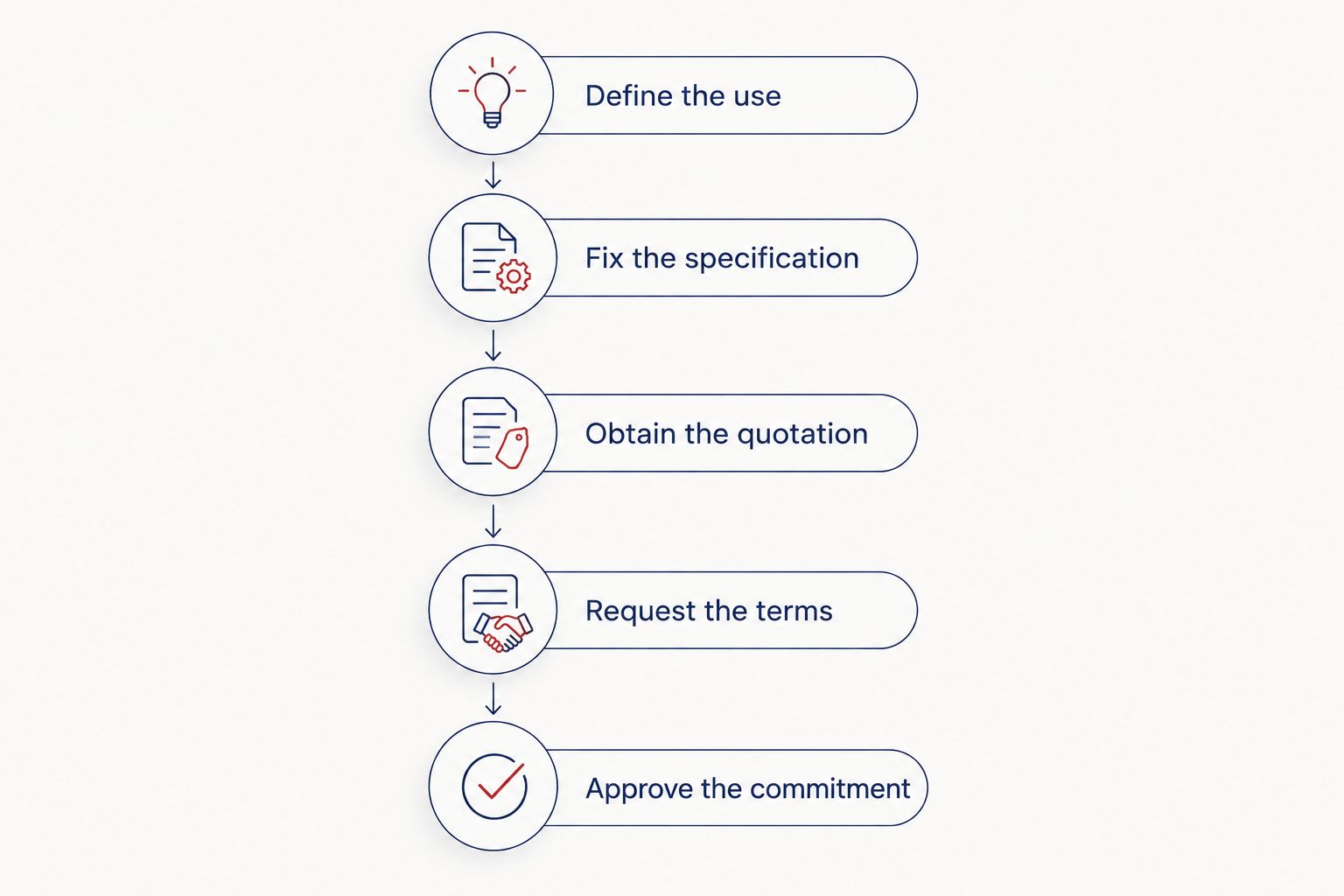
- Define the use. State the task: customer calls, remote interviews, video meetings or private colleague discussions. Identify whether people use the space alone or together.
- Fix the specification. Record the exact product and any separately quoted items. Keep the same configuration throughout the funding comparison.
- Obtain the quotation. Ask for a written quotation that clearly identifies included and excluded items. Give the lender that document rather than a rough shopping list.
- Request the terms. Obtain the proposed initial payment, full repayment schedule, charges and end-of-agreement position. Identify anything still subject to approval.
- Approve the commitment. Review the purchase and funding together. Assign responsibility for ordering, payments and checking that the final documents match the approved brief.
The order matters. If you request finance before defining the use, the discussion centres on a borrowing amount rather than a workable workspace purchase.
Compare the full cash commitment
Build your comparison from the actual proposals. Record what leaves the business initially, what leaves during the agreement and what remains payable at the end. Keep the supplier quotation beside that schedule.
Total scheduled repayments alone are not the complete comparison if an initial payment or separate end payment sits outside them. Equally, a funding proposal is not a complete project budget if part of the equipment quotation is excluded. Mark each exclusion clearly.
Use your own cash-flow forecast to assess affordability. Include the proposed commitment during quieter trading periods as well as stronger ones. Do not substitute an assumed increase in staff productivity for the ability to make repayments.
A clear internal decision states both sides: why the business needs the pod and why the chosen payment structure fits. If either argument is weak, revise the proposal before committing.
Avoid confusing finance with a product guarantee
Funding approval answers a lending question. It does not establish acoustic performance, suitability for a particular conversation or whether your chosen configuration meets the workplace brief.
Check product information separately from the funding paperwork. For a call booth, assess the stated use and supplied specifications. For a meeting booth, check the intended number of participants against the product description rather than assuming that larger borrowing capacity justifies a larger pod.
The same separation applies to supplier policies. Confirm the purchase terms directly; do not assume that a lender's involvement changes returns, warranty or other supplier arrangements. Keep the relevant documents together so your team knows which organisation answers each question.
FAQ
Can I finance an office pod without using the seller's finance provider?
You can explore business borrowing separately from the seller, subject to lender approval. Give the lender the exact product quotation and confirm how the purchase will be funded.
Does Soundbox Store offer monthly payments on office pods?
Confirm any monthly-payment arrangement directly with Soundbox Store before ordering. A product listing does not establish a finance offer, approval or repayment schedule.
Is financing an office pod the same as leasing it?
No: borrowing to fund a purchase and leasing equipment are different structures. Check the agreement for ownership, use and end-of-agreement arrangements rather than relying on the label.
What should I send a lender for an office pod purchase?
Send the exact product quotation and a clear description of the purchase scope. Ask the lender which business information it requires to assess the application.
Can furniture and accessories be included in office pod finance?
Ask the lender whether separately quoted furniture and accessories can be included. Do not assume that funding for the pod automatically covers every item in the workplace project.
Should I choose the lowest monthly repayment?
Do not choose on the monthly repayment alone. Compare initial payments, the full repayment schedule, charges and end-of-agreement terms against the same purchase quotation.
One last thing
A funding commitment can remain after the workplace need changes. Before approving finance, ask what happens if the team moves, reorganises or no longer needs the same type of private space. Get the funding provider's answer in writing rather than treating future flexibility as an assumed benefit.
Then check the simplest point: does the final agreement refer to the equipment your team actually approved? A suitable funding structure cannot correct an unsuitable purchase.


