 nl/be


 Productgids
How to make a small meeting room quieter
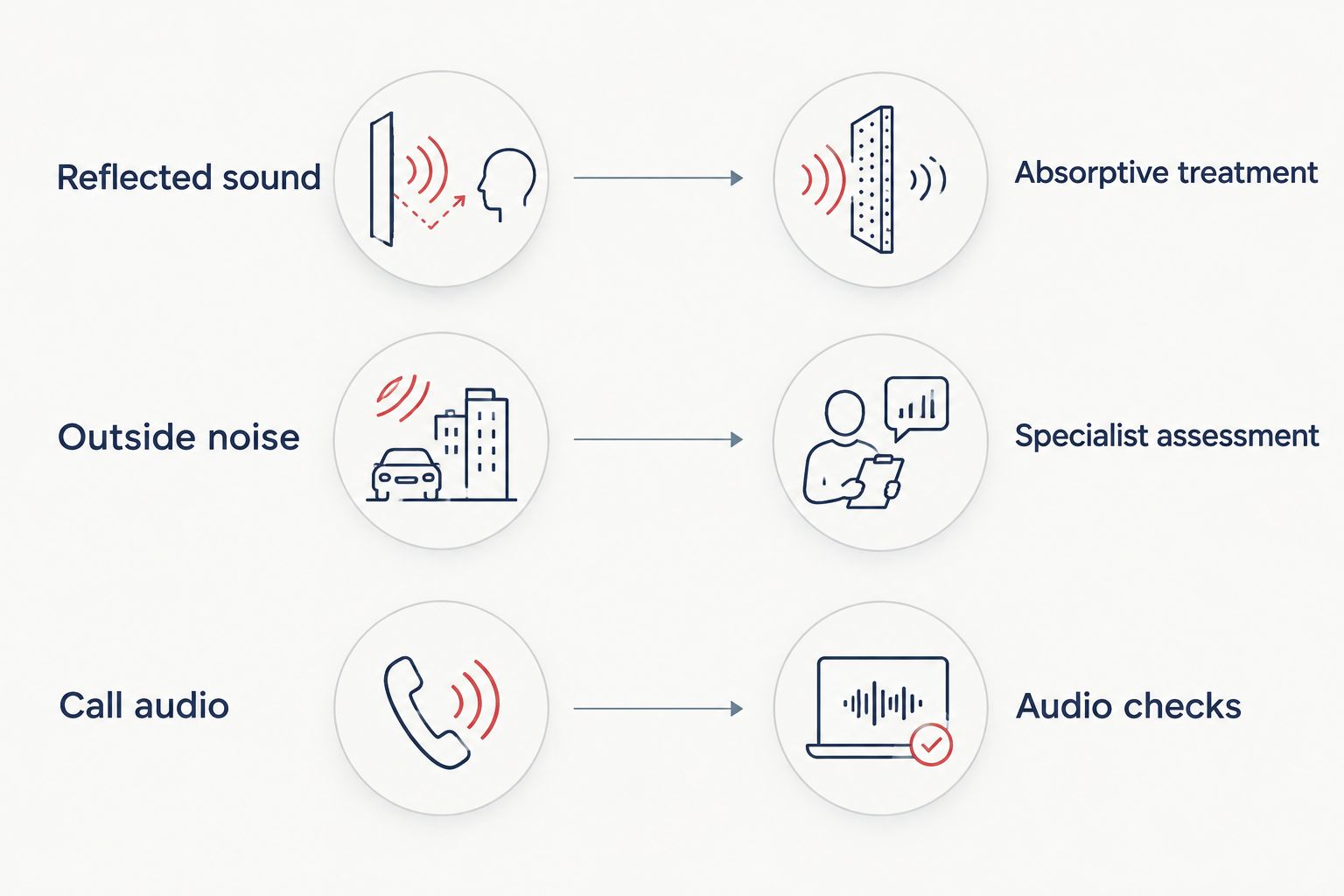
To make a small meeting room quieter, identify whether the problem is speech reverberating inside, noise entering from outside, or the video-call audio system. Use sound-absorbing treatment for reverberation, address sound transmission with an acoustics specialist, and check the microphone and loudspeaker setup separately. Acoustic panels reduce reflected sound; they do not turn an ordinary meeting room into a sound-isolated enclosure.
- To make a meeting room quieter, separate reverberation, outside noise and video-call audio problems before choosing treatment.
- Acoustic wall and ceiling panels address reflected sound, not every route by which noise enters a room.
- Soundbox Store meeting booths suit businesses seeking a separate space for small-group conversations.
- Judge the result from the meeting seats and the remote participant’s end, not just the doorway.
Why this matters
A room can sound noisy even when nobody outside is speaking. Hard surfaces reflect voices back into the room, making conversation less distinct and encouraging people to talk over one another.
The opposite problem also occurs: a room sounds comfortable inside, but nearby colleagues can still understand the conversation. That is a speech-privacy issue, not simply an echo problem. Soundbox Store sells acoustic panels and meeting booths, but those product types serve different purposes; start with the symptom rather than the catalogue.
If voices sound particularly harsh or reverberant inside the room, acoustic wall panels are a relevant treatment category to investigate. Do not treat them as a substitute for assessing sound passing through the room’s enclosure.
How do you make a small meeting room quieter?
Identify the dominant noise problem, choose a response that addresses it, then repeat the same conversation or call to check the result. Follow this sequence before changing the room.
- Listen without a call running. Have someone speak normally from a meeting seat. Notice whether words remain distinct or seem to linger and overlap.
- Listen while the room is unoccupied. Check whether you hear corridor conversations, neighbouring meetings or a persistent equipment hum. Record the source you can actually identify.
- Compare local and remote listening. Ask a remote participant whether they hear reverberant speech, background noise or a delayed repeat of their own voice. These are different symptoms.
- Choose the matching response. Consider absorption for reflected sound, a specialist assessment for transmission, and an audio-setup check for call-specific problems.
- Repeat the original task. Use the same seats, speaking positions and call equipment so you can judge the change fairly.
Keep a short written description of the problem. “People repeat questions during hybrid briefings” is more useful than “the room needs soundproofing”, because it identifies the task that must improve.
Match the symptom to the response
| What you notice | Likely issue to investigate | Best for | Main limitation |
|---|---|---|---|
| Voices linger or sound harsh inside the room | Reflected sound and reverberation | Absorptive wall or ceiling treatment | Absorption alone does not establish speech privacy |
| Corridor conversations interrupt meetings | Sound transmission into the room | Assessment of the room enclosure and sound paths | More soft furnishings do not address every transmission path |
| Remote participants hear a delayed repeat | Call-audio routing or acoustic echo | Reviewing active microphones and loudspeakers | Room treatment does not correct every audio configuration problem |
| A steady hum masks quieter speakers | Building services or equipment noise | Identifying and assessing the source | Adding panels does not remove the source |
| Small private meetings need a separate setting | Lack of an appropriate enclosed meeting space | A meeting booth matched to the group | A booth is a separate space, not a treatment for the existing room |
These responses are not interchangeable. A room with both reverberation and incoming corridor noise needs each problem considered separately, rather than a single purchase expected to solve everything.
Reduce reverberation inside the meeting room
Sound absorption is the relevant starting point when speech reflects around the room. Glass, bare walls and other hard surfaces reflect sound; absorptive treatment reduces the reflected energy rather than blocking every sound entering or leaving.
That distinction matters in a small room used for briefings or interviews. The goal is clearer conversation at a normal speaking level, not a room that simply looks more furnished.
Wall treatment: best for reflected speech
Acoustic wall panels are worth considering when the room sounds reverberant during an ordinary face-to-face conversation. Their benefit is absorption within the room; their limitation is that they are not a complete sound-isolation system.
Choose treatment for its stated acoustic purpose rather than its appearance alone. An acoustic consultant can assess the room and recommend an appropriate treatment plan without relying on a generic panel quantity.
Ceiling treatment: best when wall space is limited
A ceiling treatment is another option when glazing, presentation surfaces or doors leave little usable wall area. It addresses room reflections without requiring every treatment surface to be a wall.
The limitation remains the same: absorption is not equivalent to isolating the room. Discuss the room as a whole with the supplier or an acoustics specialist rather than assuming that treating the ceiling will stop neighbouring conversations.
Existing furnishings: useful, but not proof of performance
Soft furnishings can contribute absorption, but their effect depends on the materials and the room. A rug, upholstered chair or curtain does not establish a measurable acoustic result simply because it feels soft.
Do not judge acoustic performance by how cosy the room looks. Judge whether speech becomes easier to understand during the meeting tasks that previously caused difficulty.
Investigate noise entering from outside
If you clearly hear nearby conversations while the room is empty, internal reverberation is not the whole problem. Sound can travel through the enclosure and through connected paths around it.
Describe when the disturbance occurs and where you hear it most clearly. A nearby conversation, passing footfall and continuous equipment noise need different investigations; grouping them together as “office noise” makes the brief less useful.
Ask the facilities team or an acoustics specialist to assess the source and transmission paths. This is an assessment task, not a reason to alter doors, partitions or building services yourself.
Separate comfort from privacy
A quieter-sounding room does not automatically keep conversations private. Absorption can make speech clearer inside while understandable words remain audible elsewhere.
Use non-sensitive sample speech when checking what listeners hear outside. If confidentiality is central to the room’s purpose, request a professional assessment rather than treating an informal listening check as proof of privacy.
Check the video-call audio separately
A remote participant hearing echo does not always mean the room needs more acoustic panels. A delayed repeat of the remote participant’s own voice can involve sound from a loudspeaker returning through a microphone.
Start by identifying which devices are handling the room’s audio. Multiple laptops joining the same meeting with microphones and loudspeakers active can complicate the audio path.
Use the intended room-audio configuration and follow the equipment provider’s guidance. Then ask the remote participant to describe the remaining issue precisely: distant speech, reverberation, background noise or repeated audio.
Use a realistic call check
Ask someone to speak from each normal meeting position while a remote colleague listens. Include quieter speakers and ordinary conversational speech rather than testing only with a loud voice beside the microphone.
Noise suppression can change what remote participants hear, but it does not physically quieten the room. Likewise, improving the room’s absorption does not guarantee that every microphone setting is correct.
Treat room acoustics and call audio as connected but separate checks. That prevents a software adjustment from hiding an unresolved room problem, or room treatment from being blamed for an equipment issue.
When a separate meeting booth fits the task
A meeting booth is relevant when you need another enclosed setting for small-group conversations, rather than just better acoustics in the existing room. Soundbox Store meeting booths suit businesses seeking a separate space for small-group conversations. They do not repair the original meeting room.
Match the enclosure to the people physically attending. A 1-person phone booth serves a different task from a 2-person discussion or a 4-person team meeting; remote attendees do not change the number of people who need seats inside.
| Soundbox Store option | Stated capacity | Best for | Benefit supported by the product description | Limitation for this task |
|---|---|---|---|---|
| 2-person meeting booth | 2 people | Private face-to-face discussions | A freestanding acoustic enclosure designed for private meetings | Does not accommodate a 4-person meeting or improve the original room |
| Quell 4-person meeting booth | 4 people | Small-group confidential discussions | A freestanding acoustic enclosure designed to seat four people | Creates a separate meeting setting rather than treating the existing room |
Do not choose capacity by the largest meeting you can imagine. Write down the recurring task first, then compare the relevant product information against it.
For an existing room that only sounds reverberant, investigate absorption before treating a booth as the answer. For a workplace missing a suitable enclosed discussion space, a booth addresses a different need.
Why the right acoustic response varies
The same complaint can describe different underlying problems. These factors explain why a useful recommendation needs more than the room’s headcount:
- Dominant sound source. Voices inside, corridor conversations and equipment hum call for different responses.
- Reflective surfaces. The room’s combination of glazing, walls, ceiling and furnishings affects reflected sound.
- Transmission paths. Sound entering or leaving depends on the enclosure and connected paths, not just internal finishes.
- Meeting format. Face-to-face discussion and hybrid calls expose different listening problems.
- Audio configuration. Active microphones, loudspeakers and processing affect the remote listening experience.
- Required outcome. Easier conversation, fewer interruptions and speech privacy are distinct goals.
There is no useful universal panel count or guaranteed noise reduction for an unspecified room. Define the outcome before asking for a product recommendation.
FAQ
What should I try first to make my meeting room quieter?
First, identify whether you hear reflected speech, outside noise or a call-audio problem. Listen in the room without a call running, then compare that experience with what a remote participant hears.
Will acoustic panels stop people outside hearing our meetings?
Acoustic panels alone do not establish speech privacy. They absorb reflected sound inside the room, while sound transmission through the enclosure needs separate assessment.
Should I choose wall panels or ceiling treatment?
Choose wall or ceiling treatment as part of a room-specific absorption plan, not by assuming one surface is always better. Ceiling treatment is an option when glazing and other room features leave limited wall space.
Why do remote participants hear echo when the room sounds acceptable?
Remote echo can involve loudspeaker sound returning through a microphone, rather than room reverberation alone. Check the active audio devices and follow the room equipment provider’s configuration guidance.
How many people does a small meeting booth accommodate?
The supplied Quell meeting-booth options include 2-person and 4-person models. Choose according to the people physically attending; a 1-person phone booth serves an individual-call task instead.
How can I tell whether the room has improved?
Repeat the same conversation and remote-call check from the same seats using the same equipment. Compare speech clarity, interruptions and the remote listener’s experience; assess confidentiality separately if that is a requirement.
One last thing
A successful acoustic change can make voices clearer without making the room silent. That is a useful result when overlapping reflections were the problem, but it is not proof that conversations remain private.
Before choosing anything, finish this sentence: “This room needs to let us ___ without ___.” A specific task and a specific interruption give your facilities team a much better brief than “make it soundproof”.


