 nl/pt
nl/pt




















 Productgids
Office Pods for Mortgage Brokers: 2026 Guide & Verdict
Office pods for mortgage brokers are freestanding, soundproof booths built for one adviser's private call or one adviser-and-client review, not for the kind of ten-person meeting a boardroom is designed for. Mortgage advice runs on income figures, credit history and lender criteria repeated out loud several times a day, and an open-plan branch floor puts that detail within earshot of every other desk.
- Office pods for mortgage brokers replace a booked boardroom with a booth sized for one call or one client review.
- The Quell Office Pod Solo suits back-to-back private calls; the 2-person meeting booth suits face-to-face affordability reviews.
- Soundbox Store booths cut surrounding noise by roughly 30-35 decibels, enough to stop a neighbouring desk catching income figures.
- Sizing pods by concurrent call volume beats sizing by headcount — three busy advisers need three booths, not eight.
- Place the client-facing booth near reception, not at the back of the floor, to keep clients away from other live calls.
Why office pods matter for mortgage broker offices
A broker reading a client's salary and existing debt back to them at a desk three metres from another adviser doing the same thing isn't a minor annoyance — it's the kind of detail a client notices in a first meeting and remembers. Office pods for mortgage brokers solve this without asking the practice to knock through a wall or hand over the only meeting room for a fifteen-minute call.
Soundbox Store's booths range from a solo office pod up to a six-person meeting booth, and the smaller sizes cut surrounding noise by roughly 30-35 decibels. That's the difference between a colleague catching a client's name and number, and a colleague hearing a low murmur through the panel instead.
How to plan office pods for a mortgage broker office
Count how many private conversations happen at once
Before buying anything, work out how many sensitive conversations are actually running at the same time on a normal day.
- Track a typical Tuesday and Thursday and log every call or meeting that touches a client's financial detail.
- Note how many advisers are on the phone simultaneously during peak hours, usually mid-morning and early evening.
- Separate calls that need full privacy — affordability checks, credit discussions — from routine scheduling calls.
- Count walk-in client meetings separately from phone-only advice calls.
Split call volume from meeting volume
A solo caller and a face-to-face client review need different rooms, and mixing the two up is the most common early mistake.
- Map concurrent phone calls against concurrent client meetings — the two rarely peak at the same time of day.
- Decide whether client meetings happen in person at all, or whether the branch runs entirely on phone and video.
- Flag which advisers spend most of the day on calls versus which ones see clients face to face.
Size the pod to the conversation, not the headcount
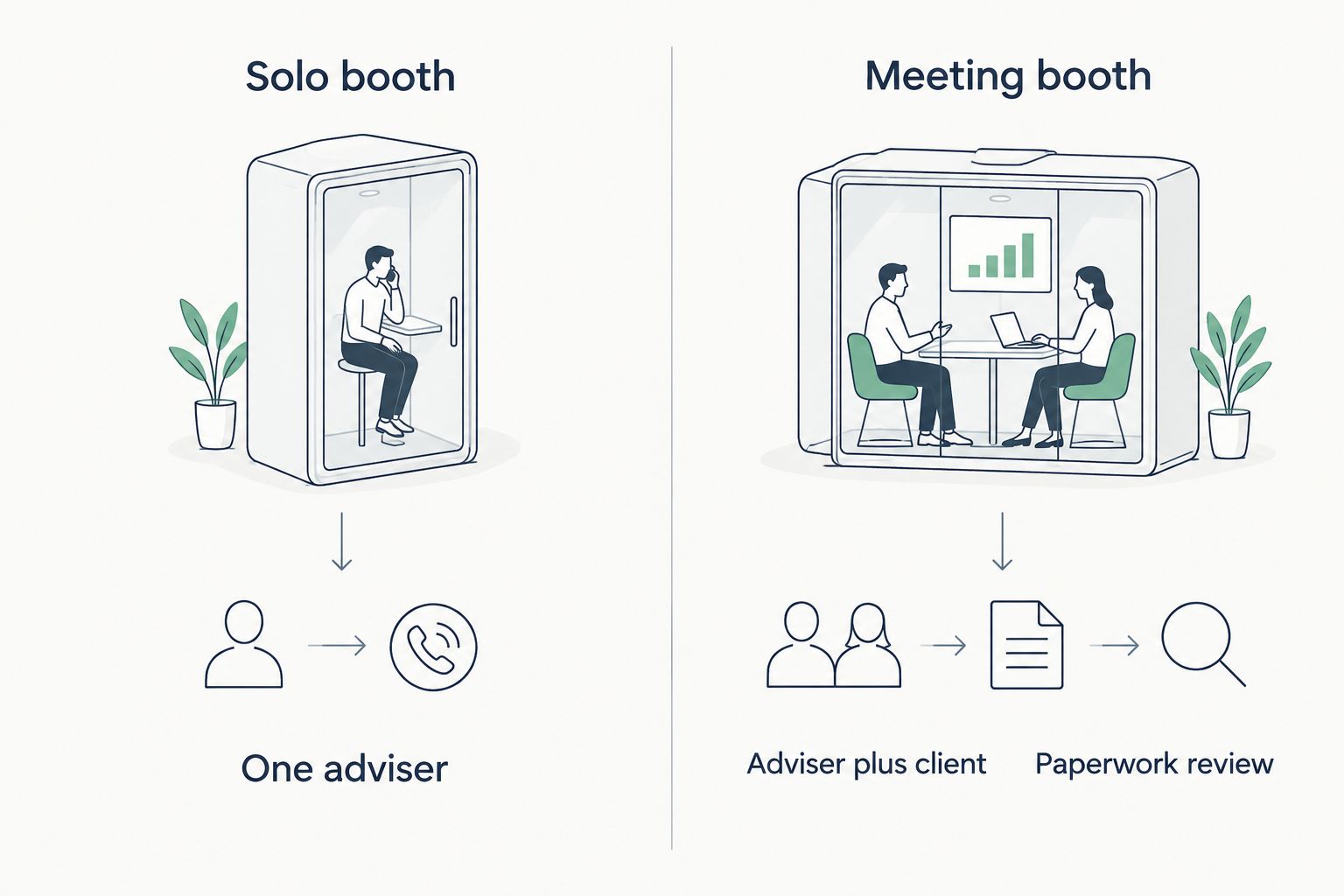
A single adviser taking back-to-back calls needs a one-person booth, not a shared meeting room booked in half-hour slots. The solo office pod fits one person and a laptop, built for calls rather than paperwork spread across a desk. A client sitting down with an adviser to work through an affordability form needs two seats and worktop space, which is what a 2-person meeting booth is built for.
- Buy solo booths against the number of advisers on calls at once, not total desk count.
- Buy client-facing booths against how many face-to-face reviews happen per day, which is usually lower than call volume.
- Don't assume one size covers both jobs — most broker floors need at least one of each.
Fit the booth for paperwork and video calls, not just conversation
Mortgage conversations involve printed disclosures, ID checks and screen-sharing with lender portals, so a booth needs a worktop, not two chairs facing each other.
- Add a stable surface for a laptop rather than relying on a lap or a knee for a 40-minute call.
- Set seat height so a webcam sits roughly at eye level for video-based client reviews.
- Keep a small shelf inside for printed forms so paperwork doesn't end up on the floor.
Keep sensitive conversations off open desks entirely
A rule of "no income or credit conversation at an open desk" only holds if there's always a free booth to move to.
- Route walk-in clients straight to a booth from reception rather than the nearest free chair.
- Fit lockable access on client-facing booths so paperwork can stay inside the room between meetings.
- Keep at least one solo booth free at any given time during peak calling hours.
Place pods where clients already walk
Booth position matters as much as booth size on a broker floor.
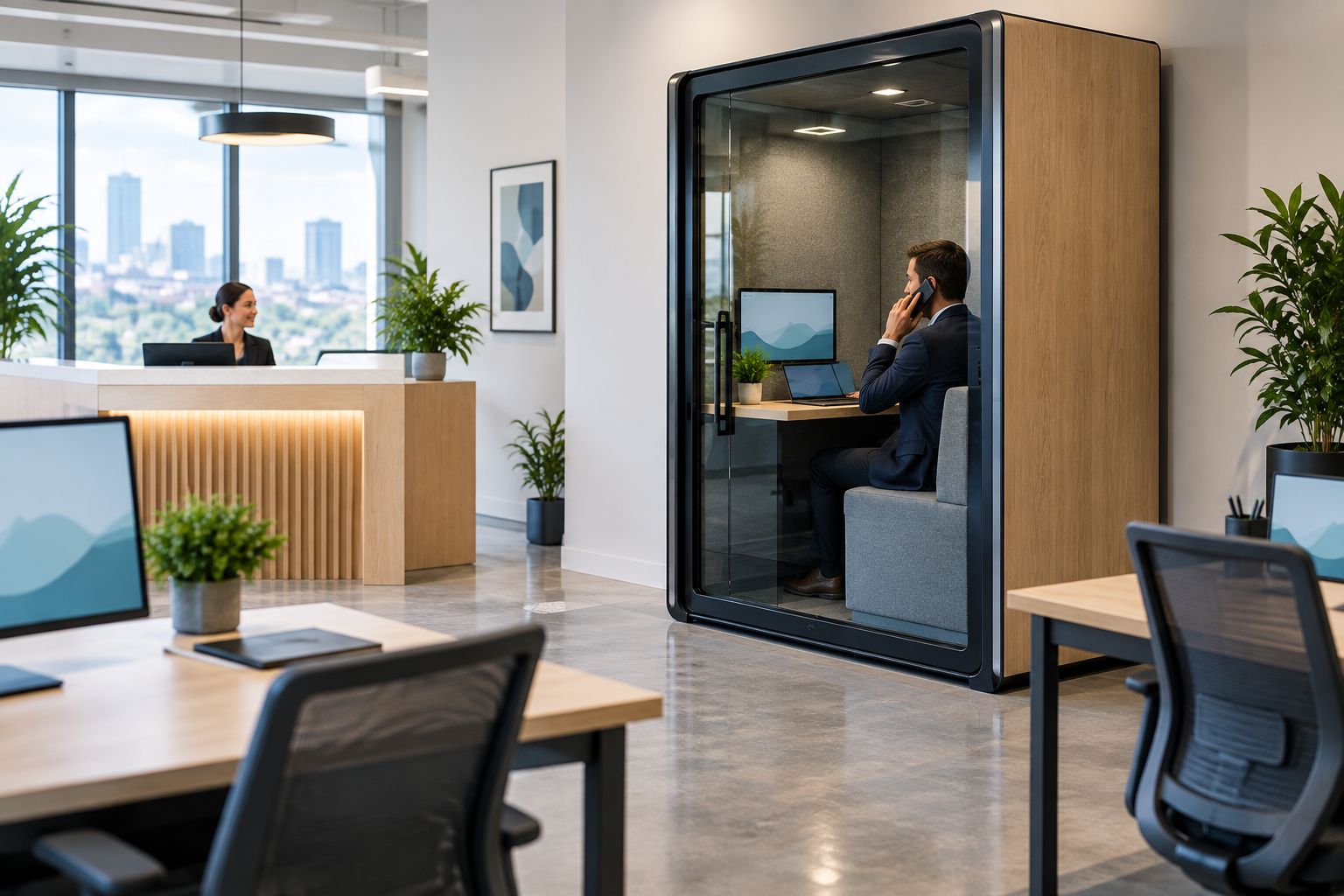
- Put the client-facing booth near reception, not at the back of the office past six other advisers' desks.
- Spread solo call booths across the floor near the advisers who use them most, rather than clustering them in one corner.
- Keep a clear sightline from reception to the booth door so staff can see at a glance whether it's free.
Phase the rollout against call volume, not the whole floor at once
Start with the busiest cluster of desks — the two or three advisers with the highest concurrent call volume — and add a solo booth there first. Add the client-facing meeting booth once phone volume is under control, since face-to-face reviews usually run at lower volume than calls. Check back after a month: if the booth isn't being used, move it before ordering a second one.
Comparing pod options for mortgage broker offices
Here's how the main options stack up for a broker floor:
| Option | Best for | Key limitation |
|---|---|---|
| Solo phone booth (Quell Office Pod Solo) | One adviser handling back-to-back private calls | Fits one person only — no room for a client to sit in |
| Higher-spec solo pod (Quell+ Acoustic) | Advisers who record calls or want the quietest booth on the floor | Same one-person footprint as the standard solo booth |
| 2-person meeting booth | Adviser and client working through an affordability form together | Too tight for a couple attending with the adviser — three people won't fit comfortably |
| Acoustic wall panels, no booth | Budget-limited practices not ready for a full enclosure | Cuts reflected noise but doesn't stop a client's name and numbers carrying to the next desk |
Pods for mortgage broker floors
These are the sizes most broker offices end up ordering:


Common mistakes mortgage broker offices make with office pods
- Sizing by headcount instead of concurrent calls. Buying one solo booth for eight advisers when three are typically on calls at once leaves five advisers with nowhere private to go.
- Putting the client-facing booth next to the waiting queue. A 2-person booth right by a busy reception area means waiting clients hear the numbers from the meeting before their own.
- Skipping furniture for paperwork. A booth with two chairs and no worktop turns a document review into advisers holding forms on their laps.
- Treating the boardroom as the only private option. Booking a full meeting room for a ten-minute affordability call wastes the room and doesn't solve the volume problem on the open floor.
- Locking the office but not the booth. Sensitive paperwork left inside a booth overnight needs its own lock, not just a locked front door.
FAQ
What's the best office pod for a mortgage broker taking private calls?
A one-person booth such as the Quell Office Pod Solo suits a mortgage broker taking back-to-back affordability and credit calls, since it fits one adviser and a laptop without needing a bookable meeting room. For client-facing reviews, a 2-person booth works better because it gives the client a seat and worktop space.
How many office pods does a mortgage broker branch need?
It depends on how many advisers are on private calls at the same time, not total headcount — a floor of eight advisers with three typically on calls at once needs roughly three solo booths, not eight. Count concurrent call volume over a normal week before ordering.
Is a 2-person meeting booth big enough for an affordability review?
A 2-person meeting booth fits one adviser and one client with room for a laptop and printed paperwork on a shared worktop. It isn't sized for a couple attending together with the adviser — that needs a larger booth.
Do office pods stop clients overhearing income and credit details?
A soundproof booth contains a normal speaking voice inside the enclosure, so a conversation happening inside doesn't carry to the next desk the way it would across an open floor. Soundbox Store's booths reduce surrounding noise by roughly 30-35 decibels, enough to stop adjacent desks catching specific numbers.
Can an office pod double as a video call room for mortgage brokers?
Yes — a solo or 2-person booth fitted with a small worktop and a webcam-height seat works for a video-based affordability call the same way it works for a phone call. The booth needs a stable surface for the laptop, not just two chairs facing each other.
What's the difference between a phone booth and a meeting booth for a broker office?
A phone booth is built for one person on a call or focused work, while a meeting booth is sized for two or more people sitting down together with paperwork or a shared screen. A mortgage broker office typically needs both — phone booths for call volume, meeting booths for client-facing reviews.
One last thing
The single biggest layout mistake on a mortgage broker floor isn't skipping a pod — it's putting the only client-facing booth at the back of the office, past six desks of advisers mid-call. Move it next to reception instead: clients reach it faster, and the walk itself doesn't take them past someone else's live credit conversation.


