 pl/pt
pl/pt




















 Przewodnik po produktach
Can Two People Share a 1 Person Office Pod? No | 2026
No. A 1-person office pod is designed for one occupant, so two colleagues should use a 2-person meeting booth for a face-to-face conversation. If only one person needs acoustic privacy, the other can join remotely from a separate space.
- Can two people share a 1 person office pod? No; choose a 2-person booth for a conversation inside the pod.
- A solo pod suits one caller; a meeting booth gives two colleagues a shared conversation space.
- Soundbox Store’s 2-person Quell meeting booth is the better fit for face-to-face meetings than a solo pod.
Why this matters
A solo call and a private conversation between colleagues place different demands on a workspace. In a solo call, one person needs a place to speak away from the surrounding office. In a face-to-face meeting, both people need to occupy the same space, hear each other and work with whatever furniture the pod provides. Selecting by the number of people who need to be inside avoids treating a solo booth as a small meeting room.
Soundbox Store lists the Quell Office Pod Solo as a solo option. That is the relevant category for one person taking a call, not for two colleagues meeting inside. The same distinction applies when you plan pod use in 2026: count the people in the booth, not everyone participating in the call.
Can two people share a 1 person office pod?
Use a 1-person pod for one occupant and a 2-person booth when both colleagues need to be inside. The product descriptions distinguish solo pods from meeting booths intended for two people. They do not provide a basis for treating a solo model as a two-person meeting space.
| Option | Best for | Main advantage | Main limitation |
|---|---|---|---|
| Quell Office Pod Solo | One person making a call or working privately | Keeps an individual task separate from the main office | Not the right choice for two people meeting inside |
| Office Phone Booth Quell – 2 Person | Two colleagues meeting face to face | Described as a meeting booth for two people | Uses a meeting booth for tasks one person could do alone |
The table answers the occupancy question, not every specification question. The supplied product information does not establish that these two models have identical furniture, dimensions or acoustic performance. Compare the current product details for the exact model you intend to use rather than carrying a feature across from another pod.
For 2026 office planning, the decision starts with the meeting format. If one colleague is on a video call with someone elsewhere, that is still one person inside the pod. If both colleagues walk into the booth to talk, choose a model presented for two people.
What counts as sharing a pod?
Sharing a booking is not the same as sharing the space. Two colleagues can use a solo pod at different times without occupying it together. Likewise, a person inside a solo pod can speak to several remote participants; the number of voices on the call does not change how many people are physically inside.
The question changes when both colleagues need to sit or stand together for a discussion. An interview, a private review and a joint video call all involve two people in the enclosure. In those cases, a 2-person booth matches the stated use more closely than a solo booth, even if the meeting is brief.
There is also a difference between meeting in a pod and speaking to somebody outside it. If a colleague stays at a desk and joins remotely, the solo pod still serves one occupant. If they need to look at the same work and speak face to face, choose a shared meeting space instead of trying to make the solo space perform a different job.
Match the booth to the conversation
Start with the people who need to be present together, then check how they will use the space. A product labelled for two people answers the occupancy part of the question, but the meeting itself determines which layout deserves attention.
- One private call: Choose a solo pod when one person needs separation from office conversation. Another participant can join remotely without entering the booth.
- A face-to-face discussion: Choose a 2-person meeting booth when both colleagues need to speak inside the same space.
- A joint video call: Choose a 2-person option when both colleagues must appear together from one room. Review that model’s furniture against the way you intend to take the call.
- A meeting with more people present: Move beyond the 2-person category when additional colleagues need to occupy the space. Soundbox Store also lists meeting booths for larger groups; select against the actual attendance.
This is a useful distinction for 2026 booking rules. A booking labelled call does not tell colleagues whether the booth is for one person or two. Label the intended use by occupants instead, so someone looking for a face-to-face conversation does not reserve a solo pod by mistake.
A simple visual check helps: picture everyone who must speak from within the enclosure, not everyone invited to the meeting. That keeps remote attendees out of the occupancy count while making the need for a shared booth clear.
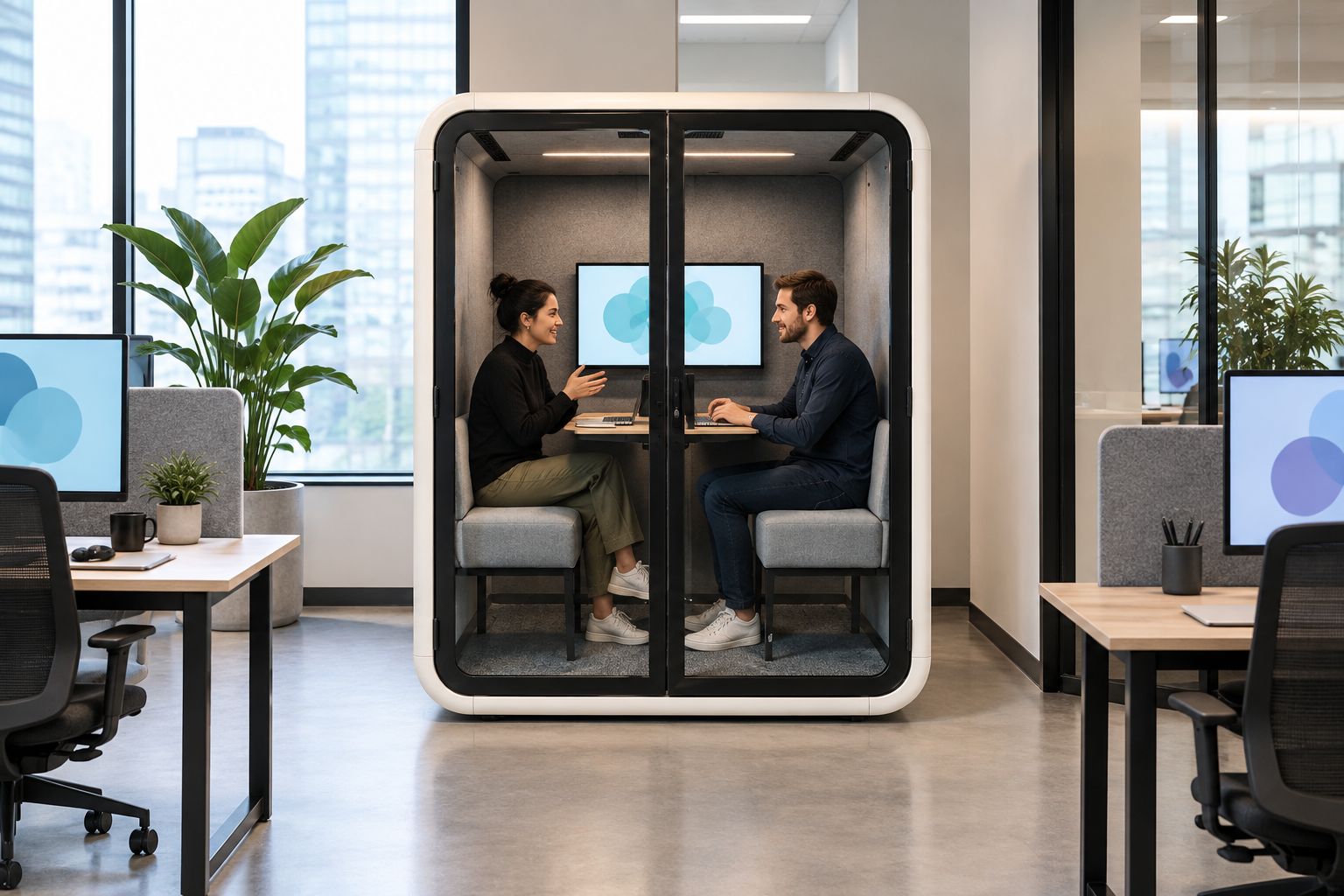
Why a 1-person pod is not a shortcut to a 2-person meeting
The solo designation tells you the intended format. It does not give you an extra seat, a shared work surface or a reason to assume that a conversation for two will work as well as it would in a meeting booth. Those details depend on the specific model, and the supplied solo listing does not establish them for two-person use.
Do not choose a pod solely because it looks close to the size you need. Look at the stated person capacity and the work you need to do inside. A brief conversation is still a conversation between two occupants; its short duration does not turn a solo model into a meeting booth.
The opposite mistake also matters. Reserving a 2-person booth for every individual call leaves a shared space occupied by someone whose task fits a solo pod. Where an office has both formats, describing bookings by use gives colleagues a clearer choice without guessing from the booth’s appearance.
For a 2026 workspace review, write down the recurring situations rather than a single preferred pod size. Separate private calls from conversations in which two people must be physically together. That split tells you which category each task belongs to before you compare individual models.
Which 2-person option fits your meeting?
Soundbox Store’s two-person products include the Quell meeting booth and Omni Two. Their supplied descriptions point to different meeting setups: the Quell is described for private meetings between two people, while Omni Two is described as a compact acoustic pod for face-to-face collaboration and one-to-one reviews. Neither description makes a solo pod a substitute for both.
If your question is simply whether two colleagues can hold a private discussion in the same pod, start with the Quell 2-person meeting booth. If the conversation is a one-to-one review or face-to-face collaboration, Omni Two is another relevant two-person option. Check each current product page for the furniture and layout you need; do not assume that matching person counts mean matching interiors.
Soundbox Store’s 2-person Quell meeting booth is best for two colleagues who need a private face-to-face conversation. Its advantage over the solo option is the stated two-person meeting purpose. Its limitation is equally clear: an individual call does not require a shared meeting booth.


Why the right pod varies by task
There is no single answer for every meeting that involves two colleagues. These factors determine whether a solo pod or a shared booth fits the work:
- People physically inside: One occupant points to a solo pod; two occupants point to a 2-person model.
- Meeting format: A remote conversation needs one private calling space for each person who needs it. A face-to-face discussion needs a shared space.
- How work is reviewed: Talking through a document together creates a different furniture requirement from taking an individual call. Check the model’s stated setup.
- Use of the office floor: A shared booth and a solo pod answer different requests. Distinguish them in booking descriptions so colleagues choose the space intended for their task.
- Group size: If more than two colleagues need to meet inside, a 2-person label no longer matches the group. Check a larger meeting-booth category instead.
These factors remain the same in 2026 even when teams change how often they meet remotely. The deciding number is the count of people occupying the pod for that particular conversation, not the total number employed in the office or invited to a video call.
Can one person use a 2-person meeting booth?
Yes. A 2-person meeting booth can serve a conversation involving one person inside and someone joining remotely. It is a less direct match for a routine solo call when a dedicated 1-person pod is available, because the two-person space also serves colleagues who need to meet together.
Treat that as a booking decision, not an unsupported claim about a product’s performance. The supplied details describe what the booths are for; they do not establish that a larger booth gives one caller better acoustic results than a solo model.
What if the second colleague joins by video?
Use a 1-person pod if only one colleague is physically inside. The second colleague can join remotely from another location; a video call with two participants is not automatically a two-occupant pod meeting.
If both colleagues need to sit together for the same video call, choose a 2-person option and review its furniture against the call setup. That is a different requirement from giving one caller privacy.
Should you choose a larger pod just in case?
Choose for the people who regularly need to meet inside, not for a hypothetical meeting that has no defined use. A 2-person booth suits two-person conversations; a larger meeting booth becomes relevant when the group itself is larger. This keeps the reason for each pod clear when colleagues book it in 2026.
FAQ
Can two people share a 1 person office pod?
No; choose a 2-person meeting booth when both people need to be inside. A 1-person pod is the appropriate category for one occupant making a call or working privately.
Does a call with two participants require a 2-person pod?
No. If one participant joins remotely, only the person inside needs the pod; choose by physical occupants rather than the number of people on the call.
What is a 2-person meeting booth best for?
A 2-person meeting booth is best for two colleagues meeting face to face inside the same space. Check the individual model’s furniture for the conversation you have planned.
Can a solo pod replace a meeting booth for a quick conversation?
No. A short conversation between two occupants still calls for a space presented for two people; the length of the meeting does not change the solo pod’s stated purpose.
Is a larger booth necessary for one-to-one reviews?
No. A 2-person option is the direct category match for a one-to-one review with both people inside; Omni Two is described for that use.
How should an office label solo pods and meeting booths?
Label them by occupant count and purpose: individual calls for solo pods, and face-to-face conversations for 2-person booths. That makes the booking choice clearer than calling every enclosure a meeting pod.
One last thing
A meeting invitation counts participants; a pod choice counts occupants. Keep those two numbers separate. When colleagues say they need a pod for a two-person call, ask whether both people will be inside. That single question decides whether a solo calling space or a shared meeting booth is the relevant category.


