 pl/pt
pl/pt




















 Przewodnik po produktach
How thick are office pod walls? Model-specific | 2026
Office pod wall thickness is model-specific: there is no single millimetre figure that answers the question for every soundproof pod. Use the exact model’s wall-section dimensions for space planning and its acoustic performance data for noise reduction; a thicker-looking wall does not, by itself, establish better speech privacy.
- How thick are office pod walls? The answer is model-specific; wall depth alone does not establish acoustic performance.
- Soundbox Store acoustic office pods suit businesses seeking private workspaces for calls and meetings.
- Compare complete wall dimensions, usable interior space and acoustic evidence separately.
- A wall panel, its interior lining and a glazed section are different measurements.
Why this matters
If you are choosing a pod for video calls or small-team discussions, wall thickness answers only part of your brief. You need to know both what fits on your office plan and what the enclosure does acoustically. Treat dimensions and noise reduction as separate checks, not interchangeable specifications.
How thick are the walls on a soundproof office pod?
Office pod wall thickness depends on the particular enclosure and the component being measured. Start with the intended use, then check the dimensional information for that exact product.
| Product | Best for | Relevant purpose | Limit of this comparison |
|---|---|---|---|
| Office Phone Booth Folio | One-person calls and video meetings | A private workspace for an individual | Its purpose does not establish a wall-thickness figure |
| Office Phone Booth Quell - 2 Person | Two-person private discussions | An enclosure designed for two people | Occupant capacity does not establish panel depth or acoustic performance |
The Office Phone Booth Folio is designed for one person to take private calls, join Zoom meetings or focus. The Office Phone Booth Quell - 2 Person is designed for two people to hold private meetings. Those are useful distinctions when you choose a workspace, but neither tells you how many millimetres thick its walls are.
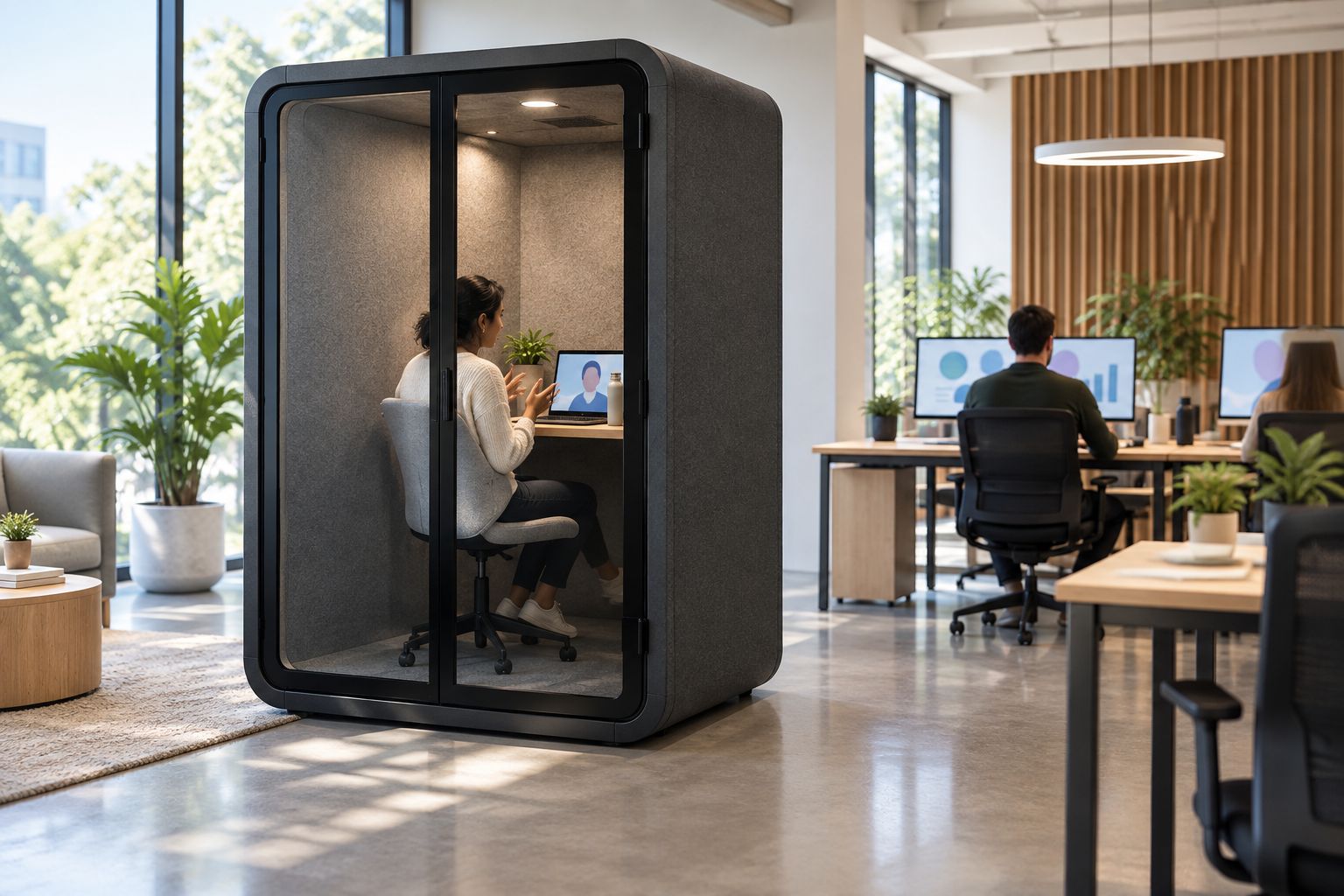
Use the model’s stated dimensions, not its capacity, appearance or product name, to answer a thickness question. A photograph helps you understand the enclosure’s form. It is not a dimensioned wall section.
What counts as wall thickness?
Before comparing figures, establish where each measurement starts and ends. A complete wall assembly, an individual panel and an interior acoustic finish are not necessarily the same thing. Comparing them as though they were produces a misleading shortlist.
| Measurement | What it describes | Useful for | What it does not establish |
|---|---|---|---|
| Complete wall assembly | The distance across the finished wall at a specified location | Understanding the wall section | Whole-pod acoustic performance |
| Individual panel | One component within the wall construction | Understanding that component | Total finished wall depth |
| Interior lining | The room-facing finish or acoustic treatment | Understanding the interior surface | Sound isolation through the complete enclosure |
| Glazed section | The specified glass assembly | Understanding the transparent part of the enclosure | The depth of adjacent opaque walls |
| External dimensions | The pod’s overall envelope | Comparing footprints | Usable interior dimensions |
Ask whether a quoted wall measurement includes the interior finish and exterior face. Also establish whether the same dimension applies throughout the enclosure. A dimension at a door frame should not automatically become the figure for every wall.
This is a comparison discipline, not a requirement for a particular construction. Different assemblies need different descriptions. Your goal is to compare equivalent measurements rather than reward whichever specification happens to contain the largest number.
Why thicker walls do not automatically mean quieter calls
Sound isolation depends on an assembly’s construction and the paths through which sound travels, not just its overall depth. Thickness is one physical dimension. It does not describe the entire acoustic system.
Adding depth and adding mass are different changes. A deeper assembly can contain a cavity, while a shallower component can contain a different material. Without the construction details, you cannot turn a millimetre measurement into an acoustic verdict.
Doors, joints, glazing and ventilation paths also form part of the enclosure. Sound does not assess the solid wall in isolation before deciding whether to pass through another route. Judge the complete pod for your call-space brief, rather than judging only its most substantial-looking panel.
This also explains why a wall-only acoustic result and a complete-enclosure result answer different questions. Keep the test scope attached to the figure. Otherwise, a technically accurate number can become an inaccurate comparison.
Noise reduction and interior absorption answer different questions
Sound isolation concerns sound passing between spaces. Sound absorption concerns reflected sound within a space. Both matter in a workplace pod, but they are not substitutes for one another.
An interior acoustic finish can reduce reflections inside an enclosure without establishing how effectively the complete pod limits sound transmission outside it. Equally, an enclosure’s noise-reduction figure does not describe every aspect of how your voice sounds through a microphone.
Soundbox Store describes its acoustic office pod range as providing 30–35 dB noise reduction. The 30 dB and 35 dB figures describe acoustic performance, not wall dimensions; do not convert them into millimetres or assign either endpoint to an individual model without model-specific information.
Decibels use a logarithmic scale. A dB figure is therefore not a percentage, and it should not be rewritten as a percentage of noise removed. Keep the original measurement and its scope together when discussing performance with your team.
Why wall-thickness comparisons vary
Wall-thickness comparisons change when the measurement, component or product changes. Separate these factors before deciding that one enclosure has thicker walls than another:
- Measurement boundary: a complete finished assembly is different from a single component within it.
- Component type: an opaque wall, glazed section and door assembly need separate descriptions.
- Measurement location: a frame or junction is not automatically representative of the main wall section.
- Model selection: specifications belong to the exact product, not every enclosure within a range.
- Interior treatment: an acoustic lining measurement is not automatically the overall wall measurement.
- Drawing scope: an external footprint and an internal dimension describe different boundaries.
These factors explain why apparently simple thickness figures can be difficult to compare. They do not establish the construction of any particular product. Use them to clarify the information you are reading, rather than to infer an undocumented material or layer.
How to compare wall information without guessing
A useful comparison follows a short sequence. Keep the same model name attached to the dimensions and performance information at every stage.
- Name the task. Write down whether you need an individual call space or a place for a private discussion. This prevents a dimensional comparison from overlooking the purpose of the enclosure.
- Identify the exact product. Record the full product name rather than a broad family name. Do not transfer a specification from another model because its photograph looks similar.
- Identify the measurement. Establish whether the figure describes the whole wall, a panel, glazing or lining. Keep those entries separate in your comparison document.
- Read the dimensional drawing. Use stated external and internal dimensions for the boundaries they actually describe. Do not derive a wall specification from visual proportions.
- Read the acoustic scope. Establish what the reported performance figure measures and which enclosure it covers. A component result is not automatically a complete-pod result.
- Make the decision in context. Compare the usable workspace and acoustic evidence against your actual task. The deepest wall should not win merely because it has the largest dimension.
A useful comparison sheet needs separate fields for wall-section information, external dimensions, internal dimensions and acoustic performance. Keeping those fields apart makes it harder for an attractive headline specification to replace the evidence your decision needs.
Why external minus internal width is not a wall specification
Subtracting internal width from external width describes the difference between two measured boundaries. It does not automatically identify the construction or thickness of a particular wall. Dividing that difference equally between the sides introduces another assumption.
That shortcut only describes an average allowance if the drawing’s boundaries are comparable and the enclosure’s geometry supports the calculation. Frames, finishes and other features can sit within those boundaries. Do not label the result as a manufacturer-stated wall thickness.
For space planning, use the external dimensions directly. For usable space, use the stated interior dimensions directly. For wall construction, use a wall-section measurement rather than trying to make the first two figures answer a third question.
A calculated allowance and a stated wall dimension are different pieces of information. Label them differently if both appear in your project notes.
Match the enclosure to the conversation
For an individual video call, the Office Phone Booth Folio’s stated purpose matches the task: one person taking calls, joining Zoom meetings or working privately. Its limitation is equally clear. A one-person workspace is not the same brief as a discussion space for two colleagues.
For a private conversation between two people, the Office Phone Booth Quell - 2 Person matches the stated occupancy and meeting use. That is its practical advantage in this comparison. It does not establish superiority on wall thickness, acoustic performance or usable space.
Soundbox Store acoustic office pods are best for businesses seeking private call and meeting spaces. Choose the enclosure around the activity first, then assess its documented dimensions and performance. That keeps a question about walls connected to the workspace you actually need.
Write a brief that separates fit from performance
Your purchasing brief should name the activity and the information needed to assess it. For example, describe an individual video-call workspace or a two-person discussion space. Then record the dimensional and acoustic questions separately.
Under dimensions, distinguish the overall enclosure from the usable interior and any documented wall section. Under acoustic performance, keep the measurement description with its result. This gives everyone reading the brief the same basis for comparison.
Avoid writing a minimum wall thickness solely because thicker sounds more reassuring. Without evidence connecting that threshold to your required outcome, it becomes an arbitrary filter. It can exclude an enclosure without telling you whether another one serves your team better.
Specify the outcome you need; use thickness to understand the construction, not to stand in for that outcome. Your final shortlist should explain why each enclosure matches the task, rather than merely repeat a panel dimension.
FAQ
How thick are office pod walls?
Office pod wall thickness is model-specific and must be read from the exact model’s dimensional information. Confirm whether the measurement covers the complete finished wall or only one component.
Are thicker office pod walls always better at blocking sound?
No. Sound isolation depends on the complete construction and sound transmission paths, so overall wall depth alone does not establish acoustic performance.
Can I calculate wall thickness from a pod’s outside and inside dimensions?
Not reliably as a product specification. The difference between external and internal dimensions describes an allowance between measurement boundaries, not necessarily the depth of a particular wall assembly.
Does an acoustic interior lining make a pod soundproof?
An acoustic interior lining does not, by itself, establish sound isolation. Absorption reduces reflections inside a space, while isolation concerns sound passing between spaces.
What does Soundbox Store’s 30–35 dB noise reduction mean for wall thickness?
Soundbox Store’s stated 30–35 dB noise reduction is an acoustic figure, not a wall-thickness measurement. It cannot be converted into millimetres or applied to a particular model without model-specific evidence.
What should I compare before choosing a pod for calls?
Compare the intended occupancy, external dimensions, usable interior and documented acoustic performance. Treat wall-section information as a separate construction detail rather than a substitute for those checks.
One last thing
A precise-looking measurement is only useful when you know what it measures. Before making a decision based on wall thickness, ask for the measurement’s boundaries and its model reference. If those are unclear, keep the figure out of your comparison rather than filling the gap with an estimate.
The strongest brief connects the enclosure to a specific task. For private calls and small meetings, prioritise the right workspace and relevant acoustic evidence; use wall thickness to understand the enclosure, not to rank it on its own.

