 pl/pt
pl/pt




















 Przewodnik po produktach
SoundBox Store vs Bureau: SoundBox Wins 2026
Choose SoundBox Store in 2026 if you need capacity-led office pods backed by supplied acoustic figures; the Quell Office Pod Solo is the clearest starting point for individual calls and focused work. Choose Bureau if your organisation already has a documented Bureau specification that must remain consistent across a wider workplace project. For SoundBox Store vs Bureau, SoundBox Store is the stronger evidence-based choice unless an existing specification makes Bureau the required option.
- SoundBox Store vs Bureau favours SoundBox Store for a specification-led office pod shortlist in 2026.
- Supplied office pod data states 30–35 dB noise reduction and testing to ISO 23351-1:2020.
- Bureau makes more sense when an existing workplace specification already requires its products.
- Compare current commercial terms, capacity, acoustic evidence and project documents before committing.
Why this matters
An office pod comparison affects more than the object placed on the floor. You are choosing how individual calls, focused work and small meetings will be accommodated, so capacity and acoustic evidence matter more than surface-level design language.
The 2026 decision separates two procurement situations. One starts with a specific workplace problem and asks which pod format solves it. The other starts with an existing design or supplier specification and asks which option preserves consistency. SoundBox Store is better supported for the first situation; Bureau can be the rational choice in the second, but only when that requirement is documented.
The evidence is uneven. The supplied information for the SoundBox catalogue includes a measurable noise-reduction range, a named test standard and formats from individual booths to meeting rooms. Equivalent Bureau product specifications, commercial terms and testing details were not supplied for this comparison. Any unsupported head-to-head claim would therefore be false precision.
At a glance
| Dimension | SoundBox Store | Bureau |
|---|---|---|
| Best for | Buyers starting with a private-call, focus-work or meeting requirement | Organisations retaining an existing Bureau specification |
| Pricing model | Products are sold directly through an online store; current terms need checking at purchase | Current commercial model is not established by the supplied information |
| Standout feature | Capacity-led catalogue with supplied acoustic performance data | Procurement continuity when Bureau is already specified |
| Acoustic evidence | Supplied range of 30–35 dB noise reduction and testing to ISO 23351-1:2020 | No equivalent evidence supplied here |
| Capacity path | Individual phone booths through to 6-person meeting rooms | Capacity range cannot be verified here |
| Product fit | Dedicated formats for calls, focused work and meetings | Must be confirmed against current product documents |
| Project documentation | Useful shortlist evidence, but exact product details still need checking | Can win if its current project pack is more complete for your brief |
| Decision risk | Lower on the evidence supplied for acoustic performance and capacity | Higher until equivalent specifications are obtained |
SoundBox Store is better for a specification-led shortlist
Start with SoundBox Store when your brief names the activity that needs privacy. Individual video calls point towards a solo booth. Regular conversations between colleagues point towards a small meeting booth, while group sessions require a larger meeting format.
That use-case structure makes the first shortlist easier to build. You can move from the number of regular occupants to the relevant catalogue group without treating every office pod as interchangeable. It also prevents a common buying mistake: selecting a large enclosure for work that mostly involves individual calls, or selecting an individual booth for meetings that require several regular participants.
Best for: facilities and workplace teams defining a new requirement from scratch.
Advantages:
- The catalogue covers individual calls, focused work and group meetings.
- Supplied acoustic data gives the shortlist a measurable starting point.
- Direct online presentation lets you inspect individual product pages.
Limitations:
- Exact dimensions, materials and included configurations are not supplied in this comparison.
- Commercial terms must be checked on the current product page.
- A category-level acoustic range does not replace the specification for the exact model being considered.
Pricing is a draw until both current offers are comparable
There is no defensible pricing winner from the supplied information. The store sells directly online, but this article does not reproduce changing commercial terms. Bureau's current pricing structure, configuration rules and project charges are also not established here.
A useful 2026 comparison puts both offers on the same scope. Check whether each proposal covers the same pod capacity, furniture requirement, optional privacy elements and project services. A lower headline figure is not a genuine saving if the two documents describe different configurations.
Use one comparison sheet with these fields:
- Exact product and intended use
- Regular occupant capacity
- Included interior elements
- Optional elements selected
- Project services listed
- Current payment terms
- Total commercial scope
The winner is the offer that meets the written brief with fewer unresolved exclusions. If either side leaves a major field blank, ask for a revised document before comparing totals.
Measured acoustic evidence is the clearest advantage
The information supplied for this comparison states that the office pods are tested to ISO 23351-1:2020 and provide 30–35 dB noise reduction. That is a testing reference and performance range, not a claim that every conversation becomes inaudible outside every pod.
For a 2026 shortlist, this evidence is useful because it gives procurement teams a named measurement basis. Ask for the exact model's current document and confirm that the stated result applies to the configuration under consideration. Do not transfer a general catalogue range to a specific product without that confirmation.
No equivalent Bureau acoustic result or test reference was supplied. Bureau therefore cannot win this dimension on the present evidence. It can only become comparable after equivalent documentation identifies the tested product, the measurement method and the reported result.
Verdict: SoundBox Store wins on supplied acoustic evidence. The magnitude of that win is substantial because one side has a named standard and measurable range while the other side has no equivalent information in the comparison record.
SoundBox Store offers the clearer capacity path
Capacity should follow the recurring task, not the largest meeting anyone can imagine. An individual booth fits private calls and focused work. A 2-person meeting booth fits regular conversations between two colleagues, while the Quell 6-person meeting booth addresses larger group sessions.
The useful distinction is regular occupancy. If a team mostly holds one-to-one reviews, buying around an occasional larger gathering misaligns the pod with daily demand. If six people meet repeatedly, an individual phone booth does not solve the scheduling or collaboration requirement.
The supplied catalogue establishes a progression from single-person booths to 6-person meeting rooms. Bureau's equivalent capacity range is not supplied, so a complete model-by-model comparison is not possible.
Best for: teams that want to map specific work patterns to a defined pod capacity.
Verdict: SoundBox Store wins the capacity-selection dimension on the evidence provided. Bureau should only be added to the final capacity comparison after its current range is documented against the same use cases.
Both options need an exact product-level fit check
Neither brand name answers whether a particular enclosure fits your workplace brief. The product page or project document must match the intended activity, expected occupancy and interior requirements. This is an honest tie because those checks remain necessary regardless of the supplier.
Separate the brief into three layers:
- Use case: individual calls, focused work, two-person conversations or group meetings.
- Capacity fit: the number of people expected to use the enclosure during normal operation.
- Configuration: the exact interior and optional elements listed for the selected product.
Do not combine different layers into one vague requirement such as a private pod for meetings. That phrase could describe an individual phone booth, a compact conversation space or a larger meeting room. A precise brief produces a cleaner comparison and exposes missing information earlier.
The tie ends when one product document answers the brief more completely. Until then, neither option wins merely because its range appears broader or its design language feels more familiar.
Bureau is better when an existing specification must remain intact
Bureau has a genuine winning scenario: your organisation already uses a documented Bureau specification and the new purchase must match that standard. Continuity can reduce internal review work because the decision begins with an approved requirement rather than a fresh category search.
This is a procurement advantage, not a claim that Bureau has better acoustic performance, capacity or product quality. None of those conclusions is supported by the supplied information. The existing specification must also be current and relevant to the new space; an old product reference is not enough.
Best for: organisations extending a workplace scheme that already names Bureau products and configurations.
Advantages in this scenario:
- The internal design requirement is already defined.
- Stakeholders can compare the new request against an existing reference.
- The decision can prioritise consistency rather than reopening the full category.
Limitations:
- No Bureau acoustic figures were supplied for this article.
- No verified Bureau capacity range was supplied.
- No current Bureau commercial model was supplied.
Verdict: Choose Bureau for documented specification continuity. Do not choose it on assumed performance.
The stronger project pack can overturn the early verdict
SoundBox Store leads the initial comparison because its supplied information includes measurable acoustic performance and a clear capacity range. A final procurement decision still depends on the exact documents attached to the selected product and project.
Bureau becomes the better documented option if it supplies a current project pack that answers the brief more completely. That pack should identify the exact product, intended capacity, acoustic evidence, selected configuration and commercial scope. This is a conditional win based on the quality of the documents you receive, not an unsupported product claim.
Use the same evidence request for both sides:
- Acoustic evidence: the result for the exact model and configuration.
- Capacity fit: the intended regular occupancy for the selected format.
- Current terms: the complete commercial scope without assumptions.
- Project documents: the product-specific information needed by the workplace team.
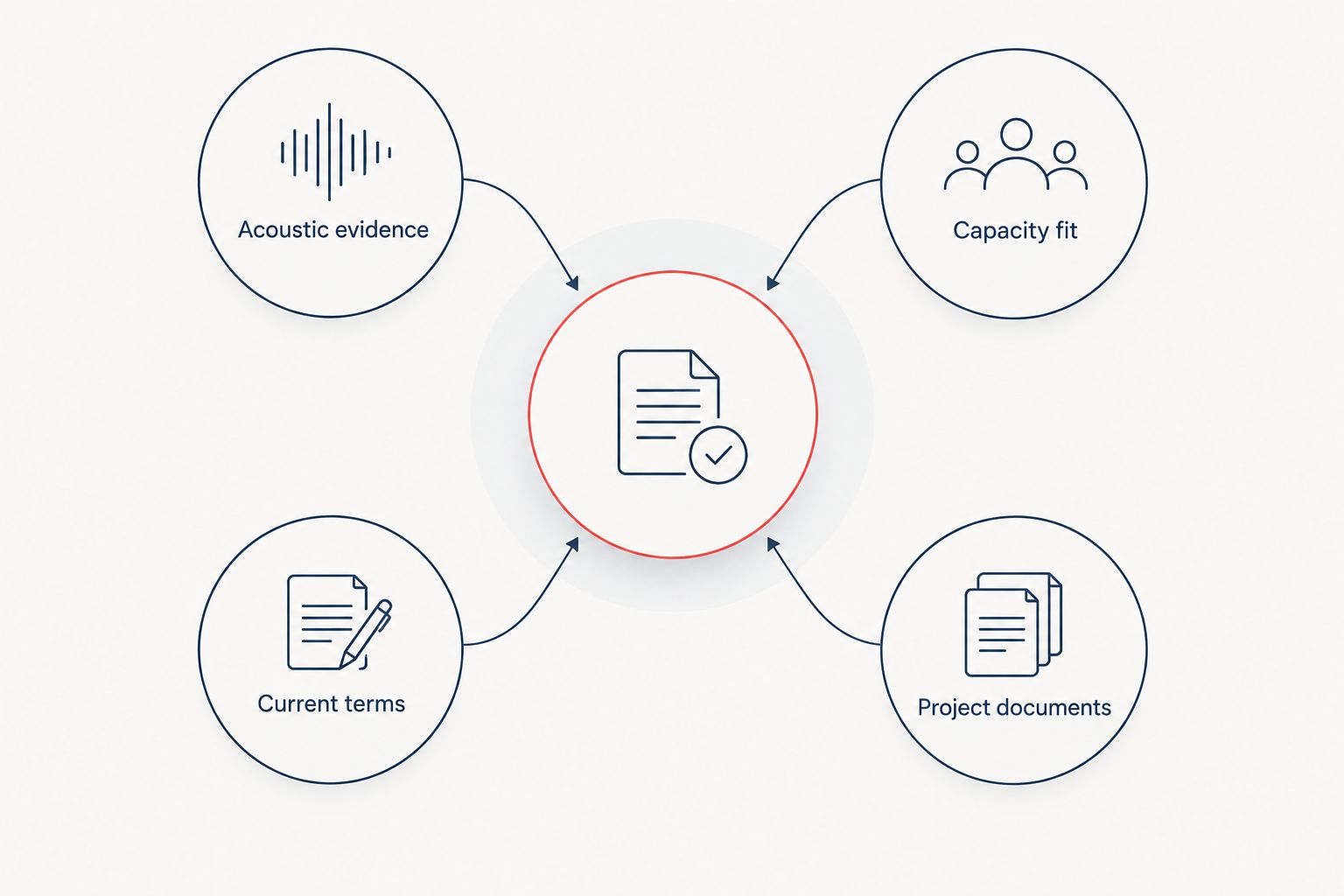
Score each response as present, missing or requiring clarification. Do not create a weighted formula unless your organisation has already agreed which fields matter most. A simple evidence record is enough to show where the decision is firm and where it still depends on an assumption.
SoundBox Store carries less evidence risk in this comparison
Evidence risk is the chance of making a decision from missing, unmatched or category-level information. It rises when one proposal gives a result for a different product, omits the selected configuration or uses broad claims without a stated measurement basis.
The supplied SoundBox information reduces that risk at the opening stage because it provides a 30–35 dB range, a named test standard and capacities from individual use to 6-person meetings. The risk is not eliminated. You still need to match the selected model to its current product document.
Bureau carries more unresolved evidence risk here because equivalent information was not provided. That verdict changes as soon as current, model-specific documents close the gaps. It is a judgement about the comparison record, not a permanent judgement about the company.
Final verdict
Choose SoundBox Store if you are starting from a workplace need
Choose SoundBox Store for a new 2026 office pod shortlist built around individual calls, focused work or capacity-defined meetings. The supplied 30–35 dB range, ISO 23351-1:2020 testing reference and progression from individual booths to 6-person rooms create the stronger evidence base.
The main limitation is product-level detail. Confirm the exact model, configuration and current commercial scope rather than relying only on the category description.
Choose Bureau if you are preserving an existing specification
Choose Bureau when a current, approved Bureau specification already governs the workplace project. That scenario gives Bureau a real procurement advantage even though its acoustic evidence, capacity range and commercial model cannot be compared from the information supplied here.
If no such specification exists, Bureau must provide equivalent product evidence before it can displace the evidence-led winner.
One-glance scorecard
| Dimension | Winner |
|---|---|
| Specification-led shortlist | SoundBox Store |
| Current pricing comparison | No winner established |
| Supplied acoustic evidence | SoundBox Store |
| Capacity-selection path | SoundBox Store |
| Exact product fit | Tie pending product checks |
| Existing specification continuity | Bureau |
| Project documentation | Whichever supplies the stronger current pack |
| Evidence risk | SoundBox Store on supplied information |
FAQ
Which is better, SoundBox Store or Bureau?
SoundBox Store is better for a new specification-led shortlist based on the supplied acoustic and capacity evidence. Bureau is better when your organisation must retain an existing, documented Bureau specification.
Is Bureau better than SoundBox Store for office pods?
Bureau is not shown to be better on acoustic performance or capacity by the information supplied here. It wins only where an existing specification or a stronger current project pack makes it the documented fit.
What acoustic information is supplied for the office pods?
The supplied information states 30–35 dB noise reduction and testing to ISO 23351-1:2020. Confirm that the exact selected model and configuration carry the relevant current result.
Which office pod capacity should I compare?
Compare the capacity used during normal work rather than an occasional maximum. The supplied catalogue runs from individual booths to 6-person meeting rooms, covering calls, focused work and group meetings.
How much do SoundBox Store and Bureau office pods cost?
A current cost comparison is not established by the supplied information. Compare both options on the same product capacity, configuration, optional elements and project scope before deciding which offer is better.
What should I request before choosing an office pod supplier in 2026?
Request model-specific acoustic evidence, intended capacity, selected configuration, current commercial terms and the project documents your workplace team needs. Apply the same request to both suppliers so missing information is visible.
One last thing
The most useful comparison document is often the shortest: one row per requirement and one column per option. If a claim cannot be tied to the exact product under consideration, mark it unresolved rather than filling the gap with a category assumption. That discipline can change the winner before the purchase decision is made.


