 pl
pl



















 Przewodnik po produktach
How much sound insulation do office pod windows give?
Office pod windows do not have a universal sound-insulation rating: the figure must describe the tested glazing assembly, not the whole booth. Soundbox Store describes 30–35 dB noise reduction across its acoustic pod range, but that range is not a window-only measurement and does not establish how much sound passes through the glass alone.
- Sound insulation of office pod windows requires glazing-specific evidence, not a whole-pod noise-reduction figure.
- Soundbox Store acoustic office pods suit businesses seeking private spaces for calls and meetings.
- Assess glass, frames and seals together; a pane alone does not describe the complete window.
- Speech privacy depends on the whole enclosure and the listening conditions outside it.
How much sound insulation do office pod windows give?
A whole-pod acoustic rating cannot be assigned to the windows. For a private-call use case, the Quell Office Pod Solo is described as a single-person phone booth; assess its complete enclosure rather than treating the visible glass as a separate performance guarantee.
The distinction is the scope of the measurement. A pane, a framed window and a finished booth are different test subjects, even when their results are all expressed in decibels.
| Evidence being considered | What it describes | What it does not establish |
|---|---|---|
| Glass-pane acoustic result | The tested pane or glazing construction | Performance of the surrounding frame, seals or finished pod |
| Complete-window acoustic result | The tested glazing assembly, including the components covered by that test | Performance of the pod's other surfaces and openings |
| Whole-pod acoustic result | The enclosure under the stated test conditions | The independent sound insulation of its windows |
| Soundbox Store's 30–35 dB range | The brand's stated acoustic pod noise-reduction range | A window-only figure or an identical result for every model |
The stated lower figure, 30 dB, and upper figure, 35 dB, belong to the pod-level description. Neither is a glass specification. Keep those figures attached to their original scope when discussing a purchase or writing a workplace brief.
Why this matters
If you are choosing a booth for recruitment calls, sales conversations or online meetings, your real concern is what another person can hear outside it. A strong-looking window is not an answer to that question. Neither is a glass-only result taken out of context.
Sound travels through the enclosure's different paths. The window contributes to isolation, but so do the door, opaque panels, joints and ventilation paths. Improving one component does not establish the performance of the finished space.
Buy for the conversation you need to contain, not for the most impressive isolated component figure. That keeps the decision focused on workplace use rather than a specification that answers a different question.
Glass-only ratings and whole-pod ratings answer different questions
A glazing result asks how a particular glass construction resists sound transmission under defined conditions. A whole-pod result asks about an enclosure. You cannot substitute one for the other simply because both use dB.
Even the phrase noise reduction needs context. A difference between measured sound levels, a building-element sound-insulation rating and a speech-related enclosure measurement are not interchangeable descriptions. Read the metric's name as carefully as its numerical value.
When reviewing an acoustic document, identify:
- Test subject: a pane, framed assembly or complete booth.
- Measurement: the acoustic quantity reported, not just its unit.
- Configuration: the components and operating conditions covered.
- Scope: the sound source and receiving conditions used.
You do not need to become an acoustician to spot a scope mismatch. If the question is about windows and the document describes a complete pod, it answers the broader enclosure question. It does not isolate the glass contribution.
This distinction also prevents misleading comparisons. A window result from one document and an enclosure result from another do not form a like-for-like shortlist.
Why office pod window insulation varies
The sound insulation of office pod windows depends on the complete assembly. Established acoustics distinguishes between transmission through materials and transmission through other paths; neither the appearance of glass nor its surface area gives you a reliable standalone rating.
The main factors are:
- Glazing construction: the pane arrangement and any interlayers affect its acoustic behaviour.
- Frequency: an assembly does not resist every part of the sound spectrum equally.
- Frames and seals: the connections around the glazing form part of the window system.
- Surrounding enclosure: doors, panels and other paths influence the finished pod's performance.
- Listening conditions: background sound and the listener's position affect whether speech remains understandable.
These are assessment factors, not specifications for a particular product. Do not infer a glass construction from a photograph or assume that a visible pane uses an acoustic interlayer.
Use the tested assembly as the reference. A material description can explain how something is built, but it cannot replace a measured acoustic result.
Frames and seals belong in the window assessment
A glass panel does not sit outside the rest of the booth's construction. Its perimeter connects it to the enclosure, and those connections matter acoustically. A pane-only result therefore leaves part of the window system outside the evidence.
Ask whether an acoustic result describes the glass itself or the glass within its frame. That is a document-scope question, not a request to dismantle or modify a pod.
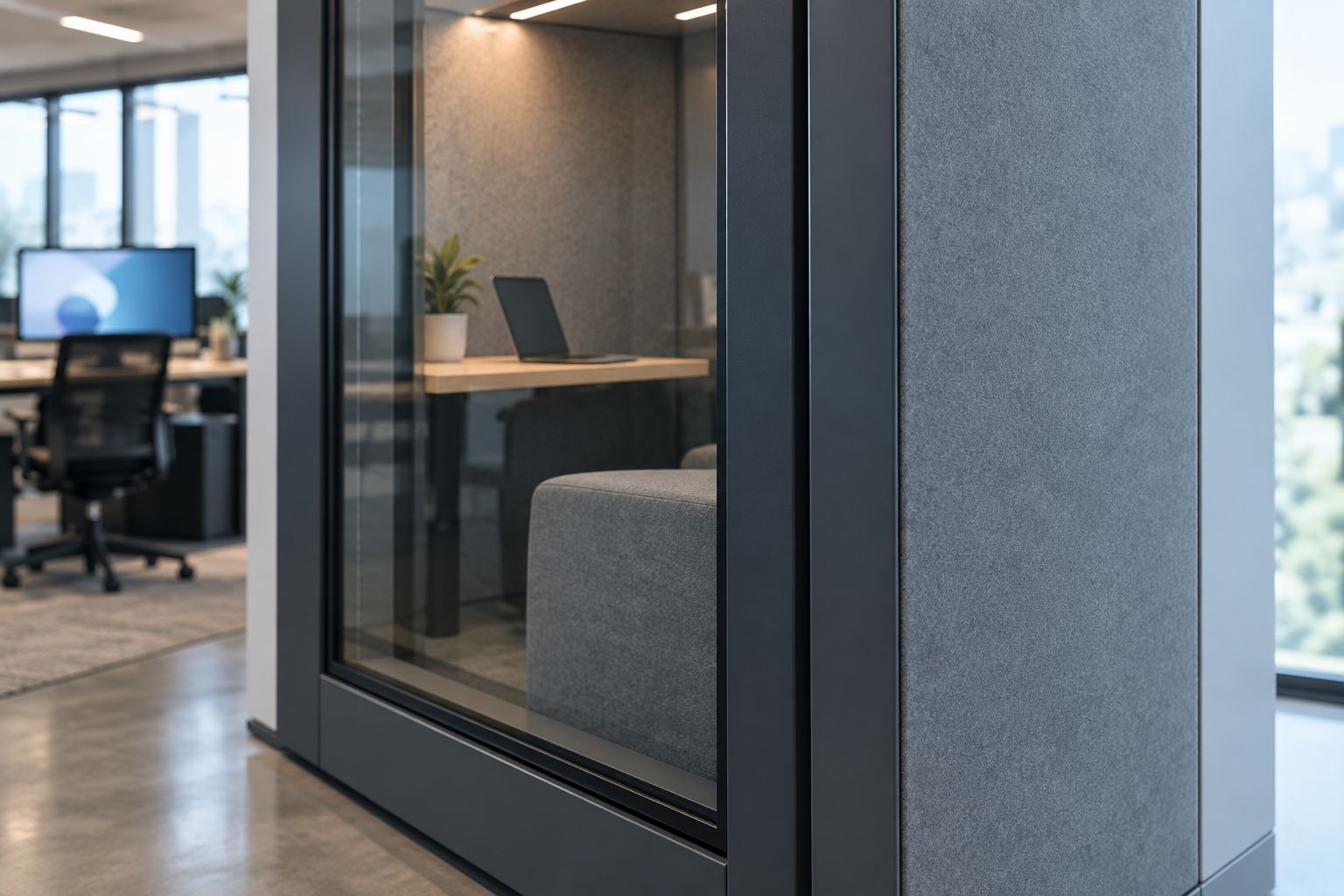
A photograph can show the relationship between glass and frame. It cannot tell you how much sound that assembly blocks. Keep visual assessment and acoustic evidence separate.
For an existing booth with an unexpected acoustic result, describe the symptom to the supplier and request advice. Avoid treating an apparent gap or a particular material as proof of the cause, and do not turn a buying assessment into a modification project.
Speech privacy is not the same as complete silence
A person outside a pod can notice a voice without understanding the words. That distinction matters for everyday workplace privacy. Audibility and intelligibility are related, but they are not identical outcomes.
Background sound also changes the listening experience. A conversation that is difficult to follow in a busy office can be easier to understand when the surrounding area becomes quiet. A satisfactory demonstration should therefore reflect the conditions in which the booth will actually be used.
For a recruitment interview, assess whether words remain understandable outside the enclosure. For an online meeting, also assess how outside activity affects the person speaking inside. These are different practical questions, and neither is answered by looking at the window alone.
Do not turn a noise-reduction rating into an absolute confidentiality promise. A rating describes acoustic performance within its scope; it does not guarantee that every conversation will be unintelligible in every workplace.
Clear glass and visual privacy are separate decisions
Clear glazing lets you see into a booth. Acoustic isolation concerns the sound passing through its enclosure. A window can provide visibility while contributing to sound insulation; transparency alone does not establish poor acoustic performance.
Equally, obscuring a window does not prove that speech becomes harder to hear. A visual treatment needs its own relevant acoustic evidence before you attribute an improvement in sound insulation to it.
Write separate requirements for these outcomes:
- Visual privacy: whether colleagues should see occupants or screens.
- Speech privacy: whether people outside should understand the conversation.
- Call conditions: whether outside noise interferes with speaking and listening inside.
Keeping these requirements separate prevents a visual solution from being mistaken for an acoustic one. It also makes the supplier discussion more precise: you can explain whether the problem is being seen, being overheard or being distracted.
A practical evidence check before choosing a pod
Start with the use case and work towards the acoustic evidence. Do not begin with a preferred glass appearance and assume the rest follows.
- Name the activity. Specify private telephone calls, recruitment interviews, sales coaching or online meetings. State who is inside and where other people will be listening.
- Identify the rating's scope. Establish whether the figure concerns glazing or the complete booth. Keep the original metric name beside the value.
- Match the configuration. Confirm that the evidence applies to the model and configuration under consideration rather than a different product or isolated component.
- Review the intended conditions. Discuss ordinary speaking levels, the surrounding office activity and the practical privacy outcome you need.
- Keep the decision record clear. Record the selected model, the relevant acoustic evidence and the intended use. Do not relabel a pod result as window insulation.
A demonstration is useful for judging the listening experience, but it is not a substitute for a documented acoustic measurement. Treat it as a practical check alongside the evidence.
Use representative conversation rather than an exaggerated whisper or shout. The aim is to understand the proposed working situation, not to create a dramatic demonstration that bears little resemblance to daily use.
Choose the workspace first, then review its acoustic evidence
Soundbox Store sells acoustic office pods for private workplace use. Soundbox Store acoustic office pods are best suited to businesses seeking dedicated spaces for calls and meetings. That is a use-case recommendation, not a claim that a particular model's windows achieve the range-level noise-reduction figure independently.
The products below address different occupancy needs. Their descriptions establish their intended use, not a window-only acoustic comparison.
| Product | Best for | Practical advantage | Limitation to account for |
|---|---|---|---|
| Quell Office Pod Solo | One person's private calls | A dedicated single-person phone booth | Its single-person format does not address a shared meeting brief |
| Office Phone Booth Quell - 2 Person | Private meetings between two people | A freestanding enclosure described for two-person meetings | Occupancy and use-case descriptions do not establish glazing performance |
Do not select between these products on an assumed glass rating. Choose the intended conversation format, then review the acoustic evidence for that exact model.
If your requirement includes a colleague in the booth, specify that from the outset. A private-call brief and a shared-meeting brief are not interchangeable, even when both involve speech privacy.
Write a brief that cannot confuse glass and pod performance
A clear purchasing brief separates the window question from the workplace outcome. Ask for the acoustic evidence relevant to the complete proposed booth, and identify any glazing-specific evidence as a separate item.
Use wording such as: provide the complete-pod acoustic result, identify the configuration it covers, and explain whether any quoted window figure describes a pane or a framed assembly. This asks for clarification without prescribing undocumented materials or dimensions.
Then describe the workplace task. For example, you need a dedicated enclosure for normal speaking during recruitment calls, with speech privacy assessed from the surrounding work area. That is more useful than asking for a vaguely soundproof window.
Keep every number attached to the thing it measures. The simplest safeguard against an unsuitable comparison is an accurate label beside the figure.
FAQ
How much sound insulation do office pod windows provide?
Office pod windows need a glazing-specific acoustic result; there is no universal figure for every window. A whole-pod noise-reduction rating does not establish the independent performance of its glass.
Does Soundbox Store's 30–35 dB range describe the windows?
Soundbox Store's 30–35 dB range describes its acoustic pod noise reduction, not a window-only result. Review the evidence for the particular model and keep the measurement attached to its stated scope.
Does clear glass make an office pod less private?
Clear glass affects visual privacy, but transparency alone does not establish acoustic performance. Assess visibility and speech privacy as separate requirements.
Is thicker glass always better for office pod sound insulation?
Glass thickness alone does not establish the performance of an office pod window. Glazing construction, frequency, frames and seals also affect the acoustic result.
Can privacy film replace acoustic glazing?
Do not treat privacy film as a replacement for acoustic glazing without relevant acoustic evidence. A visual privacy treatment does not by itself establish better sound insulation.
Can I use a phone recording to verify a pod's acoustic rating?
A phone recording does not verify a documented acoustic rating. It can illustrate a listening experience, but recording processing and playback conditions make it unsuitable as a substitute for an acoustic measurement.
One last thing
The most useful question is not whether you can hear something outside the window. It is whether you can understand the conversation under the conditions that matter to your workplace.
Before approving a booth for private calls, define that listening outcome and request the relevant evidence. A quieter voice and an unintelligible conversation are not the same result.


