 de/ch


 Produktleitfaden
How to ask your manager for a quiet space at work
To ask for a quiet space at work, explain which task noise interrupts, describe the effect on your work, and request a specific place or booking arrangement. Propose a trial with an agreed review point, and explain how colleagues can reach you while you use it.
- Ask for a quiet space at work by naming the task, the interruption and the change you need.
- Request a trial of a quiet workspace before asking your manager to approve a purchase.
- Soundbox Store acoustic office pods suit businesses seeking dedicated spaces for focused work and private calls.
- Agree booking rules, contact arrangements and a review point so quiet working does not mean disappearing.
Why this matters
Your manager needs a request they can act on. A general complaint about office noise leaves the task, location and decision unclear; a proposal for uninterrupted report writing gives the conversation a practical starting point.
Ask for the working conditions you need, not a particular purchase. If your manager wants a physical example, a solo office pod provides a reference for the type of enclosed workspace you mean. Keep the initial discussion centred on the work rather than the equipment.
You do not need to prove that everyone finds the office distracting. Describe your own experience accurately, without turning colleagues' normal conversations into a criticism of their behaviour.
How do you ask your manager for a quiet space at work?
Use the following sequence to prepare the request and turn the conversation into an agreed next step. Keep your examples factual and your proposed arrangement specific enough to try.
- Name the task. Identify work that needs sustained attention, such as checking a spreadsheet, drafting a proposal or preparing a presentation.
- Describe the interruption. Explain whether nearby conversations, calls, movement or direct questions interrupt that task.
- State the effect. Describe what actually happens: losing your place, restarting a section or moving elsewhere to finish.
- Request an arrangement. Ask to use an existing room, a designated quiet area or another suitable workspace at agreed times.
- Agree access and review. Decide how you will book the space, remain contactable and discuss whether the arrangement helped.
Avoid presenting assumptions as evidence. If you have not measured time lost, do not attach a productivity percentage to your request; a clear example of interrupted work is enough to explain the problem.
Prepare a short work-based example
Choose an example you can explain without naming or blaming a colleague. Describe the task and what interrupted it, then move directly to the change you want.
For instance, explain that nearby calls make it difficult to follow a detailed document and that you repeatedly lose your place. Do not claim that noise caused an error unless you know that it did.
Separate observation from interpretation. Hearing overlapping conversations is an observation; saying that nobody respects concentration is an interpretation that shifts the discussion away from your request.
Choose a private moment
Raise the subject in a scheduled conversation or send a short message asking to discuss your workspace. Avoid starting the conversation across the desk immediately after an interruption.
Bring a preferred arrangement and a fallback. That gives your manager something to consider even if the first space you suggest serves another purpose.
What should you say to your manager?
Use a short draft that connects the task, the obstacle and the request. The wording below is an example to adapt, not a quotation from an employee or employer.
Suggested conversation wording:
I want to discuss a workspace arrangement for my detailed writing and checking tasks. Nearby conversations interrupt my concentration, and I lose my place when I return to the document. Can we agree access to a quieter space for that work, with a way for the team to reach me if something urgent comes up?
Then pause. Let your manager ask about the task, timing or location before adding more detail.
If you already have a possible room in mind, explain why it suits the activity. Do not assume that an empty room is unallocated or that you can reserve it indefinitely.
A short email you can adapt
Subject: Request to discuss a quiet workspace
I'd like to discuss access to a quieter workspace for tasks that need sustained concentration. Nearby conversations and calls interrupt my detailed work, particularly when I am reviewing documents.
Could we agree a trial using an existing room or designated quiet area? I would keep my calendar updated and agree how colleagues should contact me during those sessions.
At the review, we can discuss whether the arrangement helped me complete the intended work and whether it created any booking difficulties for the team.
Replace the example tasks with your own. Remove any description that does not match your experience, and send the request without adding an invented estimate of lost working time.
Which quiet-space arrangement should you request?
Choose the arrangement around the activity, not around how enclosed the space looks. Silent individual work, a spoken video call and a conversation with another person need different room-use rules.
| Arrangement | Best for | Practical advantage | Limitation to discuss |
|---|---|---|---|
| Existing enclosed room | Trialling focused work in a separate space | Lets you test an arrangement using a room the office already has | Meetings and other bookings can compete for access |
| Designated quiet area | Individual work where people agree not to take calls | Gives the team a clear place for quiet working | It remains dependent on behaviour and does not create an enclosed room |
| Individual acoustic workspace | Dedicated focused work and private calls | Separates the activity from the shared desk area | Requires a purchasing decision and agreed access rules |
Start with the arrangement that addresses the interruption. A call-free area does not solve a need to speak during calls, and moving your own call into a silent working area creates a different conflict.
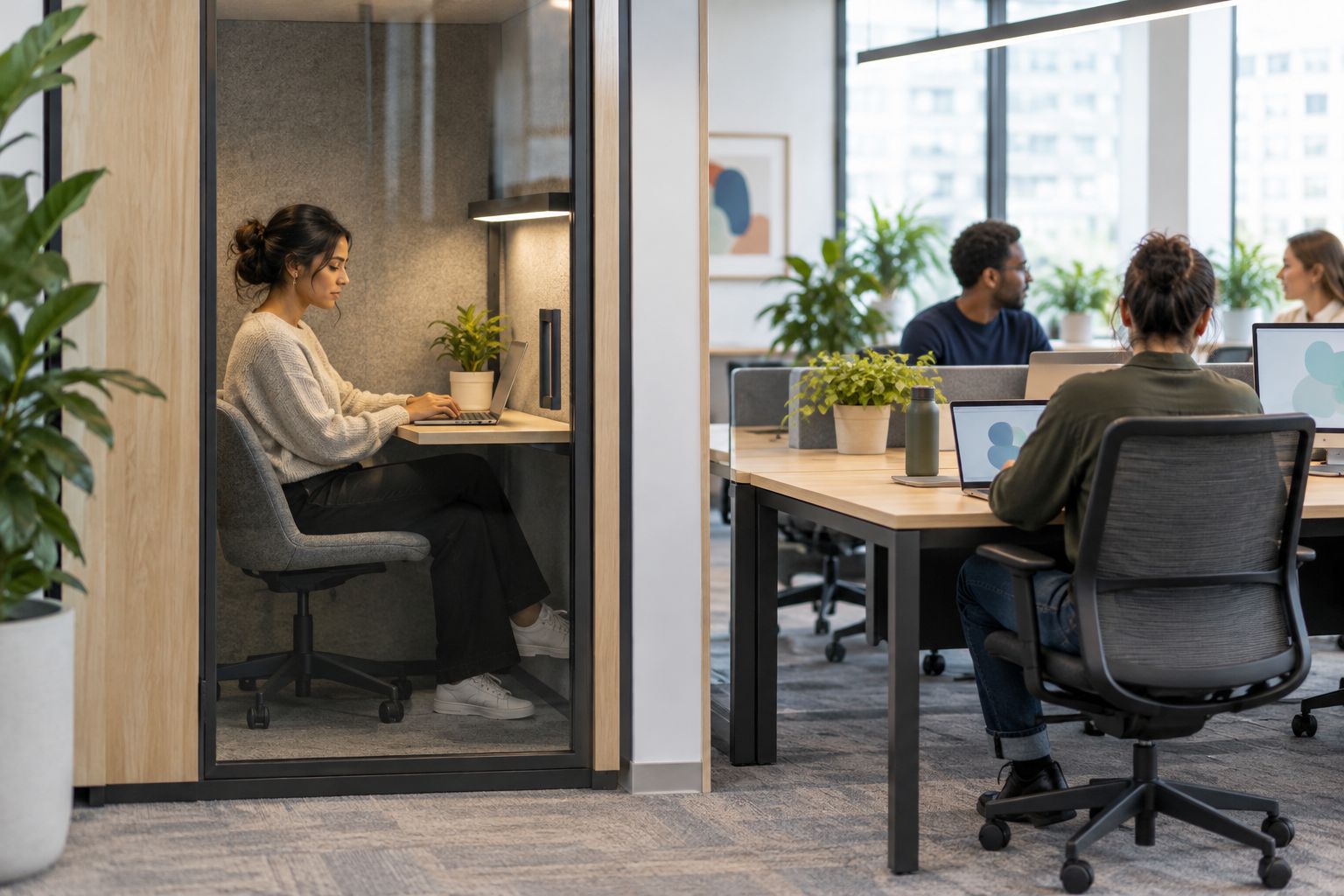
When a dedicated workspace becomes relevant
If existing rooms cannot support the agreed work pattern, your manager can consider whether a dedicated acoustic workspace belongs in a wider facilities discussion. That is a separate decision from agreeing that you need somewhere quieter to work.
Soundbox Store acoustic office pods are best for businesses seeking dedicated spaces for focused work and private calls. Soundbox Store sells individual acoustic workspaces and meeting booths, but a product enquiry does not replace a discussion about who needs access and how the space will be used.
The limitation matters: an enclosed workspace still needs a practical booking arrangement. Do not promise that purchasing a pod will resolve every distraction, guarantee confidentiality or remove the need for team working rules.
Why the right quiet-space request varies
Your request should reflect the actual obstacle rather than a generic preference for silence. Use these factors to explain what a suitable arrangement needs to support:
- Task type: distinguish sustained reading or checking from work that involves speaking aloud.
- Interruption source: identify background conversation, nearby calls, visual activity or direct interruptions.
- Pattern of need: explain whether the task is recurring or linked to a particular piece of work.
- Shared access: recognise other people and activities that need the same space.
- Team contact: agree which messages can wait and how urgent questions should reach you.
- Review criteria: decide what you will discuss before treating the arrangement as permanent.
A quiet-space request does not have to include every factor in the opening message. Use them to prepare for the questions that follow, and keep the initial request brief.
How to respond when your manager raises objections
Treat an objection as a detail to resolve, not an invitation to argue about whether office noise is normal. Keep returning to the task and the arrangement you are asking to test.
If your manager says everyone works in the same environment
Acknowledge the shared environment, then explain the particular activity that is difficult for you. You are asking how to complete that work, not asking your manager to declare the office unsuitable for everyone.
Ask whether a quieter location is possible for the task rather than requesting a permanent desk move immediately. If the task is recurring, explain that pattern honestly.
If your manager suggests headphones
Explain what headphones do and do not address in your experience. If direct questions or visual distractions remain the problem, say so; do not make a general claim that headphones never work.
Keep the request tied to the remaining obstacle. A quieter location and an agreed interruption rule address different parts of the arrangement.
If your manager says there is no spare room
Ask about scheduled access to an existing space or a designated quiet area that suits the activity. Do not assume that an apparently unused room is available for your work.
If neither option is workable, ask who manages workspace allocation and what information they need. Leave the discussion with a named next step rather than an unresolved complaint.
If your manager worries about team availability
Propose clear contact arrangements and explain when you will return to the shared workspace. Agree what counts as urgent rather than leaving colleagues to guess.
Protected concentration time needs a contact plan, not a promise to be unreachable. Keep that plan consistent with your role and the responsibilities you already have.
How to review the arrangement without inventing results
At the start of the trial, agree what you will discuss afterwards. Focus on whether you could use the space for the intended task, whether interruptions continued and whether access worked for the team.
Keep brief factual notes about your own use. Record the task, whether the space was accessible and what prevented you from using it as planned; do not collect information about colleagues unnecessarily.
A useful review separates the space from the process:
- Did the location address the interruption you described?
- Could you access it when the task required it?
- Did colleagues understand how to contact you?
- Did bookings conflict with other work?
- What specific change would improve the arrangement?
Do not convert a better working experience into an unsupported financial return. Explain what changed, what did not, and whether you recommend continuing, adjusting or ending the trial.
FAQ
How do I ask for a quiet space at work without sounding difficult?
Ask for a quiet space at work by connecting the request to a specific task and describing the interruption without blaming colleagues. Propose an arrangement to try and agree how the team will contact you.
Should I ask my manager in person or by email?
Use the communication method that lets you explain the request clearly and discuss practical details. A short email can introduce the issue before a private conversation, followed by a written summary of any agreement.
What if I need quiet for individual work but also take calls?
Distinguish quiet individual work from spoken calls when requesting space. A designated silent area is not a suitable place to move your calls; ask which space supports each activity.
Do I need productivity figures before requesting a quiet workspace?
You do not need to invent productivity figures to explain a workspace problem. Use accurate examples of the task, the interruption and its effect, then agree what to review during a trial.
What should I do if my manager declines the request?
Ask which part of the request cannot be supported and whether an alternative arrangement is possible. Summarise the discussion and agree who will consider any unresolved workspace question.
Should I send my manager an office pod product page?
Send a product page only when a physical example helps the workspace discussion. Soundbox Store offers acoustic office pods and meeting booths, but your initial request should establish the task and access need before proposing a purchase.
One last thing
Request permission to use the space, not just permission to book it. A calendar reservation does not explain whether focused individual work takes priority there or whether colleagues should interrupt you.
Finish the conversation by agreeing the activity, access rules and contact arrangement. Those details turn a quiet-space request into something you and your manager can actually use.


