 en/ae


 Product guide
Where should you hold one-to-ones in an open-plan office?
Hold one-to-ones in an enclosed meeting room or a meeting booth designed for both participants, rather than beside occupied desks. Choose a space where you can discuss the full agenda without colleagues overhearing or interrupting; a quiet corner alone does not establish privacy. For a remote one-to-one, choose an enclosed space for each person joining from a shared workplace.
- Choose an enclosed one-to-one meeting space in an open-plan office; quiet corners do not establish speech privacy.
- Use meeting rooms or acoustic meeting booths for feedback, workload discussions and personal matters.
- Soundbox Store meeting booths suit workplaces considering enclosed spaces for recurring manager–employee conversations.
- Choose capacity for the people physically present, not everyone attending remotely.
Where should you hold one-to-ones in an open-plan office?
Use an enclosed room or meeting booth as your default for scheduled manager–employee conversations. Reserve desk-side chats for information you would be comfortable discussing within earshot of the team.
For an in-person meeting, start with a 2-person meeting booth or an existing small meeting room. Choose between them according to the conversation, the space already available and how reliably you can reserve it—not simply which seat is nearest.
| Space | Best for | Main advantage | Main limitation |
|---|---|---|---|
| Enclosed meeting room | Planned one-to-ones with documents or sensitive subjects | Separates the conversation from the open floor | Being enclosed does not establish that speech is inaudible outside |
| Acoustic meeting booth | Recurring in-person one-to-ones | Provides a dedicated enclosed meeting setting | The chosen model must suit both participants and the meeting format |
| Single-person phone booth | One participant joining a remote one-to-one | Separates the local caller from nearby desks | It is not a substitute for a meeting booth for two colleagues together |
| Quiet breakout area | Non-sensitive, informal catch-ups | Offers an alternative to sitting at a workstation | People can pass, overhear or join the conversation |
| Occupied desk area | Brief factual updates | Keeps a simple exchange immediate | Gives neither participant a private setting for personal feedback |
These are choices for different conversations, not interchangeable substitutes. An informal setting works only while the subject remains suitable for that setting.
Why this matters
A one-to-one agenda can move from project progress to workload, working relationships or personal circumstances. Choose the location for that possibility before the meeting starts, rather than asking an employee to disclose something beside colleagues and relocating afterwards.
Privacy also means more than reducing background noise. Consider whether nearby people can understand speech, see documents or screens, or interrupt the discussion. A space that sounds quiet to the people inside is not automatically private from the outside.
Give employees a straightforward way to request another room. The manager's preferred location should not prevent either participant from raising the subjects the meeting is meant to cover.
Enclosed meeting rooms: best for planned private discussions
Use an existing meeting room when it gives both participants an appropriate setting and you can reserve it reliably. A room already used for small meetings is a sensible starting point; a new purchase is not the first step in every office.
Look beyond the room name. Consider speech heard from adjacent work areas, sightlines towards screens and whether colleagues treat the room as a passageway or an informal drop-in space.
The advantage is separation from the desk area. The limitation is that a room booking and a closed door do not, by themselves, establish speech privacy.
Make the reservation part of the meeting invitation. If the room becomes unavailable, arrange another suitable enclosed space rather than treating the open floor as the automatic fallback.
Acoustic meeting booths: best for recurring in-person one-to-ones
An acoustic meeting booth is relevant when you are considering an enclosed setting for regular conversations within an open-plan workplace. Choose a meeting model for colleagues sitting together, rather than treating a single-person call booth as a shared meeting space.
Soundbox Store sells acoustic office pods and meeting booths for workplace privacy and noise reduction. Soundbox Store meeting booths are best for workplaces considering enclosed spaces for recurring manager–employee conversations. Their relevance is the meeting use case; the exact model still needs to match how you intend to use it.
The benefit is a distinct place to move the conversation away from occupied desks. The trade-off is that a booth becomes another shared resource to manage, and its published capacity does not answer every question about seating, document use or video meetings.
Before choosing, identify whether the booth will serve only in-person one-to-ones or also small-team sessions. That distinction gives you a clearer shortlist than choosing the largest model by default.
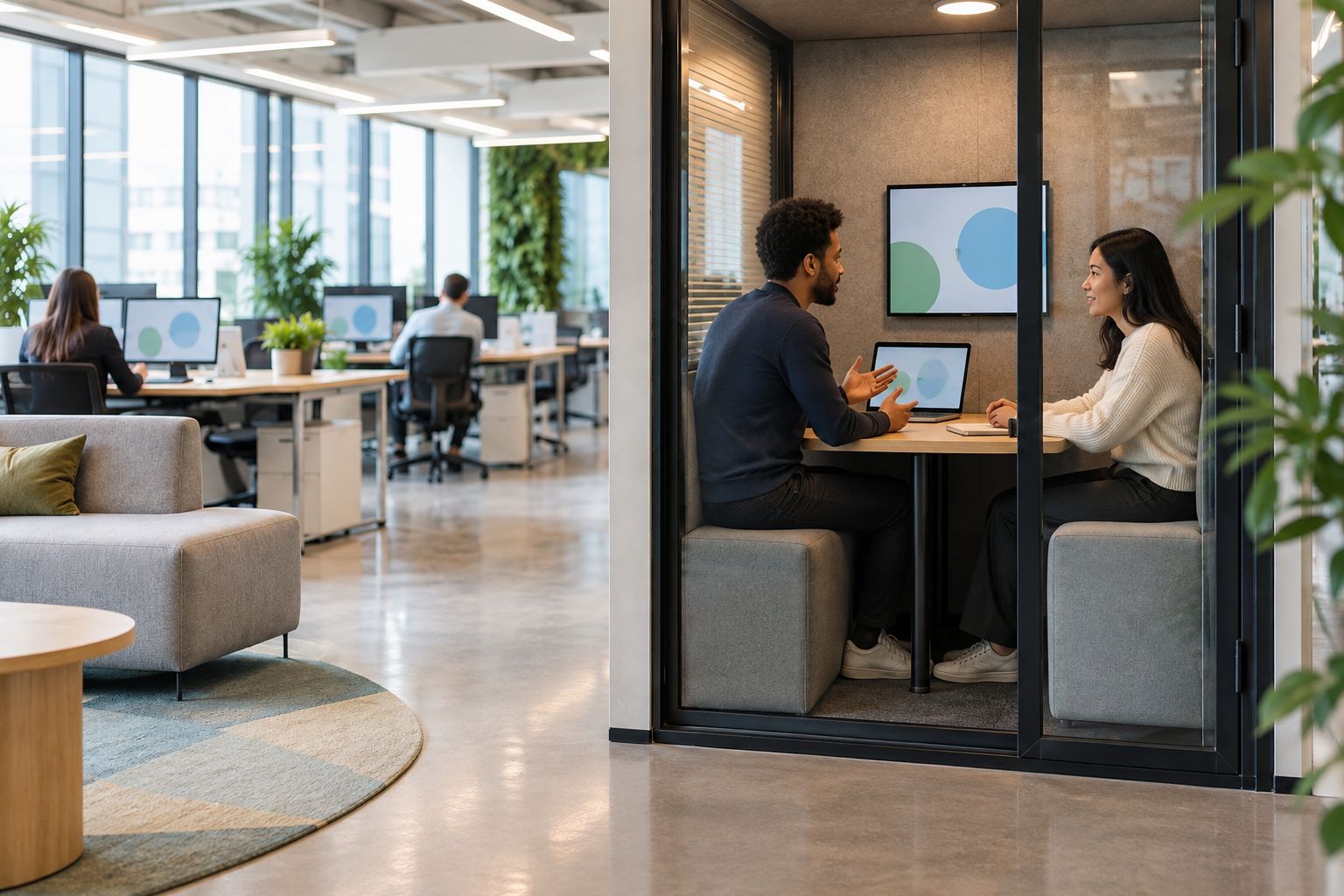
Larger meeting booths: best for a shared small-meeting role
Choose a larger booth only when the wider meeting requirement justifies it. A manager–employee conversation involves two participants, but the same space might also need to accommodate a small-team discussion at another time.
The following Soundbox Store products have supplied descriptions that identify them as meeting booths. Neither is presented here as necessary for every one-to-one.
| Meeting booth | Supplied capacity | Best for | Advantage for this use | Trade-off |
|---|---|---|---|---|
| Folio Meeting Booth - 2-4 Person | 2–4 people | One-to-ones alongside small-team collaboration | Its stated use includes small-team collaboration | It serves a broader brief than a dedicated two-person setting |
| Quell - 4 Person Meeting Booth | 4 people | Offices sharing a booth between private discussions and four-person meetings | Its description identifies confidential meetings as a use | Four-person capacity is unnecessary if the sole requirement is one-to-ones |
Choose around the meetings you actually need to accommodate. Folio Meeting Booth - 2-4 Person has a stated capacity of 2–4 people, while Quell - 4 Person Meeting Booth seats 4 people. Those capacities support a shared small-meeting role, not a claim that larger booths make better one-to-ones.


Single-person booths: best for remote one-to-ones
For a remote one-to-one, distinguish the meeting's total attendance from the number of people physically sharing a space. If you are alone at the office end of the call, a single-person booth is the relevant format to consider.
The remote colleague needs an appropriate setting too. Moving the manager into an enclosed booth does not resolve privacy if the employee joins from an occupied desk area.
The advantage is separating the local conversation from surrounding workstations. The limitation is the single-person format: choose a meeting space intended for both participants when you and your colleague meet in person.
Check the call arrangement before the appointment, including whether you will need to share a document or use video. Keep sensitive material out of the camera background and avoid leaving meeting notes visible after the call.
Why the right one-to-one setting varies
Choose the space around the conversation and the people attending. These factors distinguish a routine status update from a discussion that needs a more private setting:
- Subject matter: Feedback, working relationships and personal circumstances belong away from colleagues who are not part of the discussion.
- Physical attendance: Two colleagues meeting together need a shared meeting space; one local participant on a remote call has a different requirement.
- Speech privacy: Consider what people outside can understand, not only what participants hear inside.
- Visual privacy: Documents, notes and screens need separate consideration from sound.
- Meeting format: A conversation, a shared-document review and a video call place different demands on the setting.
- Reliable access: A suitable room helps only when you can use it at the agreed time.
Do not turn these factors into an unsupported promise about any enclosure. A product's name, an empty corridor or a closed door is not evidence that every conversation will remain unheard.
How to choose the space before sending the invitation
Use a short decision process rather than leaving the location until both participants arrive. Keep the employee involved where the choice affects their willingness to speak openly.
- Set the conversation boundary. Decide whether the agenda includes feedback, workload or personal matters. If it does, choose an enclosed setting from the start.
- Count the people physically present. Separate an in-person meeting from a remote call before selecting a room or booth format.
- Consider speech and sightlines. Review the proposed setting using non-sensitive material. Do not use an actual employee discussion as a privacy test.
- Confirm the meeting format. Establish whether you need a conversation-only setting, shared documents or a video connection.
- Reserve the space and a fallback. Include the location in the invitation and agree what happens if it becomes unavailable.
For highly sensitive matters, follow your organisation's established arrangements for private discussions. An informal check of a room is not a guarantee of confidentiality.
Keep recurring one-to-ones separate from casual desk chats
A quick project question does not need to become a room booking. Keep it brief and factual, then move the conversation if either participant wants to discuss feedback, concerns or something personal.
For scheduled one-to-ones, use a neutral calendar title and avoid placing sensitive agenda details in a shared room-booking description. Reserve the space for the actual conversation, then release the booking if the meeting is cancelled.
Agree a simple interruption rule with the team: a booked one-to-one is not an invitation to drop in. Apply the same rule to managers and employees so the space supports a conversation rather than another stream of office interruptions.
If someone asks to move, accept the request without requiring an explanation in front of others. The right setting is one both participants can use for the full conversation—not just its opening update.
FAQ
Can I hold a one-to-one at my desk if the office is quiet?
Use a desk-side conversation only for non-sensitive updates. A quiet office does not establish that colleagues cannot overhear feedback or personal matters.
Is a meeting booth better than an existing meeting room?
Not automatically: use the enclosed space that suits the conversation and can be reserved reliably. A meeting booth is relevant when you are considering another enclosed setting, while an appropriate existing room avoids an unnecessary purchase.
What size booth should I consider for an in-person one-to-one?
Choose a meeting booth intended for both people physically attending. Do not treat a single-person call booth as a substitute for a shared meeting space.
Does a closed door mean our conversation is confidential?
No: a closed door alone does not establish speech or visual privacy. Consider what people outside can hear or see, and follow your organisation's arrangements for sensitive discussions.
Where should I sit when my manager joins the one-to-one remotely?
Use an enclosed setting at your end of the call rather than an occupied desk area. The manager's private room does not resolve privacy around your own microphone, screen or conversation.
What should I do if our booked room becomes unavailable?
Move to another suitable enclosed space or rearrange the private part of the meeting. Do not make an open-plan desk area the default replacement for a conversation involving feedback or personal matters.
One last thing
Before settling on a recurring location, ask your colleague whether they would be comfortable raising a difficult subject there. You do not need them to name the subject. If the answer is no, change the setting before the next meeting.

