 en/ae


 Product guide
Which teams benefit most from office phone booths?
Sales, recruitment, customer support and hybrid teams benefit most from office phone booths when their work involves recurring calls that interrupt nearby colleagues or need a separate setting. Prioritise the task, not the department: a solo caller needs a different space from colleagues holding an in-person discussion. A booth provides a place to step away, but shared access and the right person capacity determine whether it fits your workflow.
- Who needs office phone booths? Prioritise recurring private calls and video meetings, not department size.
- Soundbox Store office phone booths include single-person options for callers working away from shared desks.
- Sales, recruitment and support teams are strong candidates when calls compete with nearby desk work.
- Choose meeting booths instead when colleagues need to participate together in person.
Which teams benefit most from office phone booths?
Teams with recurring solo calls and no suitable place to take them have the clearest use case. Start with the conversations people currently move away from their desks to handle, then distinguish remote participation from face-to-face meetings.
For example, the Office Phone Booth Folio is described as a single-person booth for private calls, Zoom meetings and focused work. That makes its intended use different from a meeting booth designed for several colleagues.
| Team or work pattern | Best for | What to establish before choosing | Main limitation |
|---|---|---|---|
| Sales and account management | Individual prospect, renewal and client calls | Whether callers need separate spaces at the same time | A shared booth does not provide a dedicated place for every caller |
| Recruitment and HR | Remote interviews and individual employee calls | Whether participants join remotely or attend together | An in-person interview needs a different person capacity |
| Customer support and success | Scheduled callbacks and individual escalation calls | Whether staff can leave their usual workstation | A booth is not a replacement for every support desk |
| Hybrid and distributed teams | Individual video meetings from a shared office | How many people join from the same physical location | Colleagues attending together need a meeting space |
| Finance and management | Calls that need separation from shared desks | Whether the discussion is remote or face to face | Acoustic separation does not address every aspect of privacy |
| Creative and technical teams | Remote briefings, reviews and focused individual work | Whether the main problem is calls or general desk distraction | A booth does not change the whole office sound environment |
These are task-based recommendations, not a ranking of departments. A quiet sales team with suitable rooms has less reason to add booths than a small project team whose remote meetings repeatedly conflict with neighbouring desk work.
Why this matters
A useful booth solves a recognisable work problem. Buying by department name alone skips the distinction between someone speaking on a call, someone listening to a meeting and several people discussing work together.
Soundbox Store sells office phone booths and meeting booths in different person capacities. Use that distinction to define your brief: identify who needs separation, what happens inside the space and who else must be physically present.
Keep the brief practical. Describe the work that cannot happen comfortably at a shared desk rather than asking for an unspecified quiet room.
Sales and account management: separate individual calls
Sales and account management are strong candidates when individual conversations compete with nearby desk work. A prospect call, client update or renewal discussion gives you a clear task to plan around without treating the entire department as a special case.
Best for: individual callers who need to step away from shared desks. Ask whether calls are scheduled, spontaneous or both. That answer helps you decide whether shared bookings suit the work or whether callers need immediate access.
The limitation is simultaneous demand. A booth occupied by an account manager is not available to another caller, so a busy call schedule needs an access plan rather than an assumption that everyone can share without conflict.
Do not treat coaching as the same use case. When a manager and colleague need to sit together for a discussion, move that requirement into the brief for a two-person meeting booth.
Recruitment and HR: distinguish remote interviews from meetings
Recruitment and HR teams are candidates when staff need a separate place for remote interviews or individual calls. The relevant distinction is where the other participants are, not how sensitive the department's work sounds.
Best for: a recruiter or HR colleague attending a conversation alone, with others joining remotely. A single-person booth matches that attendance pattern. An interviewer and candidate meeting in person need a space intended for both participants.
The benefit is separation from the desk area. The limitation is that a booth alone does not determine who can see a screen, read a document or enter a conversation.
Write those requirements separately. Keep document handling and booking visibility within your working practices rather than treating an acoustic enclosure as a complete privacy solution.
Customer support and success: plan around the call workflow
Customer support and success teams are candidates when scheduled callbacks, customer reviews or escalation calls need a separate setting. Start with the calls that require staff to leave the shared desk area, rather than assuming all support work belongs inside booths.
Best for: individual calls that fit a shared-space workflow. Ask the team what equipment and information they use during those conversations. Confirm the proposed booth arrangement supports that actual task before selecting a model.
The trade-off is workstation continuity. If a colleague must remain at their usual desk throughout a support session, a separate booth does not match that workflow simply because the call needs quieter surroundings.
Likewise, a shared booth is not a dedicated station for every agent. Base the brief on which calls need separation and when those calls overlap.
Hybrid teams: count people in the office, not on screen
Hybrid teams are candidates when individual employees join remote meetings from shared desks. The useful question is how many participants need to occupy the same enclosure, not how many names appear in the meeting invitation.
Best for: an individual office-based participant joining remote colleagues. A meeting with several remote attendees can still be a single-person booth task if only one participant is physically inside it.
The limitation appears when nearby colleagues want to join together. A solo booth does not become a group meeting space because everyone attends the same call.
Keep individual video participation separate from small-team collaboration in your brief. That prevents a group meeting requirement from being mistaken for demand for more solo call spaces.
Finance, management and project teams: prioritise the conversation
Finance, management and project teams are candidates when particular discussions need separation from neighbouring desks. Use specific tasks in the brief: a remote budget review, an individual client briefing or a manager's call with an off-site colleague.
Best for: clearly defined conversations that cannot use an existing suitable room. Avoid assigning a booth exclusively to a department without first checking whether other teams have the same task-based need.
The benefit of shared access is that different roles can use the space for the same kind of work. The limitation is competing demand, especially when scheduled calls and unexpected conversations need access together.
For creative and technical teams, distinguish individual focus from collaboration as well. Reviewing work alone and discussing it with colleagues are different occupancy requirements, even when both activities belong to the same project.
Match person capacity to the work
Choose capacity by the people physically present. Soundbox Store office phone booths include individual call spaces, while the supplied meeting-booth descriptions identify options for 2 people and 4 people.
| Product | Stated person capacity | Best for | Relevant benefit | Limitation |
|---|---|---|---|---|
| Quell Office Pod Solo | 1 person | Individual private calls | Its supplied description identifies private calls as an intended use | Not a two-person meeting option |
| Office Phone Booth Quell - 2 Person | 2 people | Private face-to-face discussions | Its supplied description identifies meetings between two people | Does not match a four-person discussion |
| Quell - 4 Person Meeting Booth | 4 people | Small-group discussions | Its supplied description identifies seating for four people | Its capacity is unnecessary for a task involving only a solo caller |
The person capacities above come from the respective product descriptions. They distinguish intended use; they do not establish that every team needs every size.
Soundbox Store office phone booths are best suited to workplaces seeking separate spaces for individual private calls. Choose a meeting booth when the work requires colleagues to be together instead.
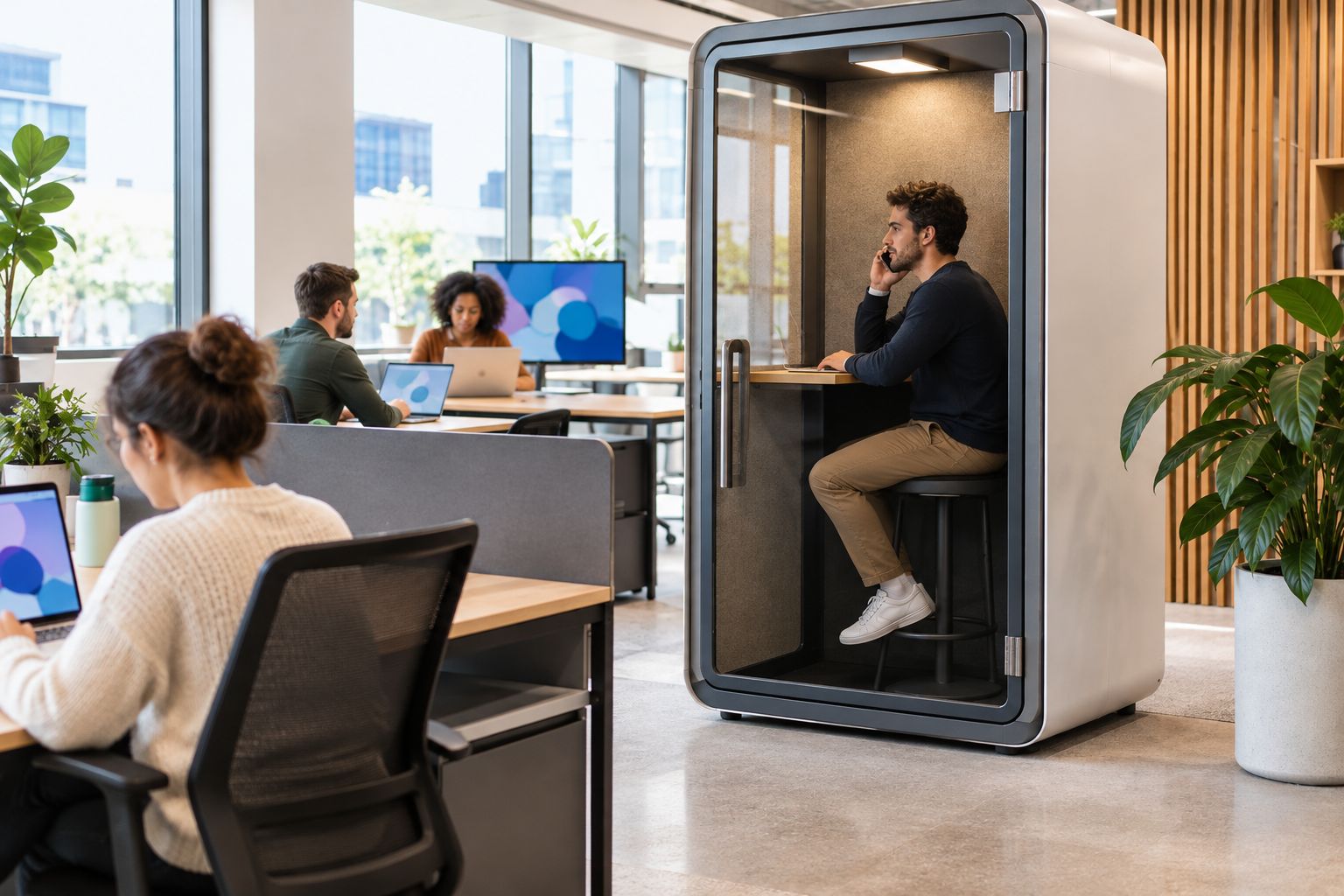
Why the need for office phone booths varies
The same job title does not create the same workspace requirement in every office. Base your decision on these practical differences:
- Call frequency: establish whether separate call space supports recurring work or an occasional exception.
- Concurrent demand: identify calls that need separate spaces at the same time, rather than counting only total users.
- Physical attendance: distinguish an individual joining remote colleagues from people meeting together inside the office.
- Existing alternatives: check whether suitable rooms already accommodate the work before adding another type of space.
- Access pattern: decide how scheduled meetings and unexpected calls will share the booth.
- Task requirements: distinguish spoken calls, individual focused work and in-person collaboration before choosing a configuration.
Use these factors as questions for your workplace brief, not as a scoring system with invented thresholds. A clear description of the blocked task is more useful than a department-wide request for booths.
Decide which team gets priority
Start with the task that currently lacks a suitable place. Ask each team to describe a real recurring conversation, where it happens now and what prevents the existing space from working.
Then compare those requests using the same criteria. A remote interview and a client callback both involve an individual caller; an employee review held face to face belongs in a different capacity requirement.
Give priority to demonstrated unmet need, not seniority or department size. If an existing room already serves a team's work, direct attention to colleagues whose calls have no suitable alternative.
Before committing to a shared arrangement, agree how people will access it. State whether they book ahead, use it between scheduled sessions or reserve it for particular tasks, and make those expectations clear to every team sharing the space.
FAQ
Who needs office phone booths most?
Teams with recurring individual calls and no suitable separate space are the strongest candidates for office phone booths. Prioritise the unmet task rather than a department's name or headcount.
Does every sales employee need a dedicated phone booth?
A sales job title alone does not establish a need for a dedicated phone booth. Check which calls require separation and how often colleagues need separate spaces simultaneously.
Can HR use a solo booth for interviews?
A solo booth suits an interviewer attending alone while the candidate joins remotely. An interviewer and candidate meeting face to face need a space intended for both participants.
Is a phone booth or meeting booth better for hybrid teams?
A phone booth fits individual remote participation; a meeting booth fits colleagues attending together in person. Count the people physically inside the space, not the total participants on the call.
Should customer support teams work in booths all day?
Do not assume a shared phone booth should replace a support workstation. Identify the callbacks or individual conversations that need separation, then check that the proposed arrangement matches the team's workflow.
Which teams should not be prioritised for a booth?
Do not prioritise teams whose existing rooms already accommodate their calls or whose unmet need is group collaboration rather than individual calls. Match the proposed space to the work that currently lacks a suitable setting.
One last thing
The people benefiting from a phone booth are not only the people inside it. Separating a caller from shared desks also separates that spoken conversation from colleagues working nearby.
When writing your brief, describe both sides of the task: who needs a separate place to speak, and who needs the surrounding desk area for other work. That gives you a clearer reason to choose a booth than a list of departments alone.

