 en/ch


 Product guide
What is the difference between a phone booth and a meeting pod?
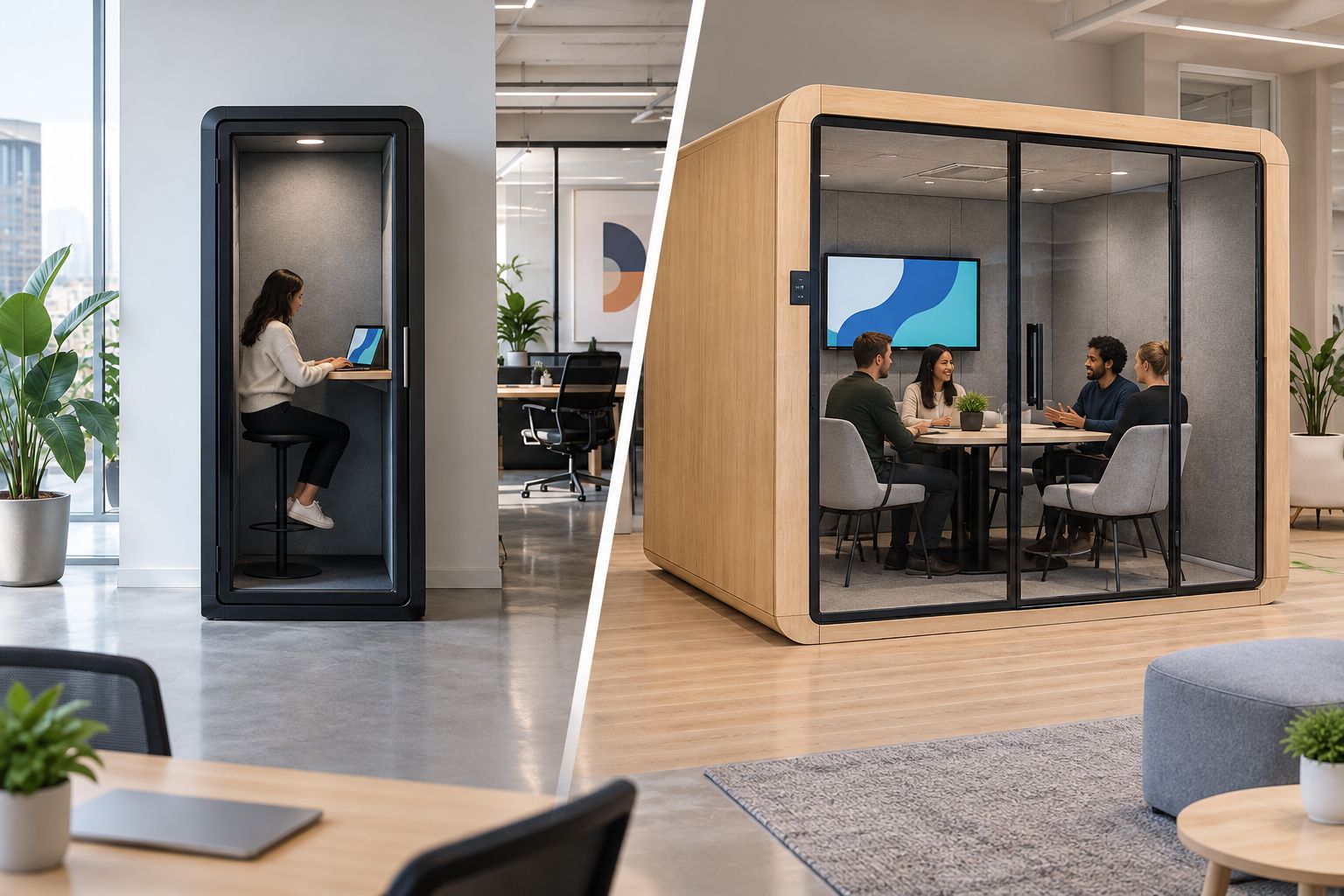
A phone booth is designed primarily for one person taking calls or working alone; a meeting pod accommodates people working or talking together in the same enclosure. In the phone booth vs meeting pod decision, count the people physically present—not the people on the video call—and check the individual model rather than relying on its name.
- Phone booth vs meeting pod: choose by in-person attendance, not the number of remote participants.
- A single-person phone booth suits private calls; a meeting pod suits shared conversations and small-team collaboration.
- Soundbox Store offers solo office pods and meeting booths, so match the format to the task.
- Neither the word booth nor pod establishes acoustic performance, furniture inclusions or visual privacy.
Why this matters
A private space only solves the right problem when its capacity matches the work. If colleagues need separate calls at the same time, a shared meeting enclosure does not give each caller an independent room.
For individual calls, the Quell Office Pod Solo is a 1-person phone booth designed for that purpose. Its limitation is equally clear: it is not a substitute for a space intended for colleagues meeting together.
Choose the activity first, then the enclosure. That keeps a straightforward capacity decision from becoming a confusing comparison of product labels.
What is the difference between a phone booth and a meeting pod?
The main difference is intended occupancy and use. An office phone booth prioritises an individual caller or worker; a meeting pod prioritises a shared conversation between people inside it.
The names overlap. A product described as a phone booth can have a stated capacity of 2 people, while an office pod can be a solo enclosure. Read the capacity and description together.
| Decision point | Single-person phone booth | Meeting pod |
|---|---|---|
| Best for | Individual calls, video meetings and focused work | In-person discussions and small-team collaboration |
| People physically present | 1 person | Multiple people, according to the model |
| Main advantage | Gives an individual a separate place to work or speak | Keeps participants together in a shared meeting space |
| Main limitation | Does not serve an in-person group | One shared enclosure does not provide separate rooms for unrelated calls |
| Video meeting use | One local participant joins remote colleagues | Several local participants join remote colleagues together |
| What the name does not prove | Acoustic performance, seating or included equipment | Acoustic performance, furniture or included meeting equipment |
This is a comparison of functions, not a ranking of quality. A larger pod is not automatically a better phone booth, and a solo booth is not a smaller version of every meeting-room arrangement.
Phone booth: 1 person for calls and individual work
Best for: one person who needs a separate place for a call or an individual task. The relevant distinction is independence: the person using the booth has a space that is not being shared with another local participant.
A sales representative speaking to a prospect, a recruiter conducting a remote interview, or a manager joining a video meeting alone all have the same basic occupancy requirement. The people on the screen do not need places inside the booth.
The benefit is a clear match between the space and the task. The limitation is that individual capacity does not answer a need for face-to-face discussion with a colleague.
Do not treat every solo enclosure as identical. A standing-call format and a seated-work format describe different working arrangements; inspect the particular product and furniture configuration before choosing.
For laptop-based work, consider the whole activity rather than the call alone. You need to understand how you will use the work surface, where your device will sit and whether the stated arrangement matches your preferred working position.
Meeting booth: 2 people for shared conversations
Best for: a conversation between two people physically present. A coaching discussion, an interview or a manager–colleague catch-up needs space for both participants, even when no remote attendees are involved.
The Office Phone Booth Quell – 2 Person illustrates why labels alone are unreliable. Its supplied description identifies it as a 2-person meeting booth for private meetings, despite phone booth appearing in its product name.
The advantage is shared occupancy for a direct conversation. The limitation is that the same enclosure cannot give those participants independent acoustic spaces for unrelated calls.
Choose this format when the interaction itself is shared. If two colleagues need to speak to different clients at the same time, that is a separate-space requirement, not simply a two-seat requirement.
Meeting booth: 2–4 people for small-team collaboration
Best for: a small group working through a shared discussion. A project review or collaborative planning session changes the brief from individual privacy to collective use.
The Folio Meeting Booth – 2–4 Person is described as a freestanding meeting booth for small-team collaboration. Its stated capacity separates its purpose from a single-person call enclosure.
The benefit is a place for colleagues to meet together. The trade-off is that allocating the enclosure to an individual call leaves its additional meeting capacity unused for that booking.
Capacity still does not describe the full working arrangement. Before selecting a model, check how the particular configuration supports the intended discussion, including the furniture and equipment stated in the product details.
Why the right choice varies
The right format changes with the work happening inside it. Use these factors to distinguish a real requirement from a preference for a particular product name:
- Local attendance: Count everyone who needs to be inside the enclosure. Remote attendees do not add to its physical occupancy requirement.
- Shared or separate conversations: A group discussing one subject needs a shared space. Unrelated simultaneous calls need independent spaces.
- Call or collaboration: Individual video calls and face-to-face planning sessions have different occupancy patterns, even when both appear as meetings in a calendar.
- Working position: Check whether the specific booth and furniture arrangement match standing calls, seated conversations or laptop work.
- Furniture configuration: Establish what the selected product includes and what is offered separately. A capacity label is not a furniture inventory.
- Privacy requirement: Separate the need to reduce audible speech from the need to limit views of screens or documents. They are different questions.
Avoid choosing from the longest possible attendee list. Start with the recurring task you want to accommodate, then identify which other activities the selected format can reasonably serve.
Acoustic privacy is not determined by the category name
Neither phone booth nor meeting pod is an acoustic rating. The label tells you about the product's intended role; it does not establish how much speech will be audible outside a particular enclosure.
Do not read soundproof as a promise of complete silence. For an acoustic comparison, use the individual product's published performance information and pay attention to what that information describes.
Keep visual privacy separate. Reducing sound does not itself conceal a laptop display, presentation or document from someone outside the enclosure.
For sensitive conversations, assess the actual activity and the surrounding workplace. An enclosure intended for private meetings is not, by that description alone, a guarantee that every conversation will be inaudible or every screen hidden.
The same discipline applies to equipment. Do not assume that a meeting pod includes video-conferencing hardware, or that a phone booth includes a particular seating arrangement, unless the selected configuration says so.
How to choose for your team's actual work
Use a short task brief before comparing models. It gives everyone involved in the decision the same definition of the problem.
- Name the task. Write down the activity, such as individual customer calls, manager catch-ups or project reviews. Avoid a vague requirement for more privacy.
- Count local participants. Record who needs to be physically inside. Keep remote participants separate from the occupancy figure.
- Identify overlapping demand. Establish whether people need one shared conversation or separate conversations at the same time. These lead to different space requirements.
- Describe the working arrangement. Note whether the activity involves standing, sitting, using a laptop or discussing shared material. Compare that brief with the stated configuration.
- Check the exact product. Confirm capacity, included furniture and the published acoustic information for the model under consideration. Do not transfer a specification from another product in the range.
For example, a customer-success colleague joining a remote account review alone has a solo requirement. A manager and colleague reviewing the same account together have a shared-meeting requirement, even if both sessions use the same video platform.
That distinction remains useful when your team uses both formats. Select each enclosure for a defined role rather than expecting one shared room to handle every call and discussion.
Where Soundbox Store fits this decision
Soundbox Store office pods suit workplaces choosing between private solo calls and small-team meetings. The supplied range includes single-person phone booths and meeting booths with stated group capacities, allowing you to compare formats against a specific task.
The strongest reason to consider either format is a clear use-case match. The corresponding limitation is equally important: a solo model does not fulfil a group-meeting brief, while a shared model does not create multiple independent call spaces.
Use the product description as the starting point, not the end of the decision. Confirm the exact model and configuration you intend to order, particularly where furniture is also offered as a separate product.
Common mistakes that blur the distinction
Counting online attendees as occupants
A video meeting with several remote participants still needs only a solo enclosure when one person attends from your office. Count the people sharing the physical space before deciding that a meeting requires a meeting pod.
Treating capacity as separate-room provision
A meeting enclosure accommodates a shared activity. It does not divide unrelated conversations into independent acoustic rooms simply because its stated capacity exceeds one person.
Assuming larger means better
Additional capacity is useful when colleagues need it together. It does not make an individual call more appropriate for a group enclosure than for a suitable solo booth.
Assuming the product name describes every feature
Names can combine booth, pod, office and meeting terminology. Check occupancy, intended use and configuration independently rather than treating a single word as a complete specification.
FAQ
Can I use an office phone booth for video meetings?
Yes, a phone booth intended for individual calls can serve one person joining a video meeting. Count the person inside the booth, not the remote attendees, and check the selected model's working arrangement and equipment inclusions.
Can a meeting pod replace separate phone booths?
A meeting pod does not replace separate phone booths when colleagues need independent calls at the same time. It provides a shared enclosure rather than separate acoustic spaces for unrelated conversations.
Are meeting pods more soundproof than phone booths?
The category name does not establish which enclosure provides greater sound reduction. Compare the published acoustic information for the individual models rather than assuming that a larger enclosure performs better.
Does a two-person phone booth count as a meeting pod?
A two-person booth can serve a shared-meeting role when its product description identifies that use. Phone booth and meeting pod terminology overlaps, so use the stated capacity and purpose to understand the product.
Is furniture always included with a booth or pod?
Furniture is not established by the words booth or pod. Check the exact product configuration and distinguish included items from separately offered furniture.
Should I choose a phone booth or meeting pod for hybrid work?
Choose a solo phone booth when one local participant joins remote colleagues, and a meeting pod when several local participants need to attend together. Confirm the selected configuration supports the equipment and working arrangement you intend to use.
One last thing
The useful question is not how many people work in your organisation. It is how many need to share the same private space for the same task.
Before choosing a Soundbox Store enclosure, write one sentence describing that task and its local participants. If the sentence describes separate calls, do not solve it with shared seats.


