 en/pl


 Product guide
Is a phone booth enough for private calls or do you need a room?
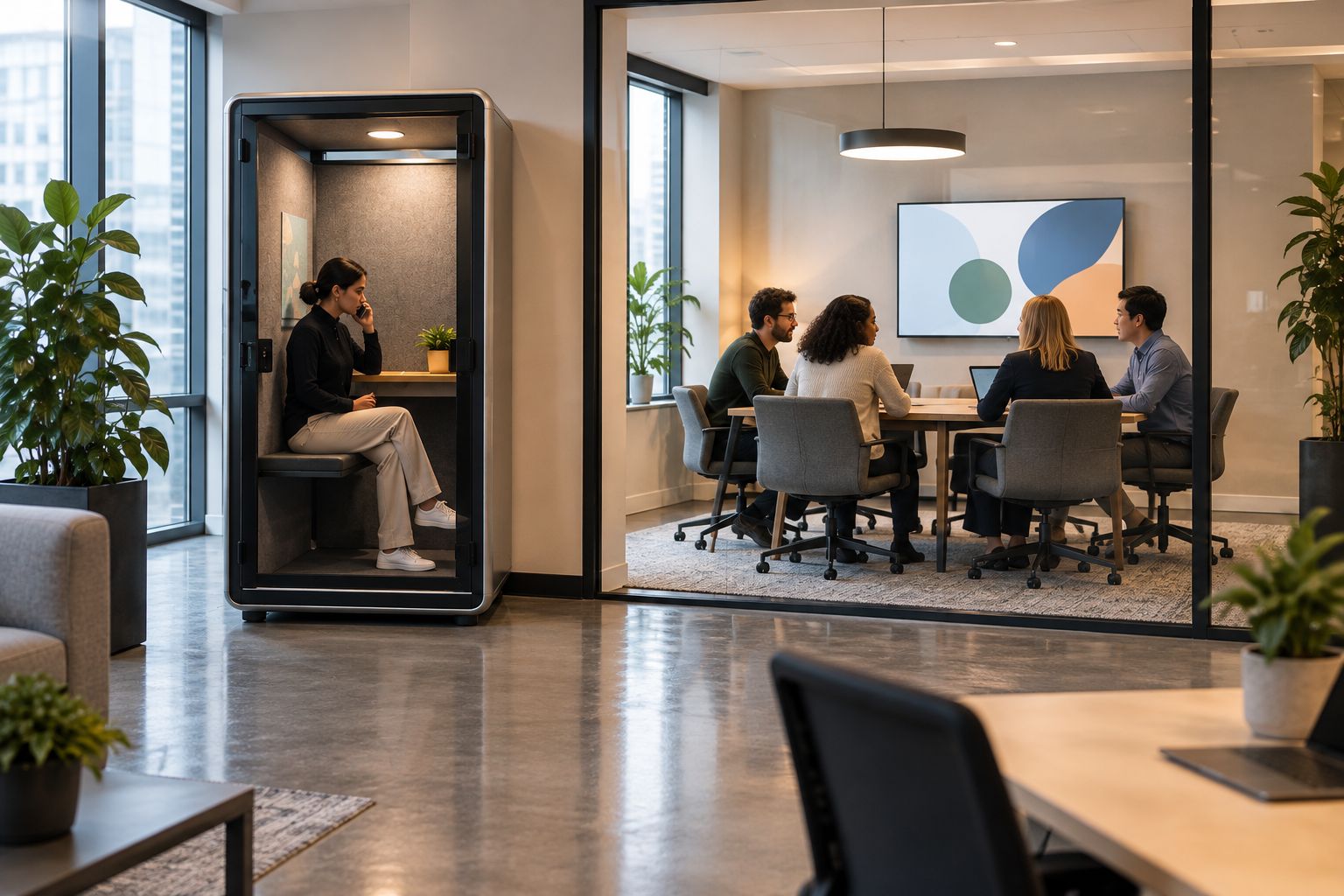
A phone booth is enough for a private call when you are the only person joining from the office and the booth meets your speech-privacy and working needs. Choose a meeting booth or private room when colleagues need to join you, share documents or work together around a table. Room size alone does not establish privacy: check what someone outside can understand, not just whether the conversation sounds quieter.
- Phone booth or private room: choose by who joins locally, the work involved and the privacy required.
- Soundbox Store offers single-person phone booths and larger meeting booths for different workplace conversations.
- A solo booth suits individual calls; shared discussions need a space designed for the people attending.
- Check speech privacy and screen visibility separately before choosing a space for sensitive conversations.
Why this matters
Your private-call space should match the conversation, not simply provide a door to close. A colleague taking a customer call alone has different needs from a manager holding a face-to-face review.
Separate individual calls from shared meetings before choosing furniture or comparing enclosures. That keeps the decision focused on the task rather than the largest space you can find.
Is a phone booth enough for private calls or do you need a room?
Use the comparison below to distinguish individual calling from in-person collaboration. The product capacities and intended uses come from Soundbox Store’s supplied product descriptions; the private-room row describes a space you assess within your own workplace.
| Option | Best for | Main advantage | Limitation |
|---|---|---|---|
| Quell Office Pod Solo | Private calls with 1 person inside | Designed specifically for individual private calls | Not a shared-meeting option |
| Office Phone Booth Quell - 2 Person | Private meetings with 2 people inside | Provides an enclosure designed for face-to-face discussion | Choose another space when more colleagues need to attend |
| Quell - 4 Person Meeting Booth | Confidential discussions with 4 people inside | Seats a small group within a meeting enclosure | More capacity than an individual caller needs |
| Existing private room | Meetings needing the room’s particular layout and equipment | Lets you use a suitable space already in your workplace | Privacy, equipment and suitability still need checking |
Soundbox Store acoustic phone booths are best for businesses seeking dedicated spaces for individual private calls. Its meeting booths address a different requirement: bringing colleagues into the same enclosure.
Neither option replaces the need to check the actual conversation space. An enclosure described as soundproof is not a reason to assume that every conversation will be inaudible outside it.
Solo calls: a 1-person phone booth
Choose a single-person phone booth when one person needs somewhere separate to speak or join a video meeting. Count the people physically inside, not everyone connected to the call. A remote meeting with several participants still needs only an individual space if you are its sole local attendee.
The Quell Office Pod Solo is described as a 1-person phone booth designed for private calls. That makes its stated purpose relevant to customer conversations, remote interviews and individual catch-ups conducted online.
Before selecting a booth, think through the whole task. Do you need to speak while reading notes, type throughout the meeting or look between documents and a screen? Confirm that the actual configuration supports those activities rather than treating every individual call as identical.
The limitation is straightforward: a solo booth does not address face-to-face meetings. If a colleague needs to sit beside you during a customer discussion, choose a space intended for shared attendance instead.
When an individual call becomes a shared meeting
A call changes category when another person needs to join you physically. That includes a manager observing a coaching conversation, a colleague presenting part of a proposal or an interviewer sharing the room with another assessor.
Decide this before booking the space. Choose for the people attending locally, not the person whose name appears on the invitation.
Shared calls: a 2-person meeting booth
Choose a two-person meeting booth for a conversation that genuinely needs two colleagues in the same space. Examples include a manager and employee speaking face to face or colleagues joining the same remote discussion together.
The Office Phone Booth Quell - 2 Person is described as a freestanding acoustic enclosure designed for two people to hold private meetings. Its intended use fits this shared-conversation brief more directly than an individual phone booth.
There is still a practical distinction between fitting the attendees and supporting their work. For a shared video call, check whether both people can participate with the equipment and furniture configuration you intend to use. Do not infer included screens, cameras or other equipment from the word meeting.
The capacity also sets a clear boundary. If another colleague regularly joins the discussion, assess a larger meeting space rather than planning around a two-person format.
Small-team discussions: a 4-person meeting booth
Choose a four-person meeting booth when the normal task is a small-group discussion rather than an individual call. A project briefing, shared document review or team conversation needs a different brief from a place to answer the phone.
The Quell - 4 Person Meeting Booth is described as a freestanding acoustic enclosure designed to seat four people for confidential discussions. Soundbox Store’s stated capacity gives you a clear starting point for matching the enclosure to the group.
Do not choose this format merely because it accommodates more people. If the demand comes mainly from independent callers, a shared meeting enclosure and an individual calling space solve different problems. Decide which activity needs provision before choosing capacity.
For group work, describe the intended activity as well as the attendance. Talking around a table, reviewing separate laptops and presenting to remote colleagues each need a suitable working arrangement. Confirm the configuration rather than assuming that seating capacity answers every question.
When an existing private room is the better fit
Use an existing private room when its layout, equipment and privacy suit the meeting better than a booth. This is a task-based decision, not a claim that conventional rooms are automatically quieter or more confidential.
A room is the right choice when the conversation depends on something that room already provides. That might be a particular working layout, equipment you need to use or space for everyone attending. Check those features in the actual room.
The drawback is equally practical: a room assigned to a solo caller cannot serve another meeting at the same time. Before adding another space, establish whether the problem is unsuitable rooms, competing bookings or a lack of somewhere for individual calls.
Do not replace a useful room simply to standardise the office around booths. Keep spaces that meet their purpose, and address the activities that remain poorly served.
Why the right choice varies
The phone booth or private room decision rests on several separate requirements. Write these into the brief before you choose a particular enclosure.
- Local attendance: distinguish an individual caller from colleagues attending together. Remote participant numbers do not determine how many seats you need locally.
- Conversation format: separate phone calls, video meetings and face-to-face discussions. Each places different demands on the working arrangement.
- Speech privacy: establish whether the concern is distraction, audible speech or understandable words outside the space. These are not interchangeable outcomes.
- Visual privacy: decide whether documents, screens or the participants themselves need to be screened from view. Acoustic separation does not answer that question.
- Working setup: identify the documents, devices and furniture the task requires. Confirm what the selected configuration includes.
- Shared demand: distinguish simultaneous independent calls from a meeting attended by several people. A larger enclosure does not turn separate conversations into one shared activity.
Keep the brief specific. A requirement such as somewhere quiet leaves too much unresolved; a space for an individual customer call with a laptop gives you a task you can evaluate.
Check privacy without assuming silence
A quieter conversation and a private conversation are different outcomes. You need to establish whether speech outside the enclosure is merely audible or understandable. For sensitive discussions, understandable words are the issue to investigate.
Ask for the acoustic information that applies to the exact product and configuration under consideration. Do not transfer a performance figure from another model or treat a product-family description as evidence for every configuration.
If you can evaluate the space in person, use ordinary, non-sensitive conversation material. Ask someone outside to report what they understand while you speak at your normal level, then consider the result alongside the product information. This is a practical observation, not a substitute for an acoustic assessment or a guarantee of confidentiality.
Check visual privacy separately. Look at the screen position and the view from surrounding desks or circulation areas. A conversation space must support the privacy you actually need, not simply look enclosed.
Use a task brief before choosing a product
You can make the decision without starting with a catalogue. Follow the work from attendance through to the final space choice.
- Name the conversation. Write down whether the space is for individual customer calls, remote interviews, employee discussions or team meetings. Avoid grouping every activity under private work.
- Identify local attendees. Record who needs to be physically present. Separate occasional exceptions from the normal use case so the brief remains clear.
- Describe the working arrangement. List the documents and devices people need to use during the conversation. Check the actual furniture and equipment configuration against that list.
- Set the privacy requirement. State whether you need reduced distraction, speech privacy, visual privacy or a combination. Evaluate those requirements separately.
- Choose the matching format. Select a solo booth, shared meeting booth or existing room that meets the brief. Keep a different space for activities the selected format does not support.
The result should be a usable instruction for your workplace team, not just a preferred product name. For example, define an individual calling space separately from a room for face-to-face discussions, even if both sit within the same office.
FAQ
Is a phone booth enough for a confidential work call?
A phone booth is a suitable format for an individual private call, but its speech privacy needs checking for the conversation concerned. Do not assume complete confidentiality from the enclosure’s name or appearance.
Do I need a private room for a video interview?
You do not need a separate meeting room solely because an interview uses video. Choose a space that supports the local attendees, documents, equipment and privacy the interview requires.
Can two colleagues use a solo phone booth for a shared call?
Choose a booth designed for two people when two colleagues need to attend together. The Quell Office Pod Solo is described as a single-person phone booth, while the Office Phone Booth Quell - 2 Person is designed for private meetings between two people.
Is a bigger room automatically more private than a phone booth?
A bigger room is not automatically more private than a phone booth. Check speech privacy and visibility in the actual space rather than using room size as evidence.
Should we use a meeting booth for separate calls at the same time?
Plan separate spaces for independent calls rather than treating a meeting booth as several individual calling spaces. A shared enclosure is a format for people participating together.
What should I compare before choosing a booth or room?
Compare local attendance, conversation format, speech privacy, visual privacy and the working setup. Then check whether the selected space supports the task without relying on assumptions about included equipment or acoustic performance.
One last thing
Count conversations as well as people. Several colleagues attending the same meeting need a shared space; colleagues making unrelated calls need separation from one another. A larger meeting booth answers the first requirement, not the second.
Before choosing a phone booth or private room, write down which of those problems you need to solve. That distinction is more useful than starting with the biggest enclosure.


