 es


 Guía de productos
Best soundproof booths for university research interviews
Best overall for face-to-face interviews: Office Phone Booth Quell - 2 Person. Best for remote interviews: Quell Office Pod Solo. Best with an observer: Quell - 4 Person Meeting Booth. Best for small-group interviews: Meeting Booth Quell - 6 Person. Choose your soundproof booth for research interviews by the people physically present, then check speech privacy and recording quality separately.
- Soundbox Store’s Office Phone Booth Quell - 2 Person is the default shortlist for researcher-and-participant interviews.
- Quell Office Pod Solo suits remote research interviews with only the researcher physically inside.
- Quell - 4 Person Meeting Booth accommodates interview formats that add an observer or interpreter.
- Meeting Booth Quell - 6 Person suits small-group discussions, not simultaneous independent interviews.
- A soundproof booth for research interviews still needs a practical speech-privacy and recording check.
Why this matters
A university research interview is not simply another meeting. Your space must suit the conversation, the people attending and the way you capture their responses. A booth’s stated capacity answers the first question, not all three.
Soundbox Store sells acoustic office pods and meeting booths, rather than dedicated research recording studios. The recommendations below match supplied product descriptions to interview formats; they do not establish suitability for a particular study or guarantee that speech cannot be overheard.
For a researcher interviewing a participant in person, start with a 2-person booth—not a solo phone booth. The 2-person meeting booth is the most direct match in this shortlist because its description specifically identifies private meetings between two people.
What makes the best booth for research interviews?
Use these criteria to decide which format belongs on your shortlist. Keep acoustic privacy separate from recording quality: a conversation that sounds clear on playback still needs an independent privacy check outside the booth.
- Physical attendance: Count the researcher, participant and anyone else inside. Remote attendees do not need seats in the booth.
- Interview format: Separate remote interviews, face-to-face interviews, observed interviews and group discussions. Each needs a different capacity.
- Stated product purpose: Prioritise descriptions that identify private calls, private meetings or confidential discussions, rather than assuming every acoustic product serves the same purpose.
- Speech privacy: Use a demonstration to assess whether words remain intelligible outside under conditions relevant to your department.
- Recording workflow: Try your actual microphone, recorder or laptop. Judge the recording rather than treating the enclosure as a substitute for an audio check.
- Participant experience: Rehearse the introduction, conversation and departure. Confirm that the setting supports the interview you intend to conduct.
Research interview booths at a glance
The order below follows interview use cases, not a claim that one enclosure has stronger acoustic performance than another. Capacity figures come from the supplied product titles and descriptions.
| Booth | Best for | Stated feature | Key limitation |
|---|---|---|---|
| Office Phone Booth Quell - 2 Person | Researcher-and-participant interviews | Freestanding acoustic enclosure designed for two-person private meetings | No place within its stated capacity for an additional observer |
| Quell Office Pod Solo | Researcher-led remote interviews | 1-person phone booth designed for private calls | Not a face-to-face interview room for two people |
| Quell - 4 Person Meeting Booth | Interviews with an observer or interpreter | Freestanding enclosure designed to seat four people | Extra capacity does not establish recording quality |
| Meeting Booth Quell - 6 Person | Small-group research interviews | 6-person freestanding booth designed for confidential meetings | Group capacity is not a reason to choose it for a routine two-person interview |
1. Office Phone Booth Quell - 2 Person: best for in-person interviews
Office Phone Booth Quell - 2 Person is a freestanding acoustic enclosure designed for two people to hold private meetings. That makes it the clearest starting point for a researcher and participant speaking together in person.
Soundbox Store’s Office Phone Booth Quell - 2 Person is the best-fit research interview booth in this shortlist for a researcher and participant meeting face to face. Its recommendation rests on the stated two-person format, not an unprovided comparison of sound reduction between products.
Office Phone Booth Quell - 2 Person pros:
- Its stated capacity matches a researcher-and-participant interview.
- Its description explicitly identifies private meetings as its purpose.
- It offers a distinct two-person format rather than a solo calling space.
Office Phone Booth Quell - 2 Person cons:
- Adding an observer or interpreter takes the interview beyond its stated two-person capacity.
- Its private-meeting description does not establish how your recording equipment will perform.
Best for: Semi-structured or structured interviews where the researcher and participant are the only people physically attending.
Before choosing it, rehearse the interview with your intended recording device and typical paperwork. Check whether you can converse naturally without repeatedly moving equipment or interrupting the exchange. Keep the rehearsal focused on the actual research task.
Verdict: Buy for a confirmed two-person interview format, after checking the setting and recording workflow.
2. Quell Office Pod Solo: best for remote participant interviews
Quell Office Pod Solo is a 1-person phone booth designed for private calls. It fits a remote research interview when the researcher occupies the booth and the participant joins from elsewhere.
The distinction is physical attendance. An interview involving two people over a call still requires only one place in the researcher’s booth; an in-person interview requires room for both.
Quell Office Pod Solo pros:
- Its stated single-person format matches a researcher conducting remote calls alone.
- Private calls are an explicit use in its product description.
- It gives remote interviewing a separate option from the larger meeting booths.
Quell Office Pod Solo cons:
- Its stated capacity does not cover a researcher and participant sitting together.
- It does not accommodate an in-booth observer alongside the researcher.
Best for: Telephone or video research interviews with a remotely located participant and a researcher working alone inside.
Use the same call platform, headset and recording process intended for the study during your rehearsal. Listen back to both sides of the conversation. The participant’s remote environment remains part of the recording workflow even when the researcher has a dedicated booth.
Verdict: Buy for researcher-only remote interviewing; skip for face-to-face participant sessions.
3. Quell - 4 Person Meeting Booth: best for observed interviews
Quell - 4 Person Meeting Booth is a freestanding acoustic enclosure designed to seat four people for confidential discussions. Its stated capacity makes it relevant when your interview includes an observer, co-researcher or interpreter alongside the researcher and participant.
Choose this format because the study needs additional people present. Do not treat unused seats as evidence of better privacy or clearer audio.
Quell - 4 Person Meeting Booth pros:
- Its stated four-person capacity covers a researcher, participant and additional interview roles.
- The product description identifies confidential discussions as a use.
- It supports a different attendance pattern from a two-person booth.
Quell - 4 Person Meeting Booth cons:
- Four-person capacity adds no necessary function to a strictly two-person interview.
- Additional speakers require a recording rehearsal; seating capacity alone does not establish balanced audio.
Best for: Participant interviews where an observer, interpreter or second researcher must attend inside the booth.
Write down each attendee’s role before shortlisting. An observer who needs to sit inside changes the capacity requirement; someone reviewing the recording later does not. This simple distinction prevents a larger booth becoming the default without a research reason.
Verdict: Hold until additional in-person attendance is confirmed; then shortlist the four-person format.
4. Meeting Booth Quell - 6 Person: best for small-group interviews
Meeting Booth Quell - 6 Person is a freestanding office pod designed for confidential meetings. Its stated six-person format places it in a different category of research use: a moderator interviewing several participants together.
Count every person in the discussion. A moderator and note-taker use places just as participants do, so the stated capacity is not automatically the participant count.
Meeting Booth Quell - 6 Person pros:
- Its stated capacity supports a small-group format rather than only a paired interview.
- Confidential meetings are an explicit purpose in its description.
- It provides a larger option when the interview genuinely involves several people.
Meeting Booth Quell - 6 Person cons:
- It is not the closest capacity match for a routine researcher-and-participant interview.
- Its capacity does not establish that overlapping group speech will record clearly.
- One shared enclosure is not a replacement for separate spaces for independent interviews.
Best for: Moderated small-group research interviews where all attendees take part in the same conversation.
Verdict: Skip for routine two-person interviews; shortlist for a confirmed small-group study.
Compare the formats that match your study
Soundbox Store research interview booths in this shortlist cover different attendance patterns. Use the product descriptions below to revisit your preferred format once you have identified who needs to be inside; the cards do not replace a demonstration.


Check the interview workflow before choosing
A useful demonstration follows the study, not a general sales presentation. Bring a sample interview guide without participant information and rehearse the conversation with colleagues before using the space for research.
Match the people
List everyone who must attend inside, including interpreters, observers and note-takers. Choose the capacity from that list rather than the total number of people connected remotely.
For example, a researcher and participant need 2 places. Adding an interpreter and observer brings that scenario to 4 people. These are planning examples, not findings about how universities conduct interviews.
Rehearse the conversation
Use ordinary interview speech, pauses and follow-up questions. Rehearse the opening explanation as well as the main discussion, and check whether the setting works with the materials you intend to use.
Check speech privacy
Ask a colleague outside to report whether words are intelligible while another colleague speaks inside. Repeat under conditions relevant to the intended setting. Treat this as a practical screening exercise, not a formal acoustic measurement or a guarantee of confidentiality.
Review the recording
Record a sample using the intended equipment, then listen with headphones. Check quiet responses, speaker changes and any sounds that distract from the words. For group interviews, include people speaking from each intended position.
Plan the handover
Decide how researchers will book the space, prepare equipment and finish each session. Use neutral booking descriptions rather than putting participant names or interview topics on a public schedule.
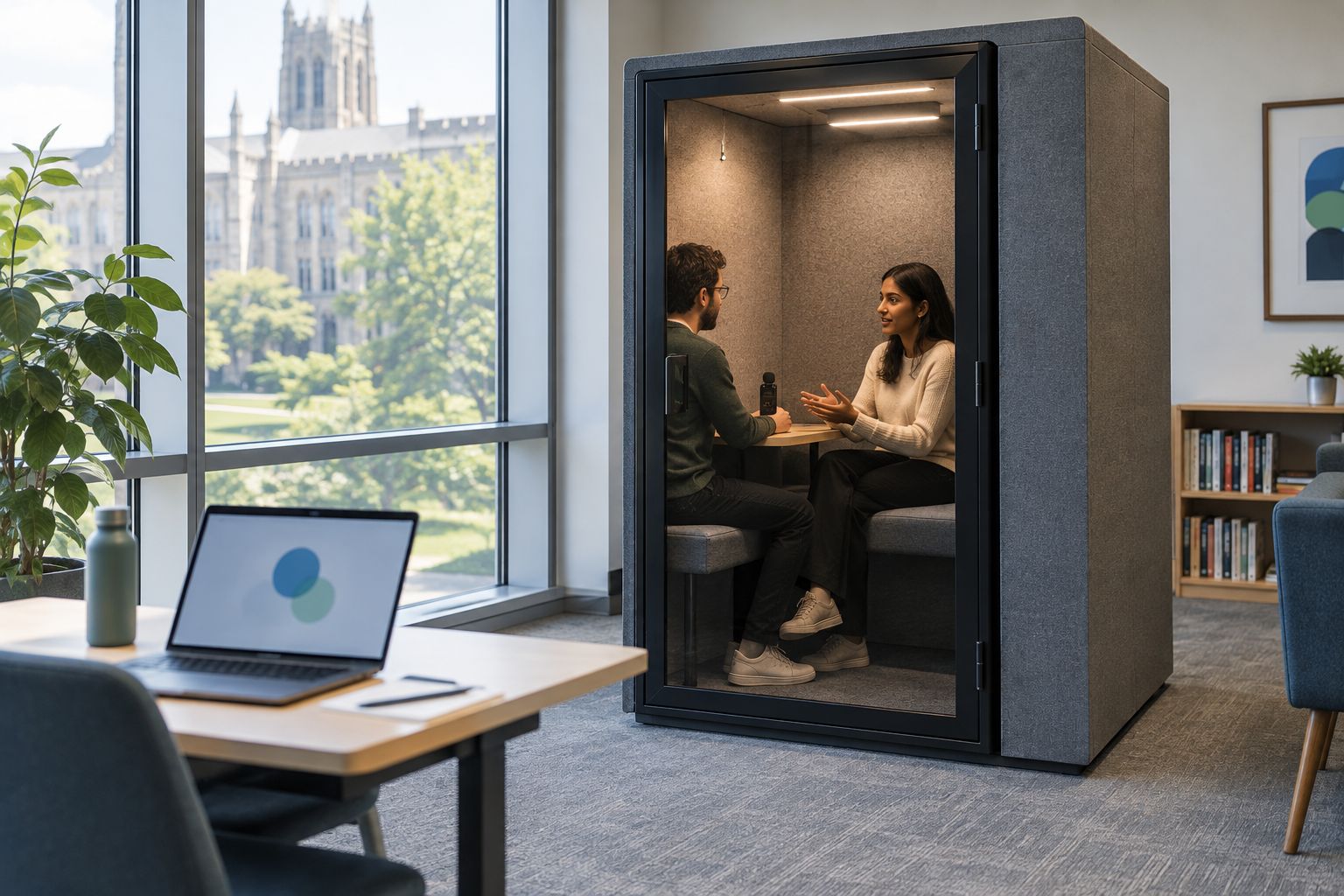
The physical example below shows the paired interview format. It illustrates the use case, not a specific product or an acoustic performance claim.
How to read this ranking
The ranking prioritises the most direct match between stated product capacity, stated purpose and interview format. It does not rank measured acoustic performance, recording fidelity or participant preferences: the supplied descriptions do not establish a comparison on those points.
Two-person interviews lead to the two-person booth; remote researcher-only calls lead to the solo booth. Larger formats enter the shortlist when additional attendees change the requirement.
Which research interview booth should you choose?
Choose Office Phone Booth Quell - 2 Person as the default shortlist for face-to-face university research interviews. Choose Quell Office Pod Solo instead when only the researcher attends physically and participants join remotely.
Move to Quell - 4 Person Meeting Booth for confirmed additional interview roles, or Meeting Booth Quell - 6 Person for a shared small-group discussion. Ask Soundbox Store about your exact interview format, then rehearse it before committing to the choice.
FAQ
What’s the best soundproof booth for research interviews?
Office Phone Booth Quell - 2 Person is the best-fit default in this shortlist for a researcher and participant meeting face to face. Its stated purpose is two-person private meetings; check speech privacy and recording quality for your study separately.
Can I use a solo phone booth for a university research interview?
Quell Office Pod Solo suits a remote interview when only the researcher is physically inside. Its stated one-person capacity does not cover an in-person researcher-and-participant interview.
Which booth should I choose if an interpreter attends?
Quell - 4 Person Meeting Booth is the relevant shortlist option for a researcher, participant and interpreter attending together. Count any observer or note-taker as well before choosing the format.
Does a soundproof booth guarantee that an interview cannot be overheard?
Do not treat the soundproof label as a guarantee that interview speech cannot be overheard. Check speech intelligibility outside the intended setting and assess the space against your study’s privacy requirements.
Will a meeting booth improve my interview recording?
A meeting booth’s description alone does not establish the quality of your interview recording. Rehearse with the microphone, recorder or call platform you intend to use, then listen to the result.
Can a six-person booth host separate interviews at the same time?
Do not use a shared six-person enclosure as a substitute for separate spaces for independent interviews. Meeting Booth Quell - 6 Person belongs on the shortlist for one small-group conversation involving everyone inside.
One last thing
Test a quiet answer, not just your own speaking voice. During the rehearsal, ask a colleague to give a brief, softly spoken response and listen back. Your recording check should include the participant’s least forceful speech, not only the researcher’s opening questions.

