 es


 Guía de productos
How to run a pilot with one office pod before buying more
Run an office pod pilot by choosing a specific workplace task, recording how staff manage it now, and tracking actual pod use alongside requests that cannot be accommodated. Buy more only when the trial shows recurring unmet demand for a pod that suits the task; bookings alone do not establish that case.
- An office pod pilot should test a named task, not general enthusiasm for quieter working.
- Soundbox Store office pods include single-person and meeting formats; match the pilot to the intended activity.
- Measure actual occupancy, missed requests and task completion, rather than relying on calendar bookings.
- Expand only when useful sessions and recurring unmet demand support another pod.
How do you run a pilot with one office pod before buying more?
Start with the work you need to accommodate, then choose the relevant capacity. Soundbox Store office pods suit businesses testing a dedicated space for private calls or small meetings. The pilot must still establish whether the selected format works for your staff.
| Pilot product | Capacity | Best for | Useful fit | Limitation for the pilot |
|---|---|---|---|---|
| Quell Office Pod Solo | 1 person | Individual private calls | Designed for private calls | Does not test face-to-face meetings |
| Office Phone Booth Quell - 2 Person | 2 people | Private paired discussions | Designed for private meetings | Does not test larger team sessions |
| Quell - 4 Person Meeting Booth | 4 people | Small-team meetings | Designed to seat four people | Does not establish demand for separate simultaneous calls |
These are task matches, not a ranking. A larger booth answers a different question from an individual call space, so do not treat capacity as a substitute for a clear pilot brief.
Choose the task and write the decision rule
Name the activity before choosing the pod. Examples include customer support escalation calls, recruitment video interviews or manager–employee discussions. Avoid a brief that simply asks whether people like having somewhere quiet.
Write down what a useful outcome looks like: staff complete the intended activity, choose the space again and encounter recurring occasions when it is already occupied. Also state what would stop expansion, such as persistent task-fit problems or demand that disappears after booking rules change.
Give someone responsibility for the record and the final recommendation. That person should gather evidence from users and people who tried unsuccessfully to use the pod, rather than relying on the most enthusiastic participant.
Record the current arrangement
Before the pod enters normal use, record where the target activity happens. Note whether staff use their desks, occupy meeting rooms, postpone conversations or leave the shared workspace to find privacy.
Use the same activity categories during the pilot. Comparing recruitment interviews before the trial with general focus work afterwards would answer a different question, even if overall usage looks encouraging.
Keep the record practical. Capture the activity, the space used, whether it was suitable and whether the person had difficulty finding somewhere. Do not collect the content of calls or private meetings; the pilot needs evidence about space, not conversations.
Make access clear and consistent
Tell participating staff what the pod is intended for and how to use its booking arrangement. Explain how to cancel unused reservations and how to report that the space was needed but unavailable.
Choose booking rules that reflect the activity. Scheduled interviews need predictable access, while unscheduled support calls need a way to record immediate demand. If both activities share the pilot, distinguish them in the log.
Keep the rules consistent while gathering comparable observations. When you change a rule, record what changed and separate the results. Otherwise, an improvement in access can be mistaken for a change in demand.
Track actual use and requests you could not accommodate
Record the booking time and the actual start and finish of each session. Mark cancellations and reservations that nobody used. A calendar entry is a claim on the space, not evidence that work happened inside it.
Provide a simple way to log unsuccessful requests. Record the activity, when the space was needed and what happened instead. Distinguish occupied space from a booking problem: an empty pod that appears unavailable calls for a different response.
Do not count every request as a separate person or session automatically. Check whether several entries describe the same incident, and keep repeat requests distinguishable from duplicate reports. This prevents the expansion case from overstating unmet demand.
Ask whether the space suited the task
After use, ask whether the intended activity was completed and what interfered with it. Separate feedback about the pod from issues involving the call connection, booking process or equipment used for the session.
Include people whose work did not suit the trial format. If staff wanted paired discussions but the pilot offered an individual booth, record that as a capacity mismatch rather than a rejection of private workspace.
Treat acoustic feedback as an experience report, not a measured performance result. A participant saying that a call felt more private does not establish a decibel figure or prove that speech cannot be heard elsewhere.
Review the evidence before expanding
Bring actual use, unsuccessful requests and task feedback together. Look for repeated instances of useful sessions occurring alongside demand that the occupied pod could not accommodate.
Check the alternative explanations. Unused reservations, unclear access rules and sessions unrelated to the pilot brief all require attention before another purchase. Separate a shortage of space from a problem with how the existing space is managed.
End with a written decision: expand the same format, test a different capacity, adjust the process or stop further purchasing. State the observations behind that decision and the limits of what the pilot established.
Why this matters
A busy pod is not, by itself, a reason to buy another. You need to know whether it supported the intended work and whether another suitable space was needed at the same time.
A pilot also keeps different purchasing questions separate. Individual calls, paired conversations and team meetings are distinct activities; success with one does not establish that the same configuration suits the others.
The useful output is a purchasing decision with boundaries. It should identify the activity, the participating group and the demand observed, rather than claim that a successful trial proves the right solution for the whole workplace.
Single-person pilot: test private calls
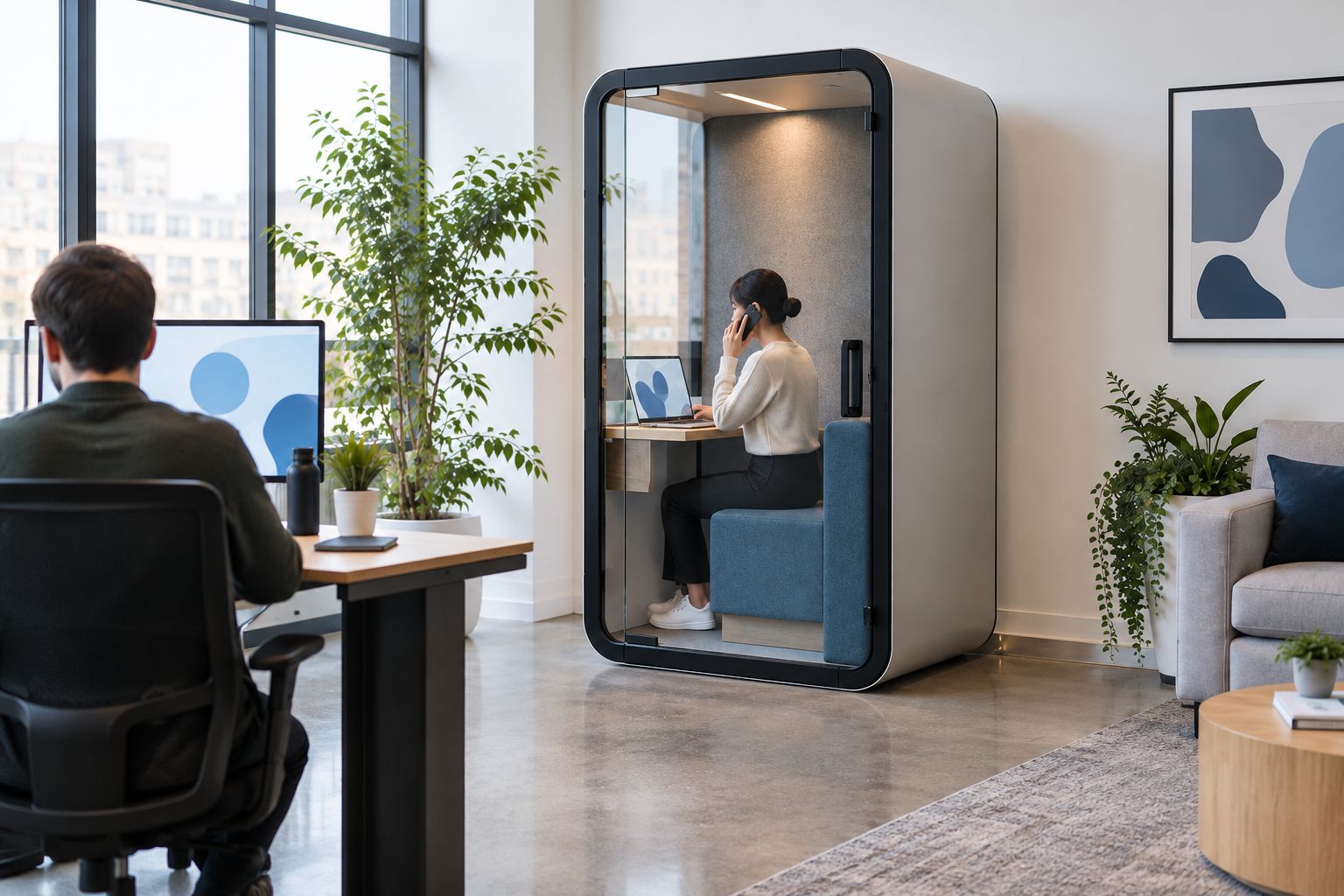
A single-person pilot is best for testing individual calls or video meetings. Soundbox Store describes the Quell Office Pod Solo as a 1-person phone booth designed for private calls, making that a clear task match.
Its limitation is equally clear: the trial cannot establish how a meeting booth works for several colleagues. Record requests for paired conversations separately instead of treating them as demand for another individual booth.
Watch for competing activities within the same format. If extended focus sessions occupy the space when calls arrive, decide whether the problem is capacity, booking policy or an unclear purpose.
Two-person pilot: test paired discussions
A two-person pilot is best for face-to-face discussions involving a pair of colleagues. The Office Phone Booth Quell - 2 Person is described as an acoustic enclosure designed for private meetings.
Record how many people actually attend. If most sessions involve an individual caller, the results support demand for private call space but do not establish that paired-meeting capacity is the main requirement.
Conversely, recurring paired discussions provide a clearer basis for repeating that format. Keep feedback about the conversation separate from the convenience of finding any available room.
Four-person pilot: test small-team meetings
A four-person pilot is best for testing small-team meetings. Soundbox Store describes the Quell - 4 Person Meeting Booth as a meeting enclosure designed to seat four people.
Log attendance alongside the activity. A full booking calendar does not reveal whether staff used the booth for group work or mainly as an individual call space.
The limitation is simultaneous demand: a group meeting occupies the shared enclosure as a single space. Requests for separate calls during that meeting need their own category in the pilot record.
Why office pod pilot results vary
Keep these factors visible when interpreting the trial. Each changes what the observations mean without automatically justifying another purchase.
- Task fit: Individual calls and group discussions require different capacities. Judge each against the pilot brief.
- Attendance pattern: Compare periods with similar office attendance, and record unusual absences or events.
- Timing: Separate demand concentrated around meetings from demand spread across the working day.
- Booking behaviour: Distinguish genuine occupation from reservations that remain unused.
- User mix: Check whether use is spread across the intended group or concentrated among particular participants.
- Process changes: Mark changes to access rules or the pilot purpose so the results remain interpretable.
Do not turn these factors into assumed explanations. Ask users, inspect the records and describe only what you can establish. An apparently quiet period is a prompt to investigate, not proof that staff do not need private space.
Build a pilot record that supports a decision
Use a shared worksheet or an existing booking record with a short feedback form. The aim is a consistent account of what happened, not a complicated reporting system.
| Record | What to capture | What it tells you |
|---|---|---|
| Intended activity | Call, interview, paired discussion or team meeting | Whether use matches the brief |
| Actual session | Start, finish and attendance | How the space was used |
| Unused reservation | Cancellation or unattended booking | Whether the calendar overstates use |
| Unsuccessful request | Time needed, activity and alternative used | Whether demand remained unmet |
| Task outcome | Completed activity and practical difficulties | Whether the format suited the work |
| Context | Attendance changes or altered booking rules | Whether periods are comparable |
For occupancy, divide actual occupied time by the time the pod was offered for use, using the same units throughout. Keep calendar reservations separate from this calculation, and define any periods excluded from the available-time total.
For unsuccessful requests, review timing as well as totals. Requests spread across the day tell a different story from repeated clashes at the same meeting time. Retain enough detail to distinguish these patterns without recording private discussion content.
Decide whether to expand, adjust or stop
Expand the same format when useful use and recurring unmet demand point to the same requirement. The strongest case links completed sessions with unsuccessful requests for that activity while the pod was genuinely occupied.
Adjust the process when staff struggle to access an otherwise suitable space. Release unused reservations, clarify the intended use or change the booking arrangement, then observe the effect before purchasing more.
Test a different capacity when the recorded need does not match the pilot. Requests for paired discussions do not justify duplicating an individual call booth; individual callers occupying a group booth do not automatically justify another group space.
Stop expansion when the evidence does not support it. Keep the successful use case if there is one, but do not turn positive comments into an assumed requirement across other teams or floors.
Your decision note should name the activity supported, the demand left unmet and the remaining uncertainty. Avoid converting every reported distraction into a financial saving or assuming that all pod sessions represent additional productive work.
FAQ
How long should an office pod pilot run?
Run the office pod pilot across representative working patterns, rather than choosing a duration as proof of success. Set a review date and identify the attendance patterns and activities the trial needs to cover.
What should I measure during an office pod pilot?
Measure actual occupied time, unused reservations, unsuccessful requests and whether users completed the intended activity. Record attendance and process changes so you can interpret the results.
Should I pilot a phone booth or a meeting booth?
Pilot a phone booth for individual calls and a meeting booth for discussions involving colleagues together. Match the format to the activity you need to test, rather than choosing extra capacity without a use case.
Does a fully booked office pod mean we need another?
A fully booked office pod does not establish that you need another. Check actual occupation, task fit and recurring unsuccessful requests before deciding to expand.
Can a pilot prove that conversations cannot be overheard?
A workplace pilot does not prove that conversations cannot be overheard. Treat user feedback as an experience report, not a measured acoustic result or a guarantee of privacy.
What should I do if staff rarely use the pilot pod?
Investigate awareness, access rules and task fit before buying more. Ask non-users what prevented use, make a documented adjustment and review the resulting behaviour.
One last thing
Ask what staff did when the pod was unavailable. That answer distinguishes inconvenience from a genuine space requirement: a postponed discussion, an unsuitable alternative and an easily rescheduled call are different outcomes.
The next purchase should solve the unmet task, not copy the first purchase automatically. Finish the pilot with that distinction written down before choosing another configuration.


