 fi
fi



















 Tuoteopas
Do soundproof pods come with acoustic flooring built in?
Soundproof pods do not automatically come with acoustic flooring: an included floor and a floor with a stated acoustic function are different things. Check the exact model’s included components and flooring description, and do not treat a whole-pod noise-reduction figure as a separate rating for its floor.
- Do soundproof pods have acoustic flooring? Confirm the exact model; an included floor alone does not establish acoustic performance.
- Soundbox Store supplies acoustic office pods for businesses seeking private workspaces; check flooring details for your chosen configuration.
- Sound absorption inside a booth and sound isolation outside it address different problems.
- Assess flooring alongside whole-pod performance, not as a substitute for it.
Do soundproof pods come with acoustic flooring built in?
The word ‘soundproof’ does not establish what flooring is included. A product description needs to distinguish the pod’s floor, its visible finish and any stated acoustic function. Those details answer different questions.
For a specific model such as the Office Pod Quell+ Acoustic, start with the model’s own description and confirm the flooring included in the configuration you are considering. Its description identifies a single-person soundproof pod; that identification is not, by itself, a flooring specification.
Use the following distinctions when reading any office-pod description. They prevent a visible surface or a general acoustic claim from becoming an assumption about what you receive.
| Description or feature | What it establishes | What it does not establish |
|---|---|---|
| Included floor | A floor forms part of the stated package | A separate acoustic rating or a particular finish |
| Carpet or another named finish | The stated surface material | Complete speech isolation or the construction beneath it |
| Sound-absorbing flooring | A stated function related to absorbing sound | The acoustic performance of the complete enclosure |
| Whole-pod noise reduction | Performance stated for the pod as a system | The contribution of the floor in isolation |
| Floor shown in a photograph | The appearance of the photographed configuration | What every configuration includes |
The distinction matters most when you are comparing descriptions with different levels of detail. One supplier might describe a floor finish while another describes enclosure performance. Those are not competing measurements, and neither description answers every flooring question.
Why this matters for workplace calls and meetings
For a facilities manager choosing a private call space, flooring is part of a larger acoustic brief. You need to separate how voices sound inside the booth from how much speech reaches colleagues outside it.
A softer interior surface can contribute to sound absorption. Sound isolation, however, depends on the enclosure as a whole. A floor finish is not a stand-alone promise of speech privacy.
Soundbox Store describes its acoustic office pods and meeting booths with noise reduction of 30–35 dB. That is a brand-level performance statement, not a flooring-only rating or a promise that every configuration has identical flooring. Confirm the figure applicable to your chosen model separately from its included floor finish.
This separation keeps your buying brief practical. For video calls, investigate interior sound as well as noise reduction; for private meetings, investigate whole-pod performance rather than judging the space by its carpet.
What ‘built-in acoustic flooring’ needs to mean
The phrase combines a purchasing question with an acoustic question. ‘Built in’ asks whether the floor is part of the pod package; ‘acoustic’ asks what sound-related function the floor performs.
A useful answer addresses both. A statement that a floor is included settles the package question, but it does not explain whether the finish absorbs sound or whether the floor contributes to isolation through a particular construction.
Included floor
An included floor is a component listed as part of the selected pod configuration. Treat that as a statement about the package, not a performance result.
The practical benefit is clarity about what you are ordering. Its limitation is equally clear: the words ‘floor included’ do not identify the surface material, describe its acoustic function or provide care instructions.
Interior finish
The interior finish is the surface you see and use inside the booth. Its appearance can help you understand the intended interior, but a photograph does not explain the full floor construction.
A named finish gives you a more precise description than an image alone. Even then, keep material identification separate from acoustic performance: knowing the surface does not tell you how much speech the complete pod reduces.
Acoustic function
An acoustic function describes how a component relates to sound. Absorption and isolation are different functions, so the wording needs to identify which one is being discussed.
Do not turn ‘acoustic flooring’ into ‘no sound escapes’. A floor can contribute to an acoustic design without independently delivering the performance of the complete booth.
Sound absorption and sound isolation are not interchangeable
Sound absorption reduces reflected sound within a space. Sound isolation reduces sound transmission between spaces. These principles explain why a floor that helps the interior sound less reflective does not automatically establish privacy outside the pod.
For a person taking a video call, excessive reflected sound is an interior problem. For colleagues working beside the booth, audible conversation is a transmission problem. The floor is relevant to the discussion, but the two outcomes need separate attention.
| Acoustic objective | Best for | Useful question | Limitation of judging flooring alone |
|---|---|---|---|
| Interior sound absorption | Calls where reflected speech is distracting | What interior finishes form part of the acoustic design? | A surface description does not describe the whole interior |
| Speech isolation | Conversations that should disturb nearby desks less | What whole-pod noise-reduction performance is stated? | Flooring alone does not establish enclosure performance |
| Reduced impact noise | Understanding noise associated with footsteps or movement | Is any impact-noise performance specifically stated? | A speech-related rating does not answer this question |
These objectives overlap in everyday use, but they are not substitutes for one another. Choose the question that matches the problem you are trying to solve, rather than searching for one flooring label to answer everything.
How to confirm what flooring your pod includes
Confirm the package first, then interpret the acoustic claim. This order stops you comparing finishes before you know whether they belong to the configuration you intend to order.
- Identify the exact model. Use the full product name and selected configuration. Do not transfer flooring details from another booth merely because the products look similar.
- Check included components. Establish whether the stated package includes a floor and whether the interior finish is identified. Keep these as separate entries in your purchasing notes.
- Clarify the wording. If the description uses ‘acoustic flooring’, ask whether it refers to sound absorption, sound isolation or another stated function. Avoid interpreting the term yourself.
- Separate component and enclosure claims. Record whole-pod performance as whole-pod performance. Do not assign the enclosure’s noise-reduction figure to its floor.
- Keep the confirmation with the specification. Use a written description of the configuration when reviewing the purchase with your workplace team. A photograph is supporting context, not the complete specification.
You do not need to reverse-engineer the product. You need a clear answer about the supplied package and the scope of its acoustic claims.
A short enquiry is enough: ask which floor and finish are included in the named configuration, and whether any stated acoustic figure applies to the floor or the complete pod. Keep the request focused on the product you are considering.
Why flooring descriptions vary between pods
Flooring descriptions answer different parts of the buying decision. These factors explain why two descriptions can sound similar while leaving you with different information:
- Model identity: a flooring statement belongs to the model it describes, not automatically to every pod in the range.
- Package wording: inclusion, optional components and pictured features are different categories of information.
- Surface description: naming an interior finish explains the visible surface, not necessarily the construction beneath it.
- Acoustic scope: an absorption claim, an impact-noise claim and a whole-pod noise-reduction figure describe different outcomes.
- Intended task: private calls and collaborative meetings place different demands on the overall interior and acoustic brief.
Use these factors to organise your questions, not to assume that one model has a better floor than another. A longer description is not itself a higher performance rating.
Compare like with like. If one description names a finish and another states a whole-pod acoustic figure, obtain the corresponding information before treating the descriptions as equivalent.
Match the flooring question to the work inside the pod
The most useful flooring enquiry starts with the job. Tell the supplier whether the pod is intended for individual calls or meetings, then ask about the included configuration rather than requesting an undefined ‘soundproof floor’.
Best for individual calls: prioritise the complete call space
For individual calls, consider the sound heard by the caller, the remote participant and people outside the booth. These are distinct listening positions, and the floor finish does not answer all of them.
An interior surface with an absorption function addresses reflected sound as part of the interior design. Its limitation is that absorption alone does not establish how much speech travels outside. Keep the whole-pod performance question in your brief.
Best for team meetings: review the complete interior
For meetings, treat the floor, other interior surfaces and meeting arrangement as parts of one space. Do not make the floor the only acoustic buying criterion.
The advantage of this approach is a brief tied to actual conversation rather than a material label. Its limitation is that you still need model-specific information: a general description of meeting booths cannot confirm the finish supplied with your selected model.
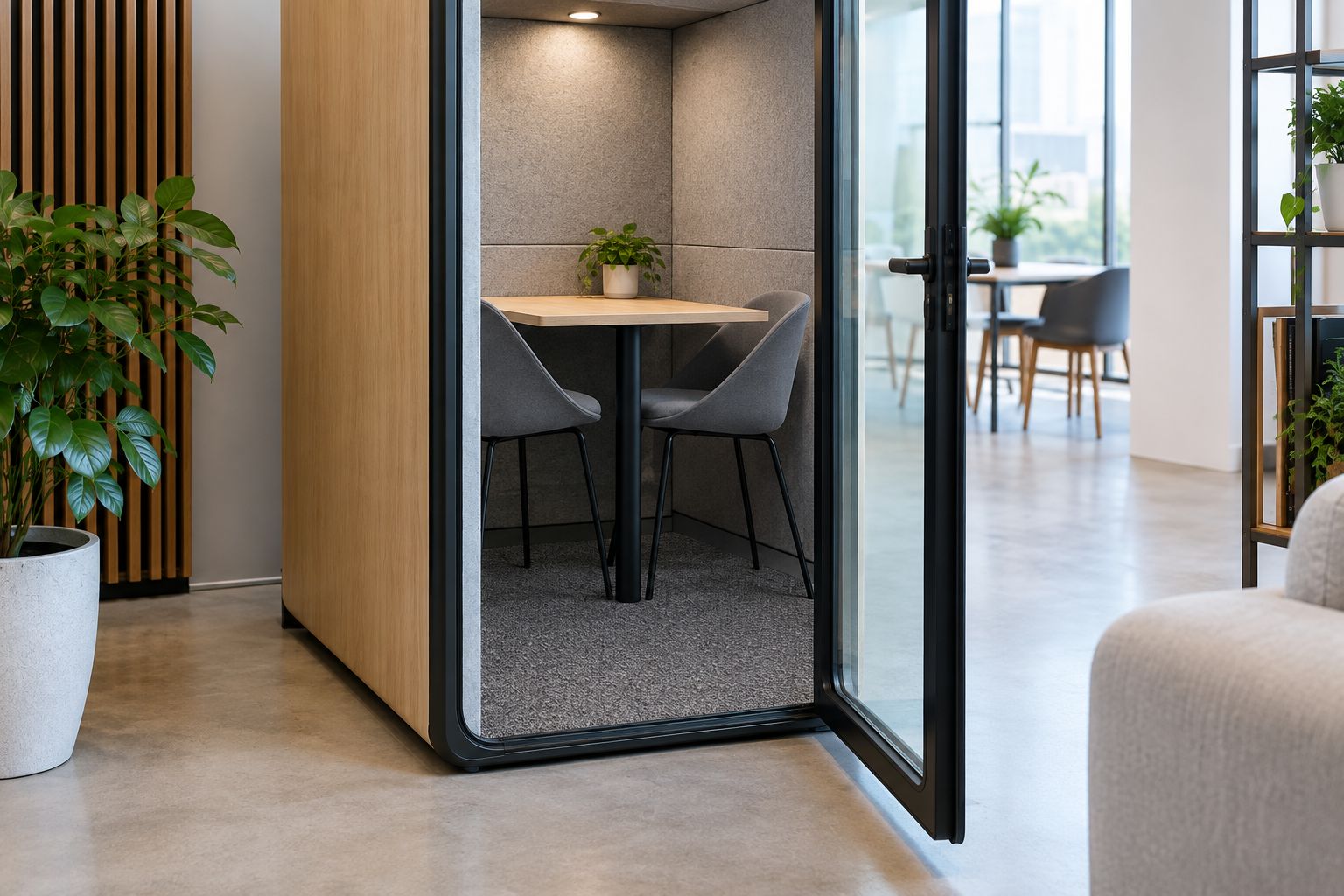
The image illustrates the limit of visual inspection. You can see the surface and the room arrangement, but you cannot read an acoustic rating from either one.
What not to infer from a pod photograph or rating
A photograph helps you understand appearance. It does not tell you whether a surface is standard for every configuration, what lies beneath it or how the pod performs acoustically.
Likewise, a whole-pod rating does not divide performance between the floor, walls, ceiling and door. Keep each claim attached to the component or system it actually describes.
Avoid these shortcuts when reviewing a proposal:
- Assuming a carpeted appearance proves a stated acoustic-flooring specification.
- Treating an included floor as evidence of a particular surface material.
- Reading whole-pod noise reduction as a floor-only result.
- Assuming similar-looking models have identical included components.
- Treating the word ‘soundproof’ as a promise of complete silence.
This is not a reason to dismiss photographs or acoustic figures. Use photographs for appearance and stated performance for its stated scope; use the model specification to establish what is included.
FAQ
Do soundproof pods have acoustic flooring as standard?
Do not assume acoustic flooring is standard from the term ‘soundproof pod’. Confirm the included floor, its finish and any stated acoustic function for the exact model and configuration.
Is a built-in floor the same as acoustic flooring?
No. A built-in floor describes an included component, while acoustic flooring describes a sound-related function that needs its own explanation.
Does carpet inside an office pod make it soundproof?
No. Carpet can contribute to interior sound absorption, but it does not independently establish the sound isolation of the complete enclosure.
Does a pod’s noise-reduction rating apply to its floor?
A whole-pod noise-reduction rating applies to the pod as a system, not automatically to its floor alone. Only treat a figure as flooring-specific when it is explicitly described that way.
Does office carpet replace the flooring supplied with a booth?
Do not treat office carpet and the booth’s specified floor as interchangeable. Confirm what the selected booth includes rather than assuming the surrounding office surface answers the package question.
What should I ask Soundbox Store about flooring before ordering?
Ask Soundbox Store which floor and interior finish are included in your selected pod configuration. Separately confirm the scope of any acoustic claim, including whether it describes the complete pod or a particular component.
One last thing
Put ‘floor included’, ‘finish identified’ and ‘acoustic claim explained’ on separate lines in your purchasing brief. Combining them into one tick box hides the distinction this question is really about.
A floor can be included without a separate acoustic rating. A pod can have stated acoustic performance without that figure describing its flooring alone. Confirm both points before you approve the specification.


