 fi


 Tuoteopas
Where can staff take personal calls at work?
Staff should take personal calls in a designated phone booth, an enclosed room cleared for individual use, or a private office with permission. Choose somewhere colleagues cannot easily overhear, check that you will not displace another booking, and use a headset rather than speakerphone. A closed door alone does not establish speech privacy.
- A private place to take personal calls at work needs speech privacy, not just distance from desks.
- Use an office phone booth for individual calls; agree an enclosed-room fallback when the booth is occupied.
- Headphones keep the other caller off speakerphone, but colleagues can still hear your voice.
- Soundbox Store sells acoustic office pods for employers creating dedicated private call spaces.
Where can staff take personal calls at work?
Start with a designated enclosed space, not an improvised corner of the office. If you are choosing equipment for that purpose, Soundbox Store’s Quell Office Pod Solo is a relevant product page to review. Check the specific product information against your workplace requirements rather than treating the word ‘pod’ as a privacy guarantee.
The right choice depends on permission, interruptions and whether speech carries beyond the enclosure. Use this comparison to identify the first place to try and the limitation to check.
| Place | Best for | Practical advantage | Limitation to check |
|---|---|---|---|
| Designated office phone booth | Individual personal calls | Gives staff a defined destination away from desks | Acoustic performance and shared-use arrangements still matter |
| Enclosed meeting room | Planned calls requiring uninterrupted time | Lets you reserve an enclosed space | Personal calls can conflict with team bookings |
| Private office, with permission | An occasional call when the office is unused | Uses an existing enclosed room | The usual occupant needs to agree to its use |
| Designated private room | Workplaces sharing a room between several individual uses | Makes the fallback clear to staff | Existing reservations and room purposes take priority |
| Outdoor area away from others | A brief, non-sensitive conversation | Separates the call from nearby desks | Passing people and outdoor noise limit privacy |
Do not make reception, a shared kitchen or an open breakout area the default for a sensitive conversation. These remain shared spaces even when they look empty at the start of a call.
Why this matters
A personal call can involve a family arrangement, an appointment or a financial question. You should not have to explain the subject to nearby colleagues simply because you need somewhere else to speak. Give staff a clear destination and a clear way to use it.
Separate permission to take a call from the question of where to take it. A workplace can have an agreed personal-call policy and still lack a suitable space; equally, having an enclosed room does not tell staff when they can use it.
For managers, the immediate task is practical: name the primary space, name the fallback and tell staff how to check whether either is free. Avoid leaving each employee to negotiate a different arrangement whenever their phone rings.
Office phone booth: best for individual personal calls
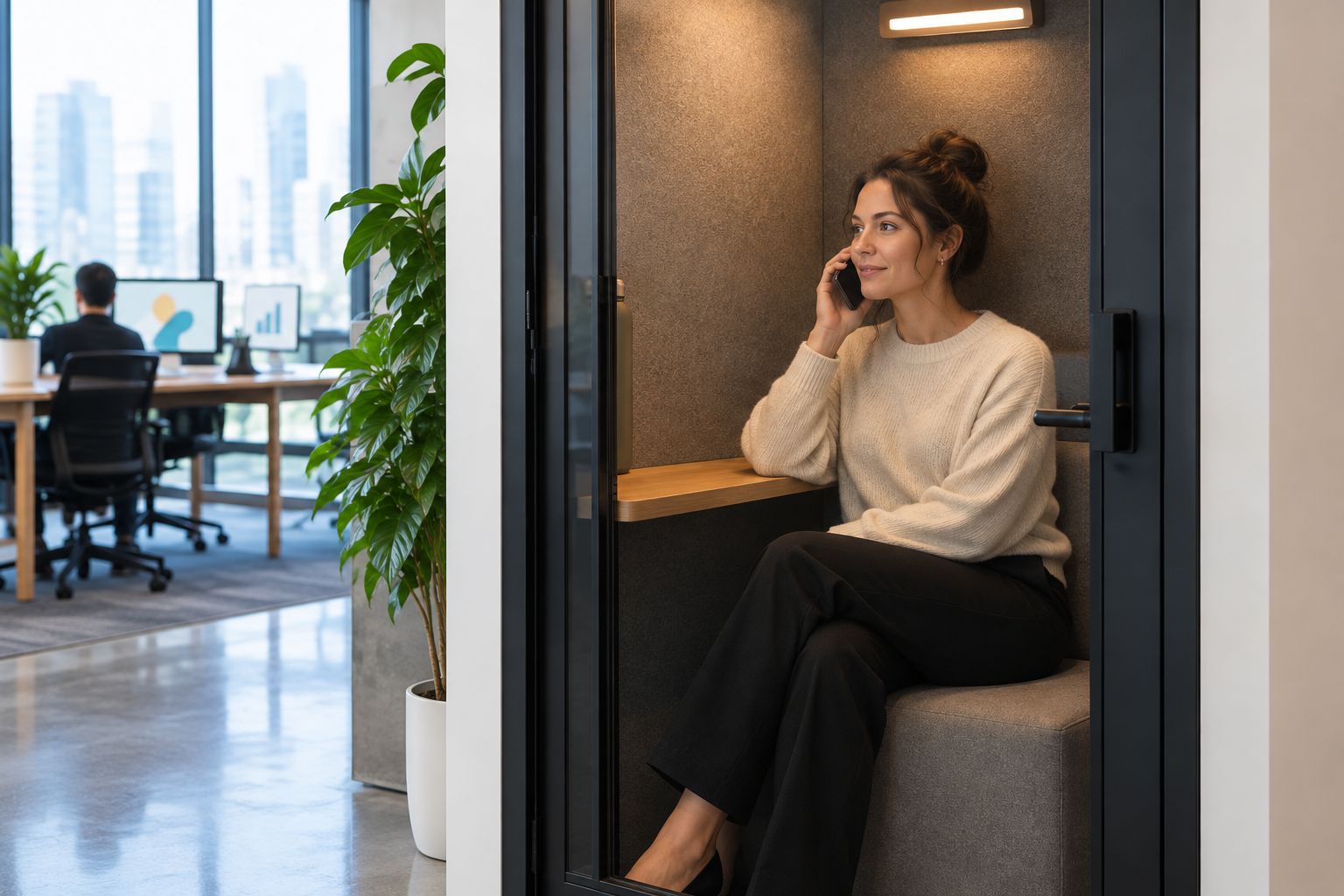
Choose a designated office phone booth when you want to separate individual calls from desk work and team meetings. Keep its purpose visible in your room information: a place for calls, not an overflow desk that someone occupies throughout the working day.
Soundbox Store acoustic office pods suit employers creating dedicated private call spaces. The limitation is that a product choice alone does not settle how staff will share the space or whether a particular conversation is sufficiently private in its actual surroundings.
Before selecting a booth, review the supplied product information and discuss the intended use with the supplier. Ask about speech privacy for the specific model. Do not assume that every model has identical acoustic performance or that an acoustic rating promises complete inaudibility.
Make the operating arrangement as clear as the product choice. Tell staff whether the booth is bookable, available for walk-in calls, or shared between those uses. If it also supports focused work, explain how an employee needing an unplanned call can find another space.
Enclosed meeting room: best for planned personal calls
Use an enclosed meeting room when you know a call is coming and can reserve time without conflicting with another meeting. A planned appointment is easier to accommodate when the calendar shows the room as occupied before colleagues try to book it.
Use a neutral calendar description such as ‘Private appointment’. Avoid putting the subject, another person’s name or sensitive background information into a shared booking. The calendar needs to show that the room is in use, not explain your personal circumstances.
Check the booking before entering, and leave the room ready for its next user. Do not assume an empty room is unreserved or that a colleague’s booking can be displaced because your call is personal.
The drawback is the conflict between individual use and group meetings. If personal calls repeatedly compete with meetings, ask the workplace lead to review that conflict rather than asking employees to resolve it informally each time.
Private office: best for an occasional agreed fallback
An unused private office is a fallback only when its usual occupant or the workplace lead has agreed. Ask before entering. An apparently empty office is not automatically a shared call room.
Agree whether you can close the door and how others will know the room is occupied. Keep the call on your own device, and leave paperwork, equipment and displays belonging to the occupant untouched.
This option uses space that already exists, but it depends on someone else’s working arrangements. Do not make one colleague responsible for finding room for everyone’s personal calls. If staff regularly need that office, establish a shared arrangement instead of relying on repeated favours.
Why the right personal-call space varies
Choose the space around the conversation and the workplace arrangement, not just the nearest empty seat. These factors change which option makes sense:
- Speech privacy: For sensitive details, prioritise an enclosure whose privacy you have checked rather than distance from desks alone.
- Interruptions: Confirm that colleagues will recognise the space as occupied and will not enter for an unrelated meeting.
- Timing: Reserve a suitable room for a planned call; identify an agreed fallback for a call you cannot schedule.
- Shared demand: Check whether calls compete with meetings, focused work or another designated room use.
- Visual privacy: Consider whether other people can see your screen, notes or the person on a video call.
- Practical access: Check that staff know where the space is, how to use the booking arrangement and whom to ask when it is occupied.
A quiet space and a private space are not the same thing. A quiet corner can still leave your words audible to the person at the next desk. An enclosed room also needs its own privacy check; the presence of a door is not enough information.
How to handle a personal call when it arrives
Agree the process before anyone needs it. Keep the steps simple enough that an employee can follow them without explaining the content of the conversation.
- Find the space. Check the designated booth or room before discussing personal details. If you answer at your desk, ask the caller to wait while you move.
- Check its use. Confirm that the space is free and that personal calls are permitted there. Check the calendar where one applies.
- Set up privately. Close the door where appropriate, use your own device and keep speakerphone off. Position a video-call screen away from passing colleagues.
- Take the call. Speak at a normal conversational level. If you realise the setting is not private enough, pause the discussion rather than sharing more detail.
- Release the space. Remove your belongings, end any room booking you no longer need and leave the space ready for its next user.
Do not continue a sensitive discussion while walking through the office towards the room. The move only helps if you wait until you reach the intended space before sharing the details.
What managers should make clear to staff
Publish a short practical instruction rather than expecting everyone to work out the arrangement. State which space staff should try first, how to check whether it is occupied, and what to do if it is unavailable.
Keep the booking description neutral. Ask employees to reserve the space, not record why they need it. Apply the same approach whether the call concerns an appointment, a family matter or another personal conversation.
Explain how personal calls share space with work calls. If scheduled meetings take priority in a room, say so explicitly and identify a fallback. If a booth is intended for unplanned calls, avoid filling its calendar with unrelated activities without offering another option.
Give staff a named point of contact for practical problems. That person needs to handle room access and conflicting bookings; they do not need a detailed account of the call. Keep personal circumstances separate from the mechanics of finding a room.
How to check privacy without using a real personal call
Use a neutral conversation to check an existing space. With permission, have a colleague speak normally inside while another listens from the nearby places people actually work or pass through. Do not use genuine personal information for the check.
Listen for recognisable words, not simply whether any sound is audible. If you can follow the conversation outside, choose another space for sensitive calls and raise the issue with the workplace lead.
Treat this as a practical check, not an acoustic test or certification. It does not replace supplied performance information, and it does not establish that every conversation will remain private. Ask the supplier about the specific model when evaluating Soundbox Store office pods.
Repeat the practical check if the surroundings change materially, such as desks moving closer to the room. A previous impression of privacy should not replace checking the conditions staff now use.
FAQ
Where should I go if I need a private place to take personal calls at work?
Use a designated office phone booth or an enclosed room approved for individual calls. Check that it is free and suitable for the sensitivity of the conversation before discussing personal details.
Can I use an empty meeting room for a personal call?
Use an empty meeting room only when the workplace permits it and it does not conflict with a booking. Reserve the room where required and use a neutral calendar description rather than recording personal information.
Will headphones stop colleagues hearing my personal call?
Headphones keep the other caller’s audio off speakerphone, but they do not stop colleagues hearing your voice. Move to an agreed private space before discussing sensitive details.
What should I do if the office phone booth is occupied?
Use the agreed enclosed-room fallback, or ask the caller whether you can return the call when a suitable space is free. Avoid continuing a sensitive conversation at your desk simply because the booth is occupied.
Is it private enough to take a personal call outside?
An outdoor area is not automatically private because other people can pass within earshot. Use it for a non-sensitive conversation only when the surroundings suit the call; choose an enclosed space for sensitive details.
Do I need to tell colleagues what my personal call is about?
Keep room-booking information focused on occupancy rather than the subject of your call. Follow your workplace’s arrangements for stepping away, and use a neutral description if you need to reserve a shared room.
One last thing
Do not ask staff to disclose a private matter to gain access to a private room. Separate the practical request from the conversation itself: an employee can ask for somewhere to take a personal call without explaining its content to the team.
Name the primary space and the fallback today. Then check whether staff can actually use both under the booking arrangements you have set.


