 fr/be


 Guide produit
How to survey staff about office noise
Run an office noise survey that asks where noise occurs, which tasks it interrupts, when it happens and whether staff can find a suitable alternative workspace. Use neutral questions, explain how responses will be handled, then compare the findings by work setting rather than naming individuals. Repeat the same core questions after making a change; staff feedback describes workplace experience, not a measured acoustic rating.
- An office noise survey should connect noise sources with interrupted tasks, locations and access to quiet workspaces.
- Ask about concentration and speech privacy separately; they require different responses.
- Soundbox Store office pods suit businesses seeking enclosed spaces for private calls and meetings, not a survey-led purchasing assumption.
- Keep core questions unchanged when comparing staff feedback before and after workplace changes.
Why this matters
A complaint that the office is noisy does not tell you what to change. You need to distinguish someone struggling to write beside a conversation from someone unable to find a private place for a client call.
Survey the work, not the personalities. Ask about activities and settings rather than which colleagues make noise. If complaints already arrive informally, use the survey alongside a consistent process for managing noise complaints in an open-plan office.
The result should be a practical brief: the affected task, the location, the recurring obstacle and the change to investigate. Do not start with a preferred purchase and write questions that justify it.
How to survey staff about office noise
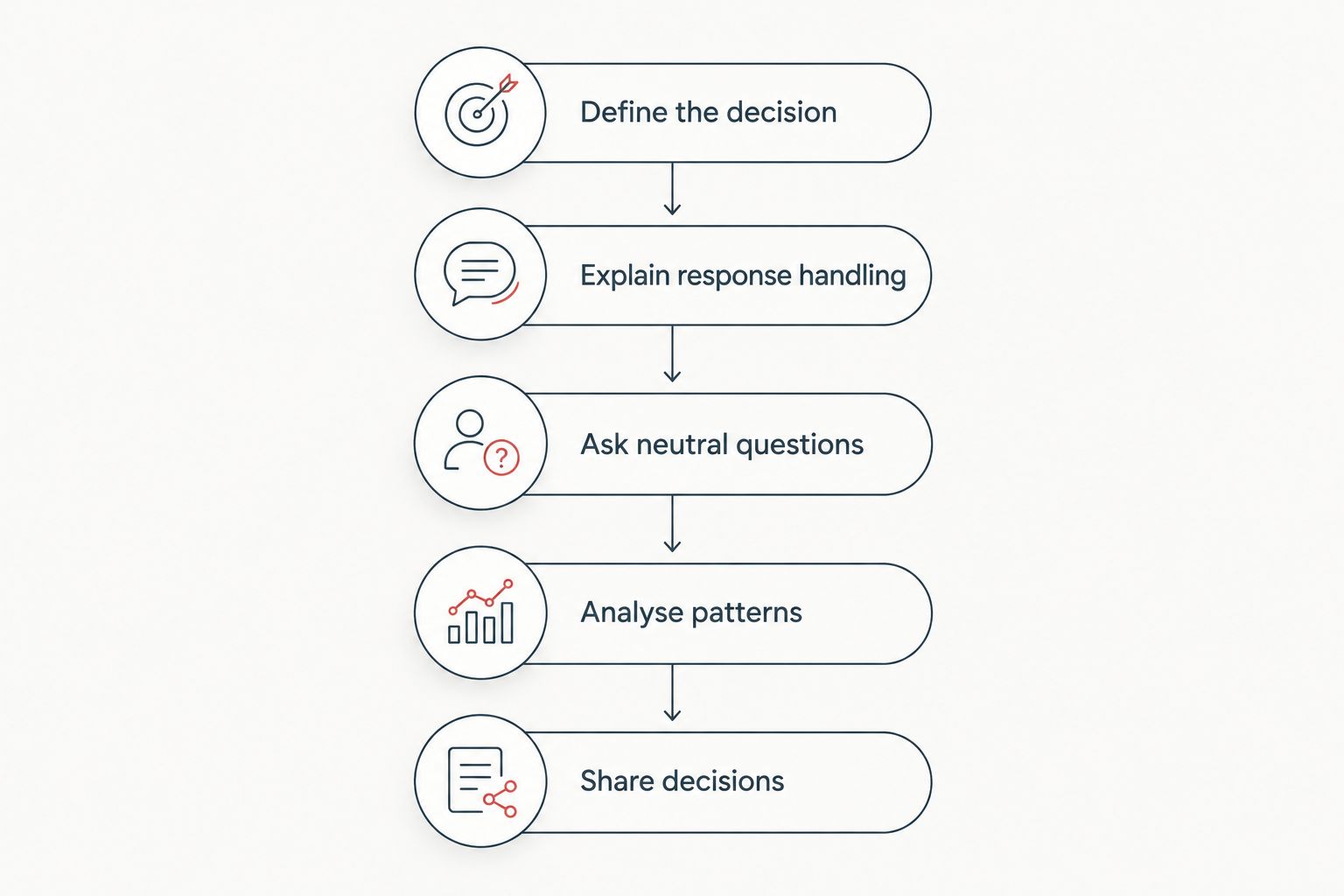
Use this sequence to build a questionnaire, distribute it fairly and turn the responses into decisions. Keep the questionnaire separate from any optional follow-up conversation so staff understand what they are submitting and to whom.
1. Define the decision before writing questions
Write down what the survey needs to inform. Examples include whether calls need a separate setting, whether quiet areas are usable, or whether conversations interrupt desk-based concentration.
Choose a reference period that matches normal office attendance and state it in the introduction. Ask staff to answer about that period rather than their worst-ever experience. Record unusual circumstances separately so you do not mistake a temporary disruption for the usual working environment.
2. Explain how responses will be handled
Tell staff who will read individual submissions, how you will report findings and whether participation is optional. Check whether the form records names, email addresses or sign-in details before describing it as anonymous.
Do not promise anonymity that the survey setup does not provide. Avoid collecting combinations of team, exact desk and working pattern that identify someone unnecessarily. Offer a separate route for anyone who wants a personal follow-up.
3. Use neutral questions and consistent answer scales
Ask how often noise interrupts a task rather than asking how badly the office disrupts productivity. Include an answer for people who do not experience the problem.
Keep frequency answers in the same order throughout: never, rarely, sometimes, often and always. Include not applicable where a task or space is irrelevant. Do not combine concentration, privacy and meeting-room access into a single satisfaction question.
4. Invite the people who use the space
Include regular office users, occasional visitors to the workplace and staff working different attendance patterns. Give everyone the same introduction and explain the closing date without pressuring individuals to participate.
Ask managers to circulate the invitation, not collect answers from their teams. Offer another response format where the standard form is unsuitable, while keeping the wording and reporting approach consistent.
5. Analyse patterns before choosing a response
Group answers by task, noise source, broad location and access to alternatives. Read the written comments alongside the structured responses rather than selecting a striking comment as the headline finding.
Separate missing space from unusable space. A quiet room that staff cannot book presents a different problem from an office with no quiet room at all. Record unanswered questions as unanswered, not as evidence that staff are satisfied.
6. Share decisions and repeat the core questions
Publish a short summary of what staff reported, what you will investigate and who owns each action. Explain which requests are outside the current scope instead of leaving them unanswered.
After staff have experienced the change during ordinary work, repeat the relevant questions with the same wording and answer scales. Note changes in attendance, workload or seating before interpreting a difference as an improvement.
Office noise survey questions you can adapt
Use the following as a questionnaire template, not a validated assessment instrument. Select questions that support your stated decision and remove anything you will not use.
Introduce the form with a plain explanation of its purpose, reference period and response handling. Ask staff not to include colleagues' names or details of private conversations in written answers.
| Survey item | Suggested wording | Answer format |
|---|---|---|
| Work setting | Which broad area do you usually work in when attending the office? | Broad zones, plus varies and prefer not to say |
| Attendance context | Which parts of the working day does your answer mainly describe? | Relevant periods, plus varies |
| Noise sources | Which sounds interrupt your work, if any? | Multiple selection, plus other and none |
| Concentration | How often does office noise interrupt work that requires concentration? | Consistent frequency scale |
| Task impact | Which activities are interrupted by noise? | Multiple selection, plus other and none |
| Call experience | How often is surrounding speech distracting during your calls? | Frequency scale, plus not applicable |
| Speech privacy | How often do you avoid a conversation because others nearby might hear it? | Frequency scale, plus not applicable |
| Alternative space | When you need a quieter setting, how often can you find one? | Frequency scale, plus not applicable |
| Access barriers | What prevents you from using a quieter setting? | Multiple selection, plus other and no barrier |
| Priority change | Which change would most improve your ability to work? | Single selection, plus other and no change needed |
| Written example | Describe a recent noise-related interruption without naming anyone. | Optional free text |
For noise sources, offer clear categories such as nearby conversations, telephone calls, video meetings, equipment, movement through the area and external sounds. Let respondents select more than one source rather than forcing a single explanation.
For task impact, distinguish writing, reading, analysis, calls and face-to-face discussions. Use vocabulary that staff recognise. A facilities term that needs explanation is a poor survey answer label.
For access barriers, include space being occupied, difficulty booking, distance from the work area and an unsuitable setting for the task. Leave room for another explanation without suggesting that every respondent must have a complaint.
Keep concentration and speech privacy separate. Being distracted by someone else's conversation is not the same experience as worrying that someone else can hear yours. Your action plan needs to preserve that distinction.
Choose a feedback format that fits the question
A form, a discussion and an individual conversation serve different purposes. Use the table to decide how to gather feedback without treating one format as a substitute for every other method.
| Feedback format | Best for | Strength | Limitation |
|---|---|---|---|
| Self-completed questionnaire | Establishing patterns across office users | Gives respondents consistent questions and answer choices | Cannot clarify an ambiguous answer immediately |
| Facilitated team discussion | Exploring shared working practices | Lets participants explain context and discuss possible changes | Comments are visible to colleagues in the discussion |
| Optional individual conversation | Understanding a specific working difficulty | Allows detailed follow-up about the task and setting | Does not establish how widespread the experience is |
Use the questionnaire for the baseline and follow-up conversations for explanation. Keep individual discussions optional and avoid presenting their content as representative of everyone.
If you combine formats, label the findings by source. Questionnaire responses, discussion notes and facilities observations should remain distinguishable in the report.
Why office noise survey responses vary
Different answers do not automatically contradict each other. Look for differences in the work and setting before deciding that one group has described the office incorrectly.
- Task: Reading a document, making a call and holding a team discussion place different demands on the workspace.
- Location: Ask whether responses concern desk areas, circulation routes, meeting spaces or shared facilities.
- Attendance: Record which working periods the answers describe rather than assuming everyone experiences the same office.
- Access: Distinguish having a quiet space from being able to use it when needed.
- Privacy: Separate unwanted background speech from concern about being overheard.
- Temporary disruption: Identify unusual events separately from the normal working pattern.
Use these categories to organise follow-up questions, not to dismiss feedback. A problem affecting a particular task still needs an owner, even when it is not the most frequently selected issue.
Turn responses into a clear action brief
Report response counts alongside the number of people who answered each question. If you use percentages, make the denominator clear and exclude not-applicable answers only when you explain that choice.
Avoid a single headline average that hides opposing experiences. Show the distribution of frequency responses and describe meaningful differences between broad work settings without exposing individuals.
Do not convert a reported interruption into invented lost hours or financial savings. A staff questionnaire does not establish how much output disappeared or what a proposed change will recover.
| Reported issue | What to investigate | What to avoid concluding |
|---|---|---|
| Calls interrupt nearby desk work | Where calls happen and which alternative settings are usable | Every caller needs a separate booth |
| Staff avoid private conversations | Access to an enclosed setting suitable for the conversation | A survey response proves acoustic performance |
| Quiet rooms exist but are difficult to use | Booking rules, competing uses and practical access | More rooms are automatically the answer |
| Noise complaints concern a specific area | Activities and sound sources around that location | The whole office has the same problem |
Give each proposed action an owner, a defined scope and a way to review it. Keep staff-reported outcomes separate from observations about room use, bookings or workplace layout.
When survey findings justify reviewing enclosed spaces
Soundbox Store office pods suit businesses seeking enclosed spaces for private calls and meetings. That makes them relevant when feedback identifies a need for those activities—not when the survey merely records general dissatisfaction.
Match the setting to the task before comparing products. The Quell Office Pod Solo is described as a 1-person phone booth designed for private calls. A 2-person conversation and a 4-person meeting require a different capacity brief; do not turn a solo-call requirement into a group-meeting specification.
The limitation is equally important: an enclosed booth does not resolve every source of office noise or every problem with booking practices. Use the office noise survey to define the requirement, not to claim that a particular product will deliver a measured improvement.
When discussing Soundbox Store meeting booths, carry the actual survey findings into the brief: who needs the space, what they need to do and what currently prevents them from doing it. Keep product evaluation separate from staff sentiment.
FAQ
Should an office noise survey be anonymous?
Use an anonymous office noise survey only when the form and reporting process genuinely support anonymity. Explain what is recorded, who sees submissions and how comments will be summarised; use a separate route for optional personal follow-up.
What is the best scale for office noise survey questions?
A consistently labelled frequency scale is a practical choice for questions about recurring interruptions. Use the same order throughout and include not applicable where respondents do not perform the task.
Can a staff survey measure how loud an office is?
A staff survey records people's experiences; it does not measure sound levels or acoustic performance. Keep statements about distraction and privacy separate from any acoustic measurement.
How do I report results without identifying staff?
Report broad patterns and remove names or identifying details from written comments. Avoid publishing small-group breakdowns or combinations of role, location and attendance that reveal an individual.
Should I ask staff whether they want an office pod?
Ask first about the task, noise source and access problem rather than a preferred product. Discuss an enclosed call or meeting space only after the responses establish a relevant requirement.
How should I check whether a workplace change helped?
Repeat the same relevant questions after staff have used the changed setting during ordinary work. Compare the answer distributions and note differences in attendance, workload or seating before attributing the result to the change.
One last thing
Ask what stops staff using the quiet space you already have. That answer belongs beside any request for additional space, because it separates a missing resource from an access problem.
Close the feedback loop with a visible decision, even if the decision is to investigate further. State the reported problem, the next action and how staff will hear the outcome. A survey is finished when its findings inform a decision—not when the form closes.


