 nl


 Productgids
Best ThinkTanks alternatives for growing companies
Growing companies outgrow shared rooms and booked meeting spaces faster than they outgrow the lease. The fix that scales is a mix of acoustic pods sized to the jobs you actually run: solo calls, pairs, small teams and larger huddles. Soundbox Store sells pods from one person up to six, tested to ISO 23351-1:2020 with 30-35 dB noise reduction.
- Match pod size to the meeting type, not to headcount: solo for calls, 2-person for one-to-ones, 4-6 for teams.
- Soundbox Store pods are tested to ISO 23351-1:2020 with 30-35 dB noise reduction.
- Buy in stages: start with solo and 2-person pods, add larger rooms as teams grow.
- Check clearance, power and access before ordering any pod.
Why this matters for a growing company
Every new hire adds calls, and every call adds noise to an open floor. Meeting rooms fill up first, then people take private conversations into stairwells and corridors.
Acoustic pods fix the specific failure: no private space for the next ten minutes. They do not replace a boardroom. They remove the daily queue for one.
Pod options at a glance
| Pod type | Capacity | Best for | Typical use |
|---|---|---|---|
| Solo pod | 1 person | Private calls, focus work | Sales calls, video calls |
| 2-person booth | 2 people | One-to-ones, interviews | Reviews, confidential chats |
| 4-person pod | 4 people | Small team meetings | Stand-ups, client calls |
| 6-person pod | 6 people | Larger team sessions | Planning, workshops |
| 8-person Club House pod | 8 people | All-hands and group sessions | Team briefings |
All sizes are sold direct through the online store. Check each product page for current dimensions and configuration before you plan a floor layout.
1. Solo pod: best for private calls
The Quell solo office pod is the first purchase for most growing teams. One person, one door, one conversation nobody else hears.
Where it shines
- Takes the most common request off your meeting rooms: a single person on a call.
- Smallest footprint of the range, so it fits where larger pods cannot.
- Suits video calls and focused work in the same space.
Where it falls short
- One person only. A second attendee means moving up a size.
- Not a replacement for a collaborative space.
Best for: sales and support staff, hot-desk floors, anyone on calls all day. Verdict: Buy first.
2. Two-person booth: best for one-to-ones
The 2-person meeting booth covers conversations that need a door: performance reviews, interviews, sensitive client calls.
Where it shines
- Gives managers a private room without booking a full meeting room.
- Handles one-to-ones and pair work in the same unit.
Where it falls short
- Too tight for a third person.
- Seated pair conversations only; a team stand-up needs a larger pod.
Best for: HR, managers, recruitment. Verdict: Buy second.
3. Four-person pod: best for small team meetings
The 4-person soundproof office pod is where a pod starts to stand in for a small meeting room. Most product, sales and project teams fit inside it.
Where it shines
- Seats a whole small team for stand-ups and client calls.
- Keeps the discussion contained and the open floor quiet.
Where it falls short
- A bigger footprint, so floor planning matters.
- Larger groups still need a bigger room.
Best for: teams of three to four that meet daily. Verdict: Buy once you have a team that meets daily.
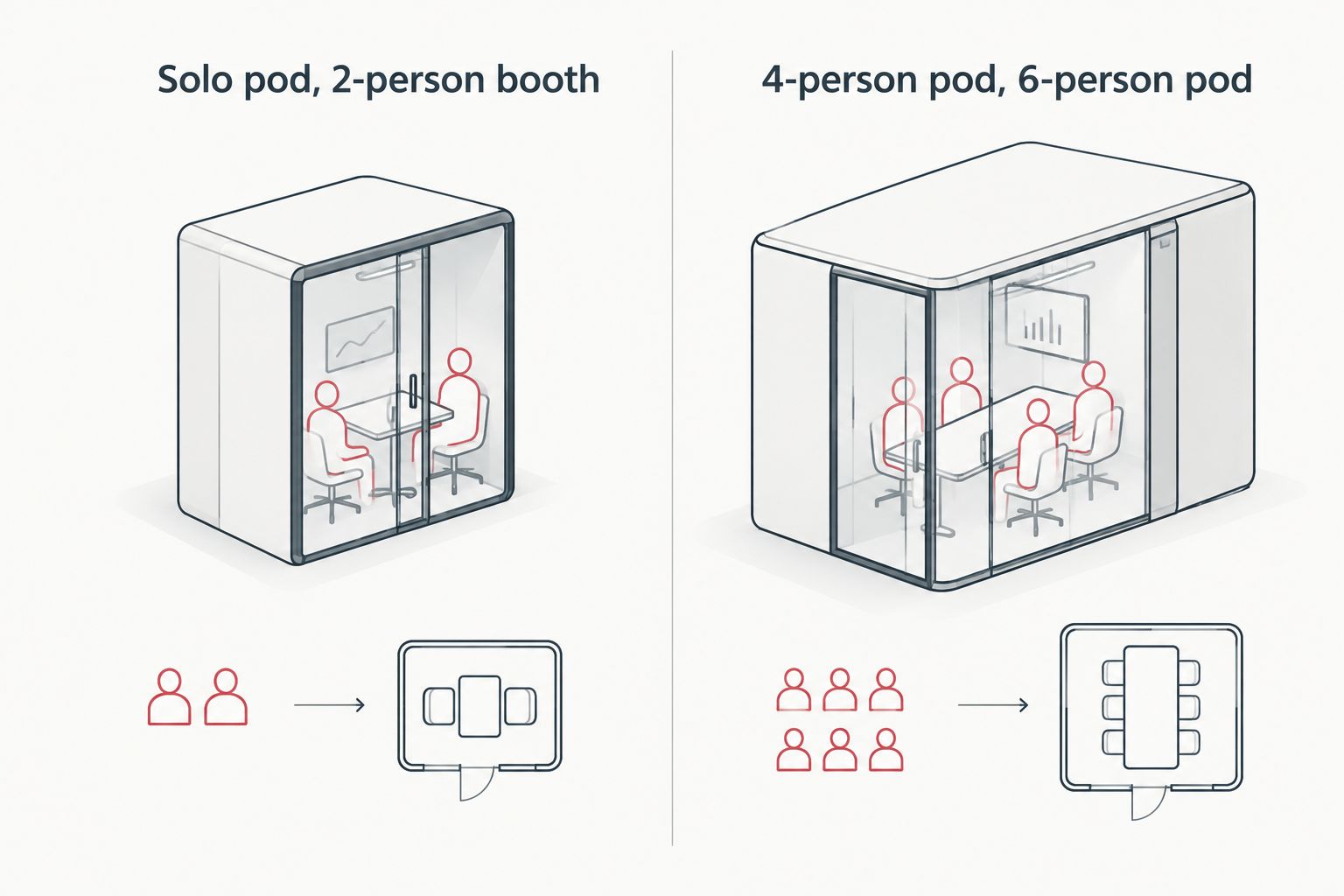
4. Six-person pod: best for larger team sessions
The 6-person meeting booth suits planning sessions and workshops that outgrow a four-seater. For bigger groups, the range also includes an 8-person Club House pod.
Where it shines
- Seats a full department or project group in one enclosed room.
- Takes pressure off the one or two real meeting rooms you have.
Where it falls short
- Needs the most floor space of the standard range.
- Overkill if most of your meetings are one or two people.
Best for: leadership groups, product teams, training sessions. Verdict: Buy when four seats are no longer enough.
How to buy in stages
Do not buy one big pod and hope. Growth is lumpy, and your meeting mix changes.
- Stage one: one or two solo pods for calls and a 2-person booth for one-to-ones.
- Stage two: add a 4-person pod when stand-ups start spilling into the open floor.
- Stage three: add a 6-person pod when a team outgrows four seats.
Size decisions are easier with a layout in hand. The guide to modular acoustic pod systems for growing office teams walks through how to add capacity without redesigning the floor.
When your current setup is the right call
If you have enough bookable meeting rooms and your team rarely needs a private call, pods are surplus. Likewise, if your work is mostly in-person collaboration with no confidentiality needs, a pod will sit empty.
Pods earn their place when the same problem repeats daily: someone needs privacy and nowhere to get it. If that is your week, buy one and watch how fast it fills.
FAQ
What size pod should a growing company buy first?
Start with a solo pod. Private calls are the most frequent request, and a solo pod answers it with the smallest footprint.
How much noise do Soundbox Store pods block?
They are tested to ISO 23351-1:2020 with 30-35 dB noise reduction. Real-world results depend on the surrounding room.
What capacities are available?
Soundbox Store sells pods from one person up to six, plus an 8-person Club House pod. Check each product page for current options.
Can a pod replace a meeting room?
For small teams, yes. A 4-person or 6-person pod covers most stand-ups and client calls. Large formal meetings still need a dedicated room.
Should I buy several pods at once or in stages?
In stages. Buy for today's meeting mix, then add larger pods as teams grow.
Where do I buy Soundbox Store pods?
Direct through the Soundbox Store online store. Check the product page for current availability and delivery details.
One last thing
Watch how people use the first pod in its first month. If it is always booked for one person, buy another solo pod before you buy a larger one. Usage tells you the next size faster than a headcount forecast does.


