 nl


 Productgids
Can a meeting pod replace a small meeting room?
Yes, you can use a meeting pod instead of a meeting room when the pod accommodates your usual group and supports the work you do together. It is a practical replacement for small-team conversations, not an automatic substitute for every function of an enclosed room. Before releasing an existing room, check seating, speech privacy, shared equipment and the meetings that overlap.
- Choose a meeting pod instead of a meeting room for small-group discussions with a clearly defined seating requirement.
- Soundbox Store meeting booths include 2-person, 4-person and 6-person options; match the enclosure to actual attendance.
- Keep a conventional meeting room for sessions whose furniture, equipment or group requirements exceed the proposed pod.
- Replacing seating capacity does not replace meeting availability: check simultaneous bookings before removing a room.
Why this matters
Replacing a room changes more than where people sit. You are deciding which conversations get dedicated space, which equipment stays ready to use and where larger meetings happen.
A product such as the Quell 4-Person Meeting Booth gives you a defined enclosure for a defined group. That is a useful starting point, but the replacement decision depends on what your current room actually does. Replace a meeting function, not just a room label.
Can a meeting pod replace a small meeting room?
A meeting pod can replace a small meeting room for conversations that fit its seating and working arrangement. A conventional room remains the better choice when your meetings require a layout or equipment arrangement that the proposed pod cannot provide.
Use this comparison to separate a genuine replacement from an additional meeting space. Neither format wins every use case.
| Option | Best for | Main advantage | Main limitation |
|---|---|---|---|
| Meeting pod | Small-group discussions with a defined seating requirement | Creates a dedicated enclosed meeting setting within the office | Its internal arrangement must suit the meeting; capacity alone is not enough |
| Conventional meeting room | Meetings requiring a room-specific furniture or equipment layout | Retains the existing room and its established working arrangement | Remains a shared resource when calls, discussions and workshops compete for bookings |
| Pod alongside a retained room | Offices with both small discussions and broader meeting needs | Assigns different activities to different spaces | Does not release the existing meeting room for another purpose |
Start with the recurring meetings you intend to move. A manager and colleague discussing a document have different requirements from a project team reviewing several laptops, printed plans and a shared display.
The useful question is not whether a pod looks like a small room. It is whether people can complete the same task inside it without losing essential working space or equipment.
A 2-person pod: best for one-to-one discussions
A 2-person pod is the relevant size to consider when the replacement brief centres on paired conversations. Think of a manager check-in, a colleague-to-colleague review or a discussion between two project leads.
The Quell+ 2-Person Pod is described for private conversations and focused work. Its named capacity makes it a candidate for this specific brief, rather than a substitute for a team meeting room.
Choose a 2-person pod for a two-person meeting requirement, not a small room that regularly hosts larger groups. Check how both people will use their laptops or documents, and whether the proposed seating arrangement supports the conversation.
Its strength is a clear purpose. Its limitation is equally clear: it does not cover the larger meetings you previously held in the same room. Identify where those meetings will go before changing the room allocation.
A 4-person pod: best for small-team reviews
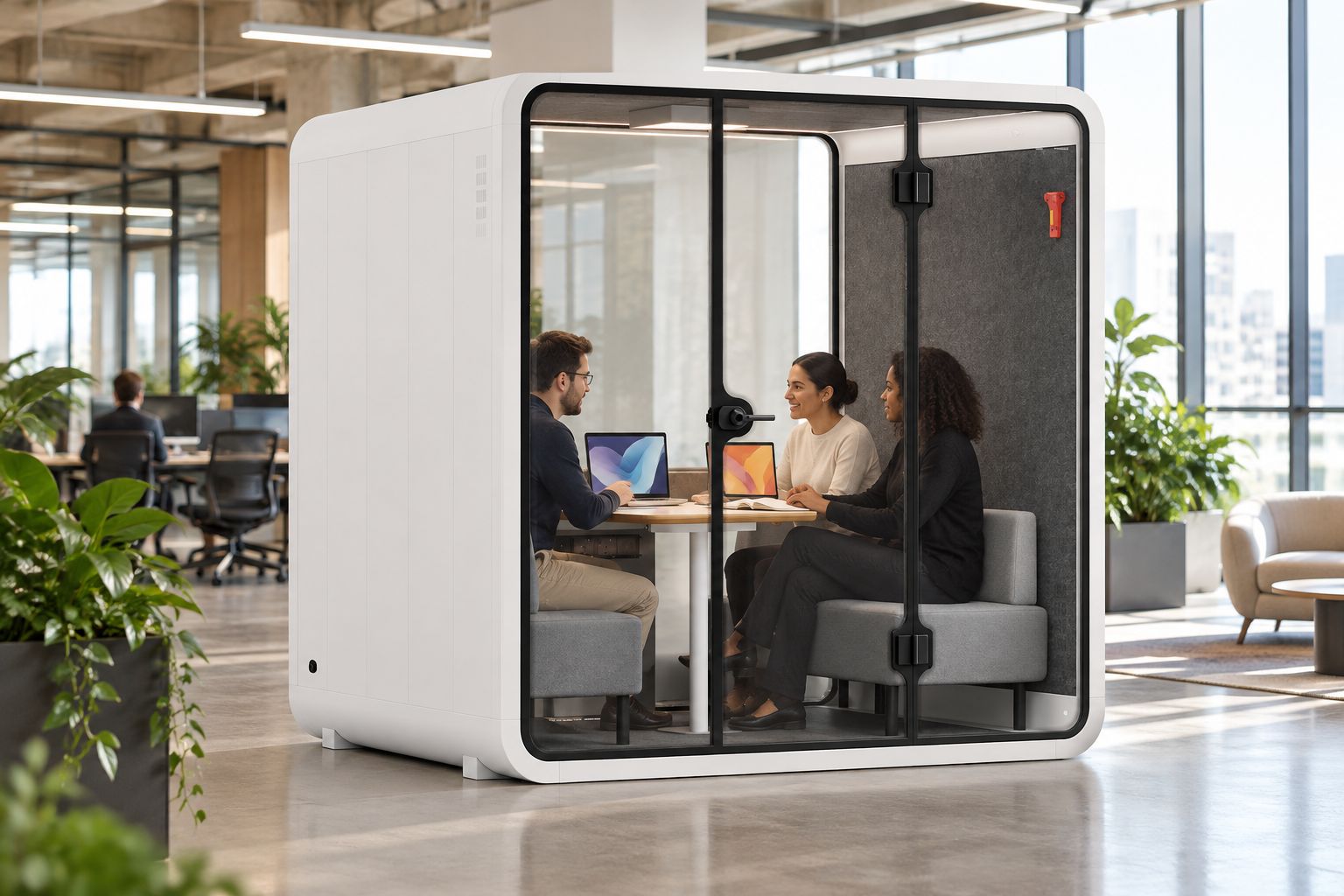
A 4-person meeting booth is relevant when your regular discussion brings a small team together. The Quell 4-Person Meeting Booth is a freestanding acoustic enclosure designed to seat four people.
This makes it a candidate for project reviews, team-lead discussions and small working meetings. The deciding detail is the activity inside the enclosure: talking around a shared document is not the same as spreading reference material across a large table.
Soundbox Store meeting booths are best for teams seeking dedicated enclosed space for small-group conversations. That is the strongest replacement case; it does not establish that every existing meeting-room activity will fit.
Consider the seating position of each participant. Ask who needs a clear view of a screen, who needs a laptop open and whether anyone must move between materials during the discussion. Review the proposed arrangement rather than treating the person count as a complete workspace specification.
A 6-person pod: best for a larger small-team meeting
A 6-person booth is the relevant candidate when the replacement needs to accommodate a larger small team. The Meeting Booth Quell 6-Person is described as a freestanding office pod designed for confidential meetings.
A larger named capacity broadens the attendance brief, but it does not answer every workspace question. Review how participants will share material, hear remote colleagues and use the table arrangement before treating the booth as a room replacement.
Choose a 6-person booth when the recurring group requires six places; retain another space for meetings outside that brief. Avoid choosing solely around the largest meeting you can imagine. Use the meetings you actually intend to transfer.
The following Soundbox Store meeting booths correspond to these attendance-led briefs. Their product descriptions establish the intended use and capacity; check each selected configuration against your meeting requirements.


Why the replacement decision varies
The right answer changes with the work your meeting room supports. Use these factors to write a replacement brief rather than choosing an enclosure first and finding a purpose for it afterwards.
- Attendance: Record the people physically present, not the full invitation list. Remote attendees do not require seats inside the pod, but they do affect the equipment brief.
- Meeting activity: Separate conversation-led meetings from sessions involving extensive paper layouts, demonstrations or movement around the room.
- Speech privacy: Define what you need to prevent others from hearing. An acoustic product description is not a promise that every conversation will be inaudible outside.
- Visual privacy: Decide whether people outside should be able to see participants, screens or documents. This is a separate requirement from reducing transmitted speech.
- Equipment: List what each meeting needs, including shared displays, laptops and conferencing equipment. Confirm the selected configuration rather than assuming features are included.
- Simultaneous demand: Check how many discussions happen at the same time. A larger enclosure does not create separate spaces for unrelated meetings.
Keep these requirements attached to named activities. “Project review with shared documents” is a more useful brief than “flexible collaboration”, because you can check whether the proposed space supports it.
Check the replacement before giving up the room
Treat the decision as a working-space review. You do not need a complicated scoring model; you need a clear account of what must continue after the room changes use.
Identify the meetings that will move
Review your existing room bookings and assign each recurring meeting a purpose. Record attendance, the materials used and whether participants join remotely. Separate actual meeting requirements from habits, such as booking a room simply because it is available.
Keep exceptions visible. A room that mostly hosts paired discussions can still have an important workshop function. Decide where that workshop will happen rather than quietly excluding it from the replacement plan.
Check the proposed working arrangement
Walk through a representative meeting with the proposed furniture layout in mind. Consider where laptops, notes and shared material will sit. Check sightlines for both people in the enclosure and anyone joining through a camera.
Ask what is included in the selected configuration. A product name that specifies the number of people does not, by itself, describe the furniture package or conferencing equipment.
Review speech and visual privacy separately
Use a representative conversation to evaluate the proposed acoustic setting. Listen from the surrounding workplace and assess whether speech remains understandable for the level of privacy you need. Do not treat a quiet interior as proof that speech cannot be heard outside.
Then review visibility. Look at the likely positions of screens and documents from outside the enclosure. Acoustic privacy and visual privacy answer different questions; neither should stand in for the other.
Keep an exception space
Identify where meetings that do not fit the pod brief will go. This might be an existing larger room or another retained meeting space. The important point is to assign the activity explicitly.
Do this before releasing the small room. Otherwise, the replacement appears successful only because the displaced meetings have become someone else's booking problem.
When should you keep the small meeting room?
Keep the room when its essential function depends on features the proposed pod does not provide. That includes a particular furniture arrangement, established equipment or working space for materials that do not suit the enclosure.
The existing room also deserves to stay if the replacement leaves recurring meetings without a suitable destination. An enclosure that handles the usual attendance is not enough when an important regular activity still has nowhere to happen.
Adding a booth without removing the room is a separate decision. It can give small conversations a dedicated destination while preserving the room for other work. Do not call additional capacity a replacement until the original room's essential functions have somewhere to go.
How should you judge whether the change worked?
Judge the change against the original brief. Check whether the intended meetings have moved into the booth, whether participants can use their materials and whether the remaining rooms still cover the exceptions.
Look beyond occupied seats. A busy booth can still be serving solo calls while the small-team meetings it was intended to accommodate continue competing for rooms. Conversely, occasional empty periods do not establish that the booth has failed its purpose.
Use booking records and direct feedback about the meeting task. Ask what prevented a session from using the booth, rather than asking only whether people liked it. That distinction turns a general preference into a specific change you can make.
FAQ
Can I use a meeting pod instead of a meeting room?
Yes, you can use a meeting pod instead of a meeting room when it supports the attendance, working arrangement and privacy requirements of the meetings you intend to move. Keep another suitable space for activities outside that brief.
What size meeting pod should a small team consider?
Consider a 2-person, 4-person or 6-person meeting booth according to the people physically attending. Soundbox Store offers meeting booths in these capacities; check the working arrangement as well as the seat count.
Does a soundproof meeting pod guarantee nobody can hear a conversation?
A soundproof product description does not guarantee that every conversation will be inaudible outside. Evaluate speech privacy in the intended workplace rather than relying on the product label alone.
Can a meeting booth support hybrid meetings?
A meeting booth is a candidate for hybrid meetings when the selected arrangement supports the required camera, audio, display and connectivity setup. Confirm those requirements for the specific configuration rather than assuming equipment is included.
Should we remove our existing meeting room after choosing a pod?
Retain the existing meeting room until every essential meeting activity has a suitable destination. Check larger groups, shared-material sessions and overlapping bookings before changing its use.
Is visual privacy the same as acoustic privacy?
Visual privacy concerns what people can see; acoustic privacy concerns what they can hear. Review screen and document visibility separately from speech transmission when assessing a meeting space.
One last thing
Count separate conversations, not just seats. A 6-person booth cannot host two unrelated discussions privately at the same time simply because their combined attendance fits.
Before replacing a small meeting room, mark the bookings that overlap. That check tells you whether you need a larger meeting enclosure, several separate meeting spaces or a retained room alongside the pod.


