 nl


 Productgids
Do acoustic panels or a pod work better for open-plan calls?
A pod works better for open-plan calls when you need to separate speech from surrounding desks; acoustic panels work better when the problem is echo across the shared room. Panels absorb reflected sound but do not enclose the caller, while a pod provides separation without treating the whole office.
- Acoustic panels vs pod: choose panels for room echo and a pod for separating calls from surrounding desks.
- Soundbox Store offers acoustic panels and office pods; match the product type to the problem rather than treating them as substitutes.
- Panels leave callers in the shared room; a pod only helps the people using its enclosed space.
- Use both when your office needs less reverberation and a separate place for calls.
Why this matters
A clearer call and a more private call are different outcomes. Reducing reflections helps with the first, but does not automatically deliver the second: colleagues can still hear speech travelling directly from a nearby desk.
Soundbox Store office pods are best for workplace teams that need a separate space for calls. The Quell Office Pod Solo is a 1-person phone booth designed for private calls; its limitation is equally clear: it serves the caller inside, not everyone working outside.
Before choosing anything, finish this sentence: you need to stop the room sounding echoey, stop calls interrupting colleagues, or stop colleagues interrupting calls. That distinction determines the right approach.
Do acoustic panels or a pod work better for open-plan calls?
Choose a pod for speech separation and panels for reverberation control. Neither does the other's job simply because both carry an acoustic description.
| Approach | Best for | Main benefit | Main limitation |
|---|---|---|---|
| Acoustic panels, including the Acoustic Ceiling Panels Set | Reducing reflected sound in a shared room | Absorb sound that would otherwise reflect from room surfaces | Do not create an enclosed call space |
| Quell Office Pod Solo | Individual calls away from open desks | Provides a separate, enclosed place for the caller | Does not treat reverberation throughout the office |
| Panels and a pod together | Offices with both room echo and call-separation problems | Address the shared room and the individual call space separately | Require planning for both room treatment and pod use |
The useful comparison is not which product makes an office completely silent. It is which sound path you need to address: reflections around the room, or speech moving between a caller and surrounding desks.
For example, a client call taken beside colleagues remains a shared-room conversation even after you add absorption. Moving that call into an enclosure changes the physical separation. Treating the surrounding room then addresses the reflections that remain outside.
Acoustic panels: best for echo in the shared room
Acoustic panels absorb some of the sound energy that reaches them, reducing reflections back into the room. That makes them relevant when speech sounds reverberant rather than simply too close.
Picture an open-plan project team holding routine calls at their desks. If the room has prominent reflections, absorption addresses that shared acoustic condition without moving each caller somewhere else. Everyone remains in the same workspace.
The advantage is room-level treatment. The limitation is that a panel on a wall or ceiling is not a continuous barrier between a speaking colleague and your microphone, or between your voice and the next desk.
What panels do not solve
Acoustic panels do not turn an open desk into a private phone booth. Even when reflected sound decreases, direct speech still reaches nearby listeners.
This matters during recruitment conversations, client discussions and personal calls. A room that sounds less echoey is not automatically a room where words cannot be understood.
Panels also do not fix every source of poor call audio. Microphone position, loudspeaker playback and the connection itself are separate issues; adding absorption is not a substitute for identifying which problem the remote participant actually hears.
Choose panels when your complaint describes the room: hollow-sounding speech, lingering reflections or an echoey shared workspace. Do not choose them solely because someone needs somewhere separate to talk.
An office pod: best for separating the caller
An enclosed pod gives the caller a distinct space within the workplace. Unlike room panels, it places an enclosure between the conversation and surrounding activity.
That makes a pod the more relevant option when a team member needs to join a client call without speaking directly beside colleagues. It also gives the caller a way to leave the open desk area rather than asking everyone nearby to change their behaviour.
Separation is not a promise of total silence or guaranteed confidentiality. Actual audibility depends on the enclosure, the conversation and the surrounding conditions; the word soundproof should not replace an assessment of the intended use.
Choose for the people inside, not the remote audience
The supplied Soundbox Store range includes single-person booths, 2-person pods and meeting spaces described for up to 6 people. These serve different patterns of use, rather than representing interchangeable answers to the same call problem.
A colleague joining a remote meeting alone needs space for that individual, regardless of how many people appear on screen. When colleagues regularly join from the same physical location, assess a meeting space for that shared activity instead.
The trade-off is shared access. A separate call space helps only when someone can use it, so a pod purchase also needs a clear decision about which conversations take priority.
Using panels and a pod: best for mixed acoustic problems
Panels and pods complement each other when the office has problems both inside and outside the call space. The pod separates the conversation; absorption addresses reflections in the larger room.
Consider a customer-facing team whose calls disturb nearby desk work in an echoey office. Moving selected calls into a pod addresses those conversations, but leaves the open room's reflective surfaces unchanged. Panels address that remaining room condition.
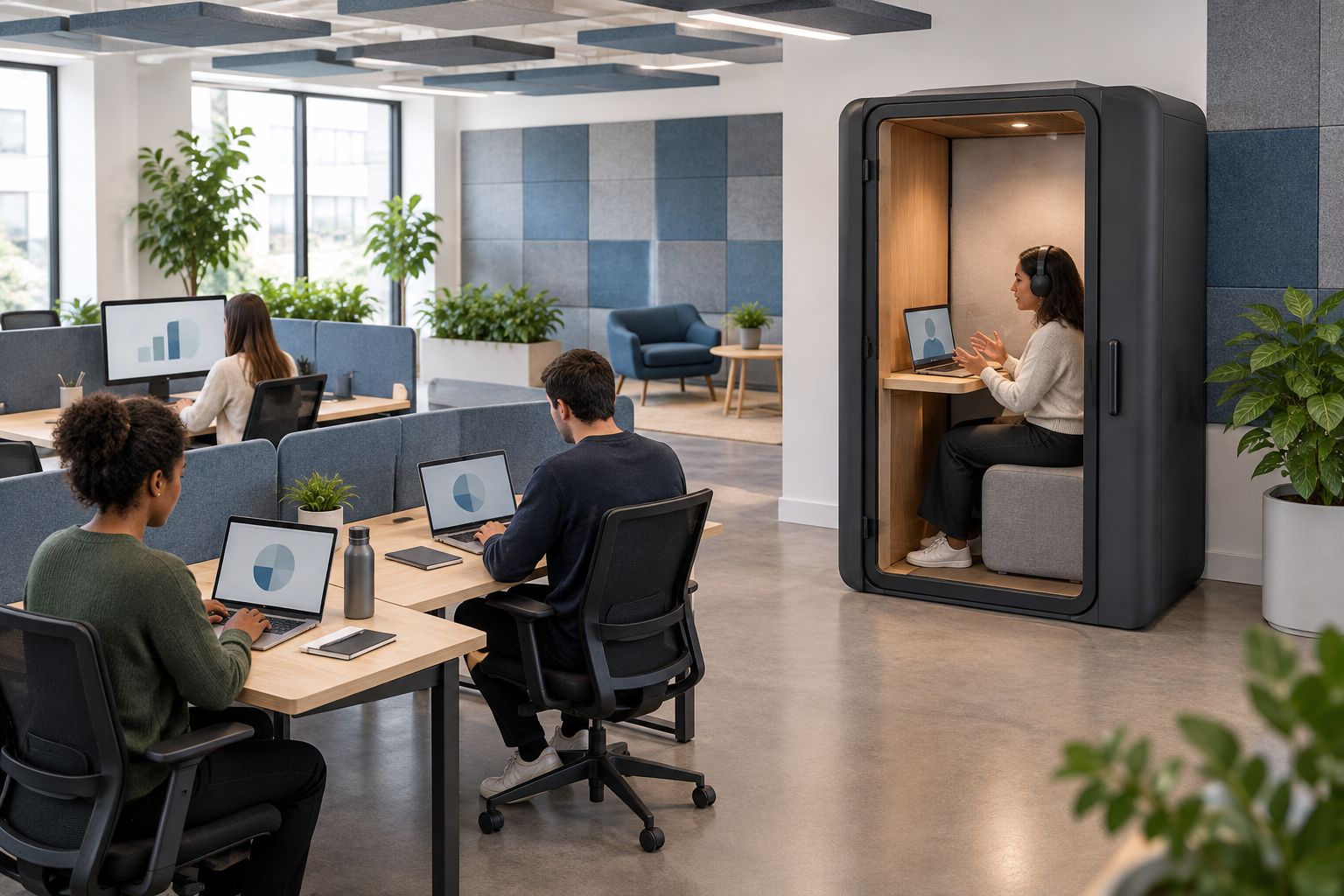
Do not assume you need both from the outset. If the shared room already sounds controlled and the remaining issue is desk-side calls, start with call separation. If nobody needs a separate conversation space and the complaint is reverberation, focus on the room.
The combined approach earns its place when you can name both problems independently. Otherwise, it risks answering a problem you do not have.
Why the better choice varies between workplaces
The right answer changes with the call pattern and the room, not just the product label. Use these factors to define the brief before comparing options:
- The sound path: Reflections from surfaces call for absorption; speech travelling directly between adjacent desks calls for separation.
- The required outcome: Clearer speech, fewer interruptions and a separate conversation space are related but distinct goals.
- The people sharing the call space: An individual call and a discussion with colleagues physically together need different spaces.
- The location of the complaint: Echo across the office and distraction beside a particular caller point to different interventions.
- Simultaneous demand: A shared booth does not resolve overlapping requests unless your team decides how to allocate it.
- The condition outside the enclosure: Adding a pod leaves the surrounding room's reverberation as a separate consideration.
Avoid choosing from a single adjective such as quiet or acoustic. Describe the activity, the people involved and what should change for the person at the next desk.
How to decide before you buy
Use a short workplace check to separate the room problem from the conversation problem. This is a decision process, not an acoustic performance test or a substitute for product-specific information.
- Name the affected activity. Identify whether the issue arises during client calls, internal video meetings or ordinary conversations. Keep the brief tied to the activity rather than calling the entire office noisy.
- Describe what people hear. Ask whether the complaint is lingering reflected speech, intelligible nearby conversation or background activity reaching the remote listener. These are different observations.
- Compare the shared area with an enclosed room. Take the same ordinary call away from the open desks. Listen for which problems change, without treating the comparison as proof of any particular product's performance.
- Identify who needs the space. Separate individual calls from conversations involving colleagues together. Remote attendance does not determine the physical capacity required.
- Set the success condition. Write down the intended result: less room reverberation, fewer desk-side conversations or a separate place for calls. Keep each outcome specific enough to review afterwards.
Keep your normal headset and call settings consistent when making observations. Changing the room and the audio equipment together makes it harder to tell which change addressed the complaint.
After the check, select the intervention that matches the remaining problem. Do not buy absorption to create an enclosure, or an enclosure to treat the entire room.
Product types that match the decision
For an individual caller who needs separation, the Quell Office Pod Solo is the relevant product type. For reflected sound in the shared workspace, the Acoustic Ceiling Panels Set is the relevant treatment type; it is not a replacement for a call enclosure.
These Soundbox Store products serve different purposes. Compare them against your intended outcome rather than expecting a single acoustic measure to describe both room absorption and speech separation.


FAQ
Are acoustic panels or a pod better for calls beside open-plan desks?
A pod is better when you need to separate the caller from surrounding desks. Acoustic panels are better suited to reducing reflected sound in the shared room, but they do not enclose the conversation.
Will acoustic panels stop colleagues hearing my phone calls?
Acoustic panels do not reliably stop nearby colleagues understanding your phone calls. They absorb reflections, while your voice can still travel directly to someone sitting nearby.
Can an office pod replace acoustic treatment across the office?
An office pod does not replace acoustic treatment across the office. It provides an enclosed space for its occupants while the surrounding room remains a separate acoustic environment.
How do I tell whether my video call problem is echo or office noise?
Listen for whether the complaint is reflected, reverberant speech or recognisable activity from nearby desks. Ask the remote participant what they hear, and check microphone and loudspeaker behaviour separately before attributing the problem to the room.
Do I need a meeting pod if I join a large online meeting alone?
You do not need a multi-person meeting pod solely because many people attend remotely. A single-person booth serves an individual caller; assess a larger space when colleagues need to participate together in person.
Which Soundbox Store product type suits an individual caller?
The Quell Office Pod Solo is a 1-person phone booth designed for private calls. Its role is a separate call space, not acoustic treatment for everyone working in the surrounding office.
One last thing
A call sounding clearer to the remote listener does not prove it is more private for people in the office. Those listeners hear different sound paths, so review both outcomes separately.
Before choosing between panels and a pod, ask a colleague at a nearby desk what they can understand during an ordinary conversation. Use that observation to define the separation you need, not as a guarantee of confidentiality. Treat the room for reflections; provide an enclosure when the conversation needs its own space.


