 nl


 Productgids
Why is it hard to concentrate in an open-plan office?
It is hard to concentrate in an open-plan office because nearby speech, visible activity and interruptions compete with the attention you need for your work. The problem is not simply loudness: even a relatively quiet conversation can pull you away from reading, writing or checking detail, while constant availability makes uninterrupted work difficult.
- To concentrate in an open-plan office, separate focused work from conversations rather than asking everyone to tolerate distractions.
- Nearby speech, movement and desk-side questions create different problems; match the response to the distraction.
- Soundbox Store office pods suit businesses that need separate spaces for private calls and focused work.
- A quieter workspace still needs clear expectations about interruptions, calls and shared access.
Why this matters
An open-plan office puts different activities within earshot of each other. Someone preparing a proposal needs sustained attention; a colleague resolving a customer query needs to talk. Neither task is wrong, but the shared setting creates a conflict.
Treat concentration as a workspace requirement, not a test of willpower. Before changing furniture or buying equipment, establish whether the main interruption comes from conversations, passing activity, direct questions or your own notifications.
Where private calls are the issue, Soundbox Store's Quell Office Pod Solo is a 1-person booth designed for that use. An enclosure addresses a different problem from an agreement to stop interrupting colleagues; your office might need both.
Why is it hard to concentrate in an open-plan office?
An open-plan office shares more than floor space. It also shares conversations, movement and signals that colleagues are available, even when they are working on tasks that demand concentration.
Use the following distinction to identify what is actually pulling you away from the work. A room that sounds busy and a desk where people repeatedly ask questions need different responses.
| Distraction | What makes concentration difficult | First response | Limitation |
|---|---|---|---|
| Nearby speech | Understandable words compete with reading and writing | Move calls and discussions away from focus desks | Requires another place to talk |
| Visible movement | Passing activity draws your gaze from the task | Choose a desk facing away from busy routes | Does not reduce conversations |
| Desk-side questions | Each exchange interrupts the task you were holding in mind | Agree when and how colleagues should interrupt | Needs consistent team behaviour |
| Notifications | Messages create another competing stream of information | Pause non-essential alerts during focused work | Does not change the room |
| Mixed activities | Calls, collaboration and individual work happen together | Give different activities distinct spaces | Space alone does not establish expectations |
Speech competes with language-heavy tasks
You do not have to join a conversation for its words to become distracting. When you are drafting a report or reading a detailed brief, nearby speech introduces another stream of language alongside the one you are trying to process.
Listen for intelligibility, not just volume. If you can follow a colleague's call from your desk, asking that colleague to speak a little more softly does not necessarily remove the distraction.
Interruptions break the thread of a task
A short question can interrupt a complicated piece of work. After answering, you still need to recover where you were, what you were comparing and what you intended to do next.
That makes the interruption's duration an incomplete measure of its effect. When checking a spreadsheet or editing a difficult paragraph, the lost thread matters as much as the exchange itself.
Visibility creates an expectation of availability
Being visible at your desk does not mean you are ready for a conversation. Open-plan working often leaves that distinction unstated, so colleagues use proximity as permission to ask something immediately.
Make availability explicit. A shared focus status only helps when everyone understands what it means and which requests genuinely need an immediate response.
Why concentration varies across the office
The same desk can support routine administration and frustrate detailed analysis. Concentration depends on the interaction between the task, the surroundings and the interruptions, rather than a single property of the room.
- Task demands: Reading, drafting and checking complex information require a different setting from a collaborative discussion.
- Speech nearby: A recognisable conversation creates a different distraction from an indistinct background hum.
- Movement in view: Desks facing a busy walkway expose you to activity that a more sheltered position avoids.
- Interruption expectations: A team that treats every question as immediate makes protected work difficult, even in a quiet room.
- Access to alternatives: A separate space only helps when you can use it at the point the task requires it.
- Digital habits: Moving to a quieter setting leaves message alerts and unnecessary application switching unchanged.
Do not assume everyone needs the same conditions for every task. Ask what people are trying to complete and what interrupts that work, rather than debating whether the office is objectively too noisy.
Match the response to the distraction
Change the source of the interruption before asking the person affected to work harder around it. Headphones, quieter desks, room treatment and enclosed spaces serve different purposes; none replaces every other measure.
Move spoken work away from focused work
If calls dominate the desk area, give callers somewhere else to go. This addresses the source of the speech rather than asking every nearby colleague to ignore it.
Keep the distinction practical. Routine conversation belongs in a collaborative area; a call or discussion that needs separation belongs in an appropriate enclosed space. Avoid turning a designated quiet area into an overflow meeting space when other rooms are occupied.
Reduce visible activity where the task demands it
For close reading or detailed checking, choose a position that does not face a constant flow of colleagues. The aim is to remove an unnecessary competing view, not to isolate everyone throughout the working day.
A different seat will not solve every acoustic problem. Check whether the improvement comes from less movement, greater distance from conversations or fewer people approaching you, so you know what to preserve.
Agree how interruptions should work
Set a clear route for non-urgent questions. A message that someone can answer after finishing a task serves a different purpose from a desk-side request that demands an immediate reply.
Preserve a route for genuinely urgent work. A focus agreement fails when colleagues either ignore it altogether or cannot reach someone when an immediate decision is necessary.
Distinguish absorption from separation
Acoustic treatment and an enclosed workspace address different aspects of office noise. Absorptive treatment reduces reflected sound within a room; an enclosure separates an activity from the surrounding workspace.
Do not describe either approach as a promise of silence. Choose according to the problem: a reverberant shared room needs a different response from a clearly audible call beside someone writing a report.
Use enclosed space for the activity that needs it
An enclosed space is relevant when the task needs separation from the desk area. Start with the activity and number of participants, rather than assuming a larger meeting booth is automatically a better focus space.
Soundbox Store office pods suit businesses that need separate spaces for private calls and focused work. Their limitation is organisational as well as physical: buying a booth does not decide who gets access or stop colleagues interrupting someone inside.
| Product | Best for | Supported use | Limitation to plan around |
|---|---|---|---|
| Office Phone Booth Folio | Individual calls and focus | A 1-person booth for private calls, video meetings or focused work | Intended for one person, not a shared discussion |
| Office Phone Booth Quell - 2 Person | Private conversations between colleagues | A 2-person acoustic enclosure for private meetings | Shared meetings and individual focus need an agreed access policy |
Choose the individual booth when one person needs to step away from desk-side distractions. Choose the two-person option when the recurring activity is a discussion that would otherwise happen beside colleagues doing focused work.
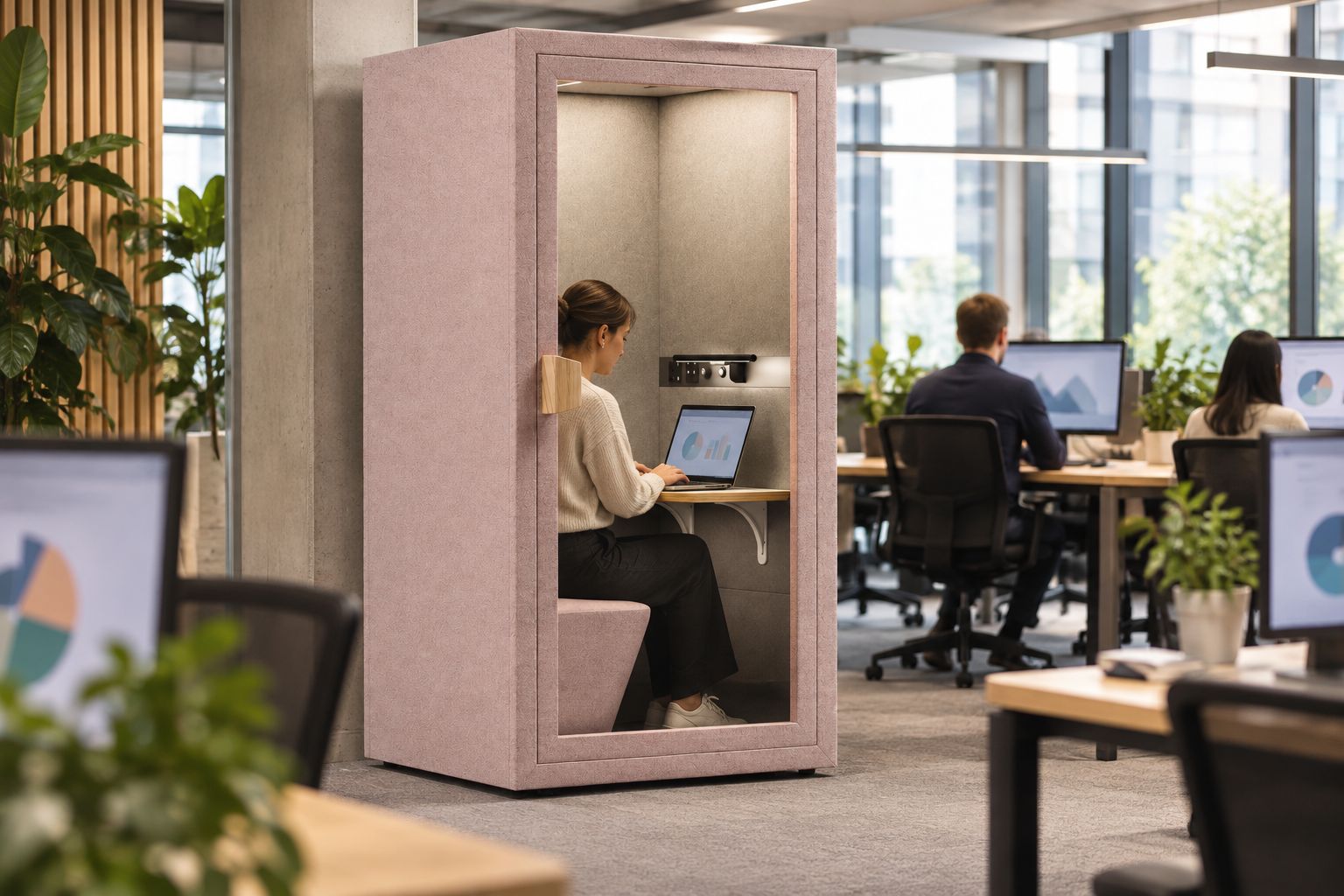
The useful distinction is not simply between an open desk and a booth. It is between a space assigned to a clear purpose and a space expected to handle incompatible activities at once.


Make the next focused task easier to complete
Start with a real piece of work, not a general promise to concentrate better. A proposal, document review or detailed check gives you a specific task against which to judge the setting.
- Name the task. Decide what you need to finish before choosing where to work. Distinguish work that needs discussion from work that needs uninterrupted attention.
- Identify the interruption. Note whether speech, movement, questions or alerts pull you away. Avoid treating every distraction as an acoustic problem.
- Choose the setting. Use a quieter desk for reduced passing activity or a separate space when the work needs separation from conversation.
- Signal your availability. Tell relevant colleagues how to reach you and which questions should wait until you have finished.
- Check the result. Ask whether you completed the intended task with fewer interruptions. If not, identify what remained rather than assuming the whole approach failed.
This is a practical check, not a productivity study. You do not need to attach a percentage improvement to notice that moving away from calls helped with reading, while leaving message alerts active continued to break your attention.
For managers, look at access as well as provision. If the only quiet space is occupied whenever detailed work needs doing, the office has not resolved that need merely by providing the room.
Avoid fixes that leave the main problem untouched
A headphone policy leaves spoken work beside focused work. It also leaves desk-side questions and visible movement unchanged, so do not treat headphones as a complete office-wide solution.
A quiet-zone label is equally incomplete without shared expectations. Explain whether calls are allowed, where conversations should move and how colleagues should ask questions without demanding an immediate response.
Booking rules need the same clarity. If every enclosed space becomes a permanent personal office, callers return to the desks; if every booth is reserved for calls, people doing concentrated individual work lose access to a quieter setting.
Protect the activity, not just the room. Decide which spaces support calls, discussions and individual focus, then make those distinctions understandable to everyone using the office.
FAQ
Why do conversations distract me when I am not part of them?
Understandable speech competes with language-heavy work such as reading and writing. A conversation does not have to involve you to draw attention away from the words you are trying to process.
Are headphones enough to help me concentrate in an open-plan office?
Headphones are not a complete solution to open-plan distractions. They leave visible activity, desk-side questions and your own notifications unchanged, so combine personal measures with clear workspace expectations.
Should I move desks or ask colleagues to stop talking?
Choose the response that matches the activity: move focused work away from passing activity, and move calls or discussions away from focus desks. A shared office needs places for both conversation and concentration rather than a blanket ban on talking.
What should I tell my manager when I cannot focus?
Describe the task, the interruption and the change you want to try. Explaining that nearby calls interrupt document checking gives your manager a clearer problem to address than saying the office is distracting.
Will acoustic panels make an open-plan office private?
Acoustic panels address sound absorption, not complete separation between conversations and nearby desks. Treat reflected sound and speech privacy as different requirements rather than assuming the same measure resolves both.
How should a team share a quiet booth fairly?
Agree which activities the booth supports and how colleagues reserve and release it. Keep access tied to a clear work need, so private calls and focused tasks do not compete without an agreed rule.
One last thing
The person who needs to move is not always the person trying to concentrate. When a desk area is intended for focused work, moving a call elsewhere addresses the interruption at its source instead of displacing everyone who can hear it.
Before choosing a Soundbox Store booth, decide which activity it will take out of the shared workspace. That answer gives the purchase a clear purpose and gives colleagues a clear reason to use it.

