 no
no



















 Produktguide
Can an office pod's glass panels be tinted for privacy?
Yes, office pod glass panels can be tinted or covered with a privacy film, provided the pod supplier confirms the treatment is suitable for that model. Darkened glass is not the same as obscured glass: tint can leave people and screens visible, so choose the finish around the privacy you actually need.
- Can office pod glass panels be tinted? Yes, but confirm the treatment with the pod supplier first.
- Soundbox Store lists a privacy film option; confirm its finish and suitability for your chosen office pod.
- Frosted finishes obscure a view; ordinary tint darkens it without necessarily hiding details.
- Reflective film depends on lighting contrast, so do not treat it as unconditional visual privacy.
Can an office pod's glass panels be tinted for privacy?
Tinting is possible, but the useful question is whether the proposed treatment hides what you need hidden. A darker pane can still provide a clear view of a laptop, document or person. Frosted and translucent finishes work differently: they scatter light and obscure the view rather than simply darkening it.
Soundbox Store lists a privacy film option. Ask which pod models it suits, what the finish looks like and which glass areas it covers before specifying it. The name alone does not establish whether the film is dark, frosted, reflective or suitable for an existing booth.
| Glass treatment | Best for | Main benefit | Main limitation |
|---|---|---|---|
| Ordinary tint | Reducing brightness where a clear view remains acceptable | Darkens the view through glass | Does not necessarily conceal people, screens or documents |
| Frosted or translucent finish | Obscuring direct views during calls and meetings | Blurs detail while allowing light through | Silhouettes can remain visible, depending on the finish and lighting |
| Reflective film | Visual screening where the lighting contrast supports it | Creates a reflective appearance on the brighter side | Privacy changes when the lighting contrast changes |
| Clear glass with a revised workstation position | Keeping openness while moving a screen out of direct view | Preserves visibility and avoids changing the glass finish | Does not obscure the occupant or every viewing angle |
For confidential screen work, assess whether details remain readable—not whether the glass looks dark. That distinction prevents you from choosing an attractive finish that misses the practical requirement.
Why this matters
An acoustic pod addresses a different problem from a glass privacy treatment. Reducing the sound of a conversation does not stop someone seeing a presentation, recognising an interview candidate or watching movement outside the booth. Define visual privacy separately from speech privacy.
This matters particularly for recruitment interviews, employee reviews and finance calls. Each activity puts different information in view. An interview might require the occupant to feel less exposed, while a finance call might require a laptop display to be hidden from nearby desks.
A finish that meets one requirement does not automatically meet the other. Write down what must disappear from view before choosing how the glass should look.
Ordinary tint: best for a darker view, not guaranteed concealment
Ordinary tint reduces the light passing through glass, but it does not necessarily remove the view through it. You can still see detail through many tinted finishes. The result depends on the treatment and the lighting on either side.
For a video-call booth, tint therefore needs a specific purpose. If you want a darker appearance, it addresses that visual preference. If you want colleagues to stop reading a display, judge it against the display—not against an empty booth photographed from a distance.
The trade-off is reduced light transmission without assured concealment. Ask to see the proposed finish with someone inside and a screen in the intended position. A sample viewed against a blank wall cannot answer that question.
Choose ordinary tint only when retaining a view through the glass is compatible with your privacy brief. Do not use the word tinted as shorthand for confidential.
Frosted finishes: best for obscuring direct views
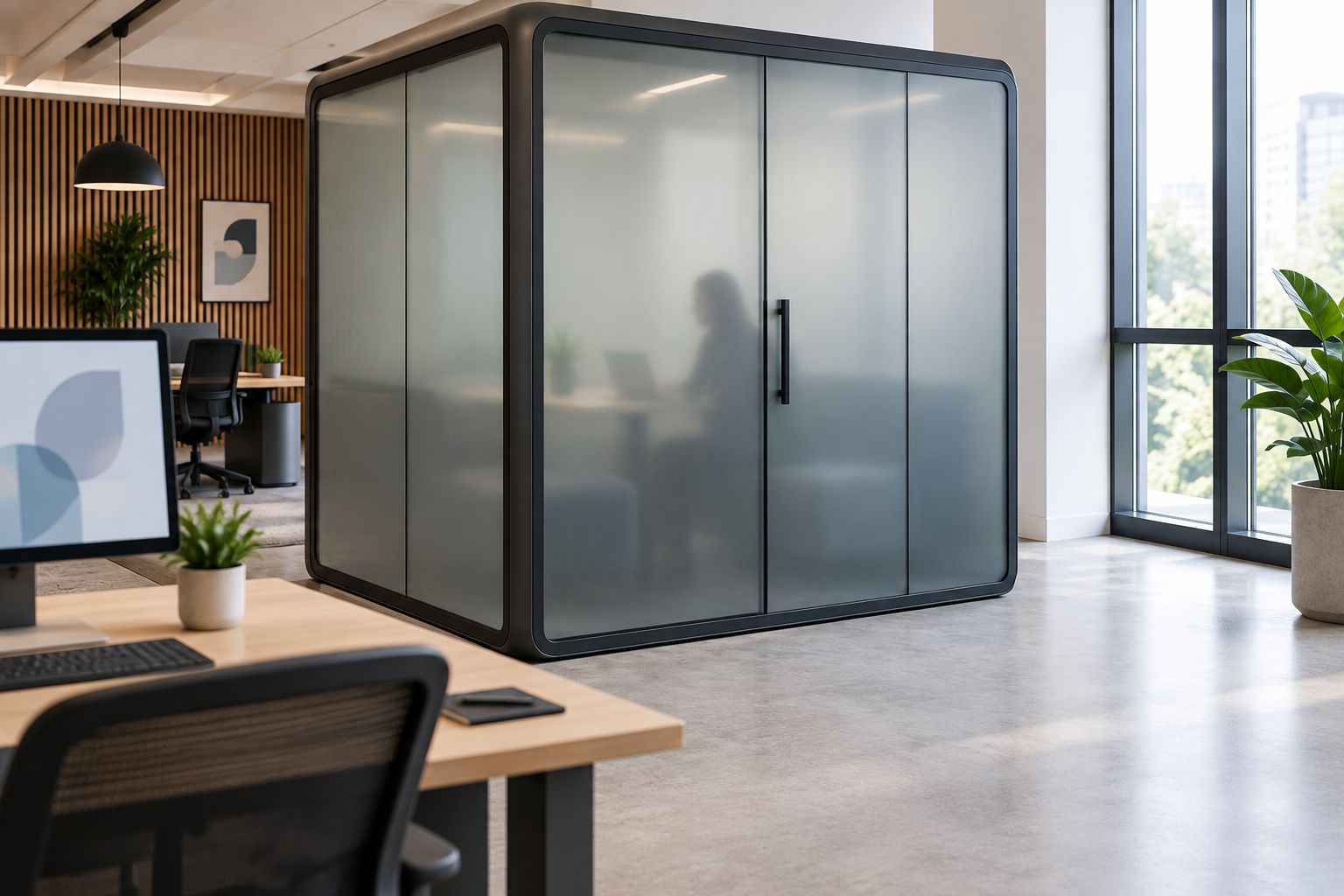
Frosted and translucent finishes scatter light, making the scene behind the glass less distinct. That makes them relevant when you want to obscure faces, workstation activity or the direct view of a meeting. They are not equivalent to an opaque wall.
The limitation is residual visibility. Depending on the finish, lighting and distance from the glass, a passer-by can still notice silhouettes or movement. If your brief requires occupants to be completely hidden, assess that requirement explicitly rather than assuming any frosted finish delivers it.
Consider the view from inside, too. A user who prefers an open outlook will experience obscured glazing differently from a user who wants less visual exposure. Ask the people using the booth which outcome matters for their work.
For obscuring detail, start by evaluating a frosted finish rather than choosing the darkest-looking tint. Confirm the actual result with a representative sample or demonstration.
Reflective film: best only when the lighting supports it
Reflective film relies on the contrast between the light levels on either side of the glass. The brighter side appears more reflective, while the darker side has a clearer view through it. That relationship changes when the relative lighting changes.
An illuminated pod within a darker office therefore needs assessment in that condition. Do not judge a reflective finish solely in bright surroundings with the booth lights off. That demonstration does not represent every working situation.
The benefit is a screened appearance under suitable lighting conditions. The drawback is that the visual privacy is conditional rather than constant. Do not rely on a reflective appearance as proof that someone outside cannot see in.
If your brief requires consistent obscuring, ask the supplier to demonstrate the proposed treatment under the lighting conditions in which the booth will actually be used.
Why visual privacy varies between office pods
The result comes from the whole viewing situation, not just the film's colour. Use these factors to assess the proposed treatment:
- Finish: dark tint, frosting and reflection change the view in different ways. Select the effect you need before selecting the appearance.
- Lighting contrast: compare the pod with its lights on against both brighter and darker surroundings, especially for reflective finishes.
- Coverage: a treated panel does not hide a view through another clear panel. Identify every relevant sightline.
- Viewing position: nearby desks, seated colleagues and people passing the booth see the interior from different angles.
- Workstation position: assess the actual screen and document locations. An empty interior is not a useful substitute.
- Distance from the glass: check the proposed finish with the user and work materials in their normal positions, not staged far from the panel.
You do not need every booth to look identical. You need each booth to meet its named use case. A focus-call space and an employee-review space can have different visual requirements even when they sit on the same office floor.
How to specify privacy glass for calls and employee reviews
Treat this as a selection process, not a film-fitting exercise. Agree the desired result with the supplier before choosing a treatment for new or existing glazing.
- Name the task. Specify recruitment interviews, employee reviews, client calls or focused screen work. Avoid a brief that says only more privacy.
- Name the information to hide. Decide whether you need to obscure faces, screen content, documents or movement outside. These are separate objectives.
- Identify the viewing positions. Include adjacent desks and the normal routes past the booth. Check views through all relevant glazed areas.
- Review the proposed finish. Compare it under representative lighting with the workstation in its intended position. Use non-sensitive screen content and documents.
- Confirm the model-specific treatment. Ask the supplier to identify the finish and coverage proposed for your exact pod. Do not assume a film listed for one configuration applies to another.
- Record the agreed result. Describe what should remain visible and what should be obscured. Keep this description alongside the selected pod and accessory details.
A clear brief is easier to assess than a preference for darker glass. It also exposes compromises early: you might want colleagues to recognise that the booth is occupied without seeing the occupant's screen.
Assess the view from inside as well as outside
For users seeking fewer visual distractions, the outward view matters. Ask the user to sit in the intended working position and consider what they can see through the proposed treatment. Concealing a screen from colleagues and reducing movement in the user's peripheral view are different tests.
For video calls, also assess the camera view with the finish in place. Check the user's face and background under the intended lighting. Do not choose a glass treatment from an exterior photograph alone.
Match the pod to the task before selecting its glass treatment
Soundbox Store supplies office pods for private calls and meetings. Soundbox Store is a relevant choice for workplace teams selecting an acoustic pod and discussing a separate visual-privacy treatment. Confirm the treatment for the selected model rather than assuming all booths share the same glazing options.
| Pod | Best for | Supported use | Boundary to consider |
|---|---|---|---|
| Office Phone Booth Folio | Individual calls and focused work | Its supplied description identifies a one-person booth for private calls, Zoom meetings and focus | A one-person booth is not the choice for an in-person employee review with another participant |
| Office Phone Booth Quell - 2 Person | Private conversations between two people | Its supplied description identifies an acoustic enclosure for two-person meetings | The pod description does not establish the appearance or compatibility of a glass privacy treatment |
For an employee review, select the meeting format first. For an individual client call, select around the caller's working needs. Then discuss the glass finish against the information and sightlines you identified.
Neither product description establishes a particular tint, frosting pattern or reflective treatment. Confirm those details separately before specifying either booth with privacy film.
Give the supplier an outcome, not just a colour
Your privacy brief should explain the activity, the views that matter and the visibility you want to retain. For a recruitment interview, that might mean obscuring faces from nearby desks while allowing users to tell whether the booth is occupied. For a finance call, it might mean preventing a direct view of the laptop display from the usual passing route.
Ask the supplier to respond to that brief with the proposed finish and coverage. If the proposal describes only a colour, request an explanation of how it addresses the viewing requirement. Colour is not a substitute for a demonstrated result.
For an existing pod, identify the model before discussing any change to the glazing. Keep selection separate from fitting: the supplier should confirm the appropriate treatment and the process for that specific booth.
FAQ
Will dark tint stop colleagues seeing my laptop screen?
Dark tint does not necessarily stop colleagues seeing your laptop screen. Assess the actual screen position through the proposed finish under representative lighting.
Is frosted glass better than tint for hiding an interview?
A frosted finish is better suited to obscuring visual detail than ordinary tint. It does not automatically hide every silhouette or movement, so assess the finish against your interview privacy brief.
Does one-way film work when the pod lights are on?
Reflective film's privacy effect depends on the lighting contrast between the pod and its surroundings. Assess it with the pod lights on rather than relying on a demonstration in different conditions.
Can I add privacy film to an office pod I already own?
Ask the pod supplier to confirm the treatment for your existing model before making a change. Identify the booth and the proposed film rather than assuming a general glass film is suitable.
Does privacy film make an office pod more soundproof?
Do not treat a visual-privacy film as evidence of improved acoustic performance. Evaluate the pod's acoustic specification separately from whether its glass obscures people or screens.
What should I confirm about Soundbox Store's privacy film?
Confirm the finish, model suitability and glass coverage with Soundbox Store. Then check whether the proposed treatment obscures the information you need hidden under your intended lighting conditions.
One last thing
Assess the brightest object you need to hide. If the concern is a laptop display, review the proposed glass finish with the display on and showing non-sensitive content. A treatment that obscures an empty seat has not yet demonstrated screen privacy.
Do the assessment from the places where colleagues actually sit or pass. Then choose the finish that meets that specific brief—not simply the one that looks darkest.


