 no


 Produktguide
How to give staff a private space for personal medical calls
Give staff a private space for medical calls at work by providing an enclosed room or single-person acoustic booth, a discreet booking process and a backup space when it is occupied. Check speech privacy, screen visibility and call connection before offering the space for personal conversations. A closed door alone is not proof that colleagues cannot understand what is being said.
- A private space for medical calls at work needs speech privacy, discreet booking and an alternative when occupied.
- Soundbox Store’s Quell Office Pod Solo is designed for one-person private calls, not shared conversations.
- Check acoustic privacy and visual privacy separately; neither proves the other.
- Let staff reserve a private-call space without entering medical details in a shared calendar.
How do you give staff a private space for personal medical calls?
Provide a closed space that staff can use without explaining their medical circumstances. Start with an existing enclosed room, then consider a dedicated phone booth if shared rooms cannot accommodate personal calls reliably.
Choose the space around the person making the call, rather than the largest meeting your office holds. These options serve different needs:
| Option | Best for | Practical advantage | Limitation |
|---|---|---|---|
| Existing enclosed room | Offices with a suitable room that can be reserved | Uses an existing workspace | Requires a speech-privacy check and protection from booking conflicts |
| Quell Office Pod Solo | One staff member taking a private call | Described as a 1-person phone booth designed for private calls | Does not accommodate a second participant |
| Office Phone Booth Folio | Individual phone and video calls | Designed for one person taking private calls, joining video meetings or focusing | A single-person format does not suit an accompanying colleague |
| Office Phone Booth Quell - 2 Person | A caller who wants another person present | Designed for two people to hold private meetings | More capacity than an individual call requires |
Soundbox Store’s single-person office booths suit workplaces providing staff with a dedicated space for private calls. The limitation is equally clear: a booth does not replace discreet booking, considerate workplace behaviour or a check of privacy in the actual office.
Why this matters
A personal medical call is not the same task as a routine team update. Staff need somewhere to speak without choosing between being overheard and searching the building while their phone rings.
Your job is to make that choice straightforward. Provide a known destination, explain how to use it and identify an alternative before someone needs it.
Keep this provision focused on employees taking their own calls. A room for staff personal conversations is a different brief from a clinical consultation space or an occupational-health service; do not present one as the other.
Set up the space and the process together
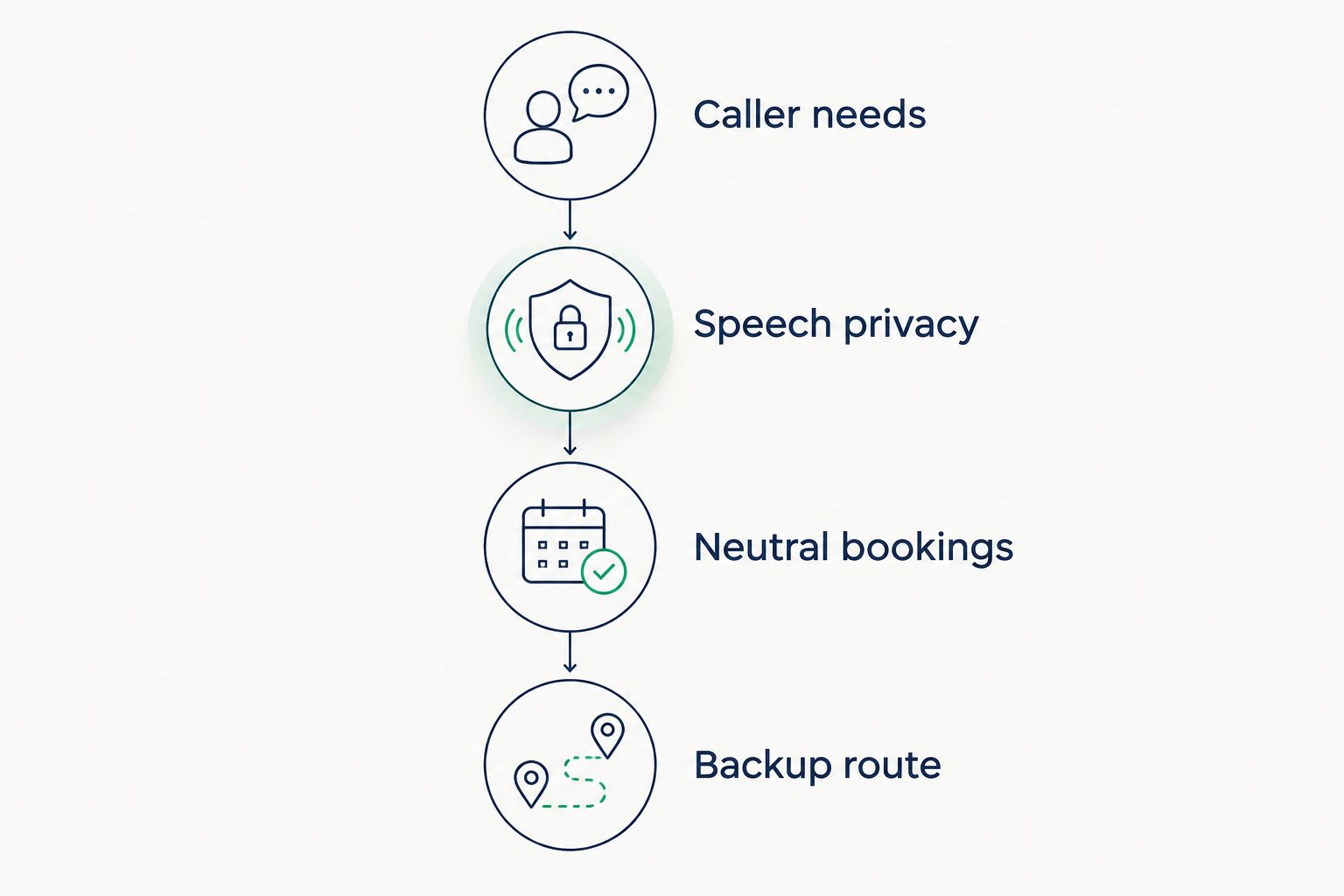
Start with the caller’s needs
Ask staff about the practical features they need, without asking what their call concerns. Establish whether they need to sit, use a laptop, take notes or have someone accompany them.
Separate a request for space from a request to share personal information. Your booking process should establish when the space is needed and whether it suits the user, not why they are speaking to a healthcare professional.
Give staff a private way to raise access or usability concerns. Do not assume a single-person booth meets everyone’s needs simply because it accommodates the most common calling arrangement.
Check speech privacy without using personal information
Use an ordinary, non-sensitive conversation to check what someone outside the room can understand. Listen from nearby desks and other positions where colleagues normally work or pass by, with the door closed as it would be during a call.
Distinguish between hearing a voice and understanding words. For this use case, the practical concern is whether someone outside can follow the conversation, not whether the enclosure feels quieter inside.
Do not use an employee’s real medical call as a demonstration. If speech is intelligible outside, choose another space while the facilities team investigates the issue; do not promise confidentiality on the strength of the product name.
Check visual privacy separately
Look at the caller’s position from outside the space. Check whether passers-by can see a laptop screen, written notes or documents placed on the work surface.
Let the user choose whether they are comfortable being visible. An enclosure that reduces noise does not automatically conceal its occupant, and a screened view does not establish speech privacy.
For video calls, check the camera view before the appointment. Use an ordinary test screen rather than opening personal records during the check.
Keep bookings neutral
Use a neutral room name and a neutral booking description, such as private call. Do not ask staff to enter the appointment type, clinician’s name or medical concern into a shared calendar.
Explain who can see reservations and what information the booking requires. If your current process exposes unnecessary detail, change the process rather than asking staff to work around it.
Avoid naming the space after a particular condition or purpose. A general private-call space lets employees use it for different personal conversations without announcing the subject to colleagues.
Provide a backup route
Tell staff what to do if the preferred space is occupied, a call arrives unexpectedly or an appointment runs beyond its reservation. Identify an alternative enclosed space and a person who can help arrange access discreetly.
Do not make the backup dependent on a public explanation at reception or across a desk row. Staff should be able to request a private room without describing the conversation they need to have.
For shared spaces, set an expectation that bookings are respected. Avoid knocking to ask whether the occupant has finished; use the agreed booking process instead.
Which booth format fits the call?
Choose capacity around who needs to be inside, not how many people are on the remote call. An employee speaking to several remote participants still needs an individual space if nobody is accompanying them in person.
A 1-person booth is the relevant format for an employee taking a call alone. A 2-person booth addresses a different requirement: the employee wants someone beside them during the conversation.
Quell Office Pod Solo: best for individual private calls
The Quell Office Pod Solo is described as a single-person soundproof phone booth designed for private calls. That makes its stated purpose relevant to an employee stepping away from an open-plan desk for a personal conversation.
Its limit is capacity. Choose another space when a second person needs to join the employee, and check speech privacy in the intended office setting rather than treating the description as an absolute guarantee.
Office Phone Booth Folio: best for individual video appointments
The Office Phone Booth Folio is described as a one-person booth for private calls, video meetings and focused work. Those stated uses make it relevant when an employee needs a personal phone or video appointment space.
The same single-person limitation applies. Check the employee’s actual calling arrangement, including their screen and note-taking needs, rather than assuming every individual call involves only a handheld phone.
Office Phone Booth Quell - 2 Person: best for an accompanying person
The Office Phone Booth Quell - 2 Person is described as a freestanding acoustic enclosure for two people holding private meetings. Consider this format when the caller chooses to have another person present.
Do not make accompaniment the default. The additional capacity is useful for that specific requirement, but it is unnecessary when the employee wants to take the call alone.
These Soundbox Store office booths address the physical-space part of the brief. Choose between them only after agreeing how employees will reserve, use and leave the space without disclosing the subject of their call.


Why the right private-call arrangement varies
The right arrangement depends on more than whether you have an unused room. Use these factors to define the brief before selecting a booth or changing room-booking rules:
- People present: An individual caller and a caller with an accompanying person need different capacities. Ask about attendance without asking about the medical issue.
- Call format: A phone conversation and a video appointment involve different screen, camera and note-taking arrangements. Check the intended task in the space.
- Speech privacy: Assess whether words are understandable outside the enclosure. Do not substitute an impression of quietness for that check.
- Visual privacy: Consider the view of the occupant, documents and screens separately from sound. Let staff identify what feels too exposed.
- Booking conflicts: A suitable room is not a dependable provision if routine meetings displace personal-call reservations. Identify a backup and a clear route to it.
- Individual usability: Give employees a way to explain what makes the space usable for them. Avoid requiring a medical explanation to discuss a practical need.
Resolve the process problem before adding more capacity. If the existing room works but staff cannot reserve it discreetly, another enclosure alone does not fix the issue.
Introduce a short, usable private-call policy
Keep the instructions practical enough for someone to follow when their phone rings. Publish the location, booking method, alternative space and contact for practical help together.
State that employees do not need to put medical details in the reservation. Tell colleagues to respect an occupied space and avoid asking the user to explain the purpose of their call.
Make the distinction between providing a room and managing work cover. If someone needs to arrange a break from a staffed desk, explain how to request that cover without discussing personal details in front of the team.
After use, ask about the space rather than the conversation. Useful questions concern interruptions, connection problems, screen visibility and whether the booking process worked; they do not concern the appointment or its outcome.
Keep any notes about improvements focused on those practical issues. A workplace-space review does not need to become a record of employees’ personal medical conversations.
FAQ
Where should staff take personal medical calls at work?
Staff should use an enclosed room or acoustic booth whose speech privacy has been checked in the workplace. Provide discreet booking and an alternative when the preferred space is occupied.
Is a closed meeting-room door enough for a private medical call?
A closed door alone does not establish speech privacy. Use an ordinary, non-sensitive conversation to check whether words are understandable from nearby working positions.
Should staff explain their medical appointment to book a room?
Design the room-booking process so staff can reserve a private-call space without entering medical details. Use a neutral booking description and explain who can see the reservation.
Does an employee need a two-person booth for a video appointment?
A two-person booth is relevant when another person will sit beside the employee, not simply because the call has remote participants. Choose capacity according to the people physically using the space.
What should happen if the private-call booth is occupied?
Staff should have a named alternative space and a discreet way to request it. Explain this backup route before introducing the private-call arrangement.
Does privacy film stop colleagues hearing a call?
Privacy film addresses visual privacy, not proof of speech privacy. Assess what people outside can understand separately from what they can see.
One last thing
Do not label the room as a medical-call booth. Give it a neutral name and permit other private personal calls, so using the space does not announce the subject of the conversation.
Before choosing a Soundbox Store booth, walk through the entire process as an employee: find the space, reserve it, check the view and identify the backup. Fix any step that requires unnecessary personal disclosure.


