 no


 Produktguide
Office pods for robotics and hardware firms: complete guide
Robotics and hardware firms’ office pods are enclosed acoustic workspaces for calls, technical discussions and focused desk work, with the aim of separating conversation from shared engineering space. Choose them around supplier calls, design reviews and remote troubleshooting—not around the assumption that every engineering activity needs another meeting room.
- Choose office pods for robotics and hardware firms by task: supplier calls, paired troubleshooting or small-team design reviews.
- Soundbox Store office pods include single-person phone booths and meeting booths for different group sizes.
- Count simultaneous private conversations before choosing pod numbers; total company headcount is not the same requirement.
- Keep this brief focused on office work, not prototype testing or equipment enclosure.
Why office pods matter for robotics and hardware firms
Separate the discussion from the equipment it concerns. A supplier call about a component drawing needs a different setting from a hands-on prototype review. Your workspace brief should distinguish those activities before you compare booths.
Start with the private conversations your existing rooms cannot accommodate. Use a calendar and a shared spreadsheet to record who needs space, what they discuss and whether they need a laptop, a colleague or the physical prototype beside them.
The useful question is not whether your business is large enough for pods. It is whether recurring office tasks lack an appropriate place. For the quantity calculation, use the guide to calculating how many pods your office floor needs.
Keep the scope precise: this guide covers office conversations and desk-based work. It does not specify enclosures for operating robots, fabrication or equipment testing.
How to choose pods around engineering work
Map the conversations that need separation
Review your existing calendar before adding another space. Label meetings by activity rather than department: a purchasing discussion and an electronics review can both involve suppliers, but they do not necessarily need the same room.
Record what makes each activity difficult at an open desk. Is someone speaking throughout a call? Does the discussion involve unreleased designs? Do colleagues need to inspect the same drawing together? These answers create a useful brief without turning every inconvenience into a purchase requirement.
Include cancelled or displaced conversations in the log. A calendar records bookings, but a short staff note also captures the call someone took elsewhere because no suitable room was free.
- Separate supplier calls from internal design reviews.
- Mark tasks that require uninterrupted individual work.
- Record the number of people physically present.
- Distinguish screen-based reviews from hands-on prototype work.
- Note which existing room could already serve each task.
Count simultaneous demand rather than total headcount
Use a shared calendar to identify overlapping requests for private space. A list of everyone who sometimes takes calls does not tell you how many conversations happen at once.
Treat solo calls and group discussions as separate demand. A large booth occupied by one caller still leaves a review team without a meeting space. Equally, a collection of solo booths does not answer a recurring need for colleagues to discuss a drawing face to face.
Choose capacity from the people in the booth, not everyone on the invitation. Remote participants affect your meeting setup, but they do not occupy seats. Record both figures so a hybrid review does not become an oversized room requirement.
- Mark overlapping calls in your shared calendar.
- Record local attendees separately from remote attendees.
- Compare booked meetings with requests that went unmet.
- Separate recurring demand from exceptional project events.
- Check whether better booking rules solve the immediate problem.
Match each task to a stated person capacity
Start by matching your activity log to rooms you already have. Once the gap is clear, Soundbox Store office pods provide a purchasing route: the supplied range includes the 1-person Quell Office Pod Solo, Office Phone Booth Quell - 2 Person, Quell - 4 Person Meeting Booth and Meeting Booth Quell - 6 Person.
Those capacities describe different choices, not a progression towards a universally better booth. A solo enclosure serves an individual caller; a group booth serves a conversation between colleagues. Neither replaces the other when both activities happen simultaneously.
For example, assign an individual supplier call to the solo category and a paired drawing discussion to the two-person category. Keep broader review meetings in the group category only when their usual in-person attendance supports it.
- Match individual calls to a 1-person option.
- Match paired discussions to a 2-person option.
- Consider a 4-person booth for four local attendees.
- Consider a 6-person booth when six people regularly attend locally.
- Retain an existing larger room for exceptional attendance.
Separate the office discussion from the prototype session
Write the meeting purpose before deciding where it belongs. If the task is discussing recorded test footage or reviewing a component drawing, describe that as an office activity. If the task depends on working directly with equipment, keep it outside this office-pod brief.
This distinction stops a purchasing request from quietly expanding. An acoustic meeting booth selected for conversation is not a specification for a technical workspace. Brief the office requirement on its own terms.
A simple workflow separates supplier calls, paired reviews and team reviews from prototype work. Use that distinction in your calendar categories and purchasing document so colleagues request the right kind of space.
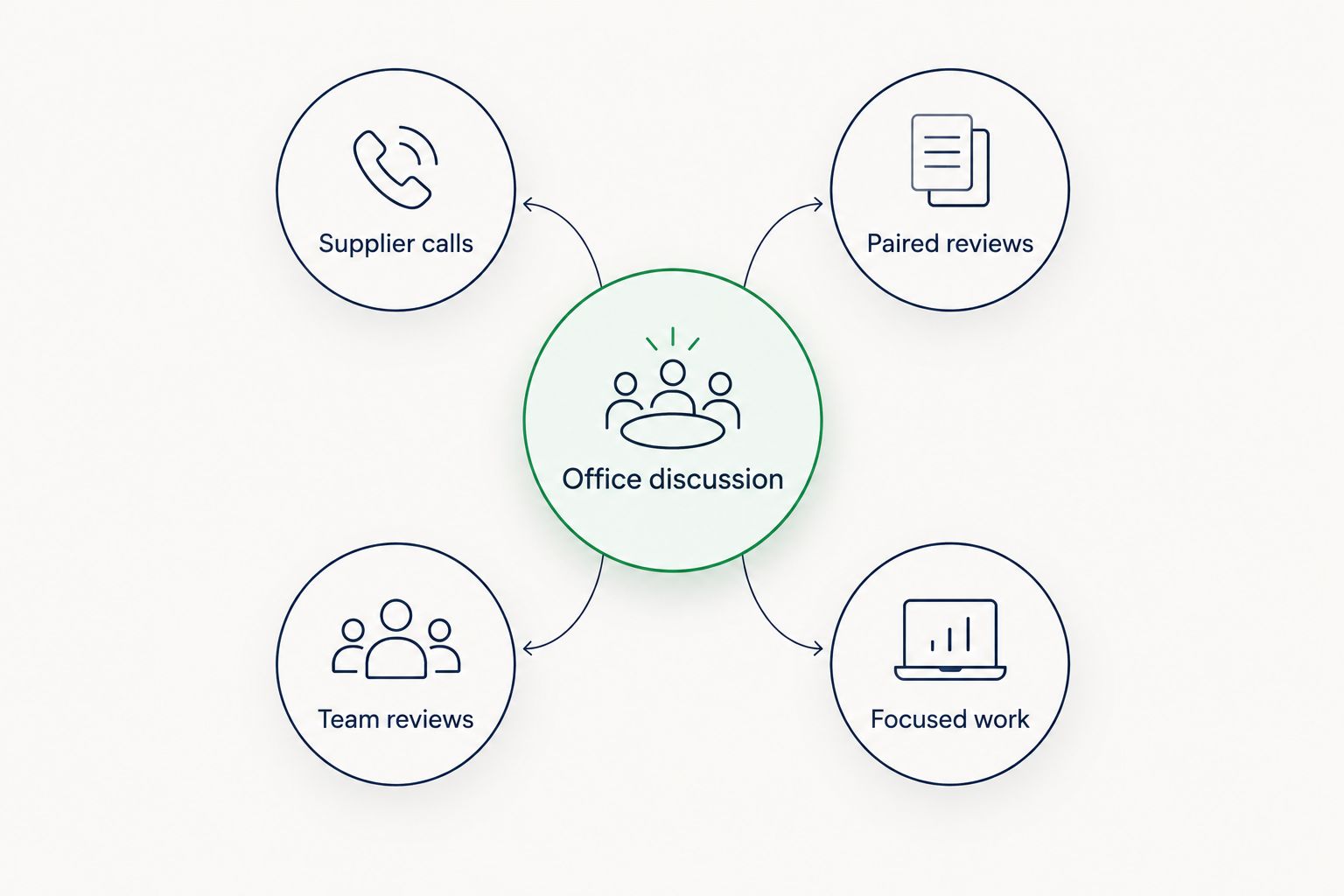
Keep the distinction practical rather than departmental. A mechanical engineer can need a phone booth for a call and a different workspace for prototype work during the same project.
- Use recorded footage when the meeting only needs discussion.
- Identify reviews that depend on physical equipment.
- Keep office-pod requirements separate from technical-workspace requirements.
- State whether attendees need shared screen viewing.
- Describe the intended task in every purchasing request.
Test the conversation and screen-viewing workflow
Rehearse a representative meeting in an existing enclosed room first. Use the laptop, headset and drawing files your team already works with, then note what the room must allow people to do together.
A paired component review is not the same exercise as a solo video call. Check whether both local attendees can follow the drawing and whether the remote participant can hear the person who is not directly facing the laptop. These are workflow checks, not assumptions about included booth equipment.
Soundbox Store describes Quell Office Pod Solo as a single-person booth for private calls. Use that stated purpose when shortlisting; confirm the selected configuration separately instead of assuming that furniture or meeting equipment comes with every enclosure.
- Rehearse a supplier call using your usual laptop.
- Open a representative drawing or presentation.
- Check shared viewing with the intended local attendees.
- Ask a remote colleague to report speech clarity.
- Confirm what the chosen configuration includes.
Define booking rules before adding more booths
Use your existing shared calendar to give each space a clear purpose. A booth labelled for supplier calls should not become an indefinite overflow desk while callers queue outside it.
Set priorities around the problem you documented. If paired troubleshooting was the reason for selecting a two-person booth, make that purpose visible in the booking description. Keep exceptions possible, but do not let exceptions erase the original requirement.
Review unmet requests alongside occupancy. A busy booth demonstrates use; it does not prove that the right tasks have access to it. Ask which conversations still move elsewhere and whether a booking change would address that gap.
- Name spaces by their intended activity and capacity.
- Add a purpose field to calendar bookings.
- Release cancelled bookings promptly.
- Record requests that could not find suitable space.
- Review repeated solo bookings in group booths.
Build the purchasing case around a documented gap
Summarise the requirement in a short document before comparing configurations. Include the recurring activity, local attendance, overlapping demand and what existing rooms fail to provide.
Soundbox Store is best for robotics and hardware firms seeking acoustic office pods for private calls and small-team meetings. Select from its stated person capacities rather than treating a larger enclosure as the default answer.
Keep the limitation equally clear: a person-capacity match does not by itself establish that a configuration suits your drawing-review workflow. Confirm the details of the selected product and what is included before making the decision.
- Name the recurring task the purchase addresses.
- Attach the calendar record supporting the request.
- State the required in-person capacity.
- Identify existing rooms that will remain in use.
- List configuration questions still needing answers.
Compare options by the conversation they serve
The comparison below matches supplied product descriptions to office activities. It does not rank acoustic performance or imply that one model provides better privacy than another.
Choose the smallest stated person capacity that fits the recurring local attendance. Then check the workflow and configuration; capacity alone is not the whole decision.
| Option | Best for | Stated capacity | Useful fit | Key limitation |
|---|---|---|---|---|
| Quell Office Pod Solo | Individual supplier calls | 1 person | Its supplied description identifies private calls as an intended use | Does not meet a requirement for colleagues to sit together |
| Office Phone Booth Quell - 2 Person | Paired technical discussions | 2 people | Its supplied description identifies private meetings between two people | Does not match a four-person local review |
| Quell - 4 Person Meeting Booth | Small-team design discussions | 4 people | Its supplied description identifies meetings for four people | A single caller occupies a group space; it does not provide separate simultaneous call spaces |
A mixed requirement deserves a mixed shortlist, not an automatic choice of the largest booth. If your log shows individual supplier calls overlapping with paired reviews, assess those as separate needs.
Likewise, keep an existing meeting room in the comparison. Where calendar changes resolve the gap, use them first. A purchase should answer the remaining requirement rather than duplicate space that already works.
Common mistakes robotics and hardware firms make
Writing a brief for engineering rather than a named task
“Space for engineering” leaves the purpose undefined. Replace it with a concrete activity such as a supplier video call, paired drawing review or small-team discussion of recorded test results.
That wording gives everyone the same decision to make. It also prevents an office-conversation requirement from being confused with a request for prototype workspace.
Counting remote participants as booth occupants
A meeting invitation does not describe local attendance. Separate people joining online from people who need to sit together, then choose the stated person capacity for the local group.
Keep the remote-participant requirement in your workflow check. It belongs there, not in the seat count.
Treating an acoustic enclosure as complete information privacy
Keep speech privacy, screen visibility and meeting practices as separate questions. An enclosure does not remove the need to control what appears on a shared screen or what remains open on a laptop afterwards.
Use representative technical material when checking the workflow. Do not use an unreleased design merely to demonstrate the need for discretion.
Buying group capacity to solve individual call demand
A larger booth still hosts one conversation at a time. If individual supplier calls are the documented gap, a group booth does not create several independent calling spaces.
Return to the overlap log before changing the shortlist. Solve the type of demand, not just the total number of people requesting space.
FAQ
What are office pods for robotics and hardware firms used for?
Office pods for robotics and hardware firms provide enclosed spaces for private calls, desk-based reviews and focused work. Specify the office conversation separately from prototype work or equipment testing.
Should we choose a phone booth or a meeting booth for supplier calls?
Choose a single-person phone booth when one local attendee takes the supplier call, and a meeting booth when colleagues need to join in person. Count local attendees separately from people joining remotely.
Which Soundbox Store pod suits an individual engineer’s private calls?
Quell Office Pod Solo is a 1-person option described for private calls. Confirm the selected configuration against the engineer’s actual calling and desk-work requirements.
Can a meeting booth replace our prototype review area?
A meeting booth addresses the discussion requirement, not the specification of a prototype workspace. Keep reviews that depend on physical equipment separate from this office-pod brief.
How many pods does our hardware team need?
Base pod numbers on simultaneous unmet demand for each activity, not total team headcount. Record overlapping solo calls and group discussions separately before choosing quantities.
Should we buy the largest booth our team can use?
Choose capacity for recurring in-person attendance rather than occasional maximum attendance. Retain an existing larger room for exceptional meetings when that arrangement meets the requirement.
One last thing
Record the meetings that never get booked. Ask colleagues to log private calls taken elsewhere and reviews postponed because no suitable space was free; those requests explain the gap that room-occupancy figures alone leave invisible.
Then write the purchasing brief as a sentence: who needs space, for which conversation, with how many local attendees. If that sentence is unclear, the shortlist is premature.


