 sv/se
sv/se



















 Produktguide
Can you test a pod's soundproofing before you buy?
Yes, you can test a pod's soundproofing before buying by arranging a live demonstration, checking what listeners hear inside and outside, and reviewing acoustic evidence for the exact model. A listening test shows whether ordinary speech remains understandable; it does not establish a laboratory noise-reduction rating. Use the demonstration to judge your working conditions, not to prove complete silence.
- To test a pod's soundproofing before buying, check speech privacy outside and incoming noise inside.
- A live demonstration is best for judging everyday calls; documented acoustic evidence supports measured performance claims.
- Soundbox Store acoustic office pods serve businesses seeking private workspaces; test the exact model against your intended conversations.
- A recorded video cannot establish what speech sounds like to someone standing outside the pod.
Why this matters
A pod for sales calls has to address two separate problems: colleagues hearing the conversation outside and the caller hearing office activity inside. Test both. A quiet interior alone does not answer the speech-privacy question.
For a single-person call space, the Quell Office Pod Solo is described as a one-person phone booth designed for private calls. Soundbox Store acoustic office pods are best suited to businesses seeking dedicated private workspaces. That use case makes a spoken-call demonstration more relevant than a test based only on music.
Buy against the conversation you need to support, not the word soundproof. Before arranging a demonstration, decide whether your priority is fewer distractions, less audible speech outside, clearer video calls, or a combination of those outcomes.
Can you test a pod's soundproofing before you buy?
Yes. Ask whether a live demonstration of the exact model is possible, then use a repeatable listening exercise and review the evidence supporting its acoustic claims. Keep those activities separate: one establishes your experience of the pod, while the other explains a measured performance statement.
Use this sequence to make the demonstration useful rather than simply impressive:
- Define the task. Choose an ordinary sales call, recruitment interview or team conversation that reflects the pod's intended use. Write down what a satisfactory result means before listening.
- Confirm the model. Record which pod and configuration you are testing. Evidence for another model does not automatically describe the pod you intend to order.
- Establish the surroundings. Listen to the demonstration room before anyone speaks inside the pod. Note nearby conversation and other background sounds rather than treating the room as acoustically neutral.
- Listen outside. Ask someone inside to read unfamiliar, non-sensitive sentences at their usual speaking level. Have the outside listener record which words they understand without seeing the script.
- Listen inside. Swap roles and assess whether conversation outside interrupts the task inside. Keep the source, speaking style and listening position consistent between comparisons.
- Run a real call. Use your intended headset or microphone and ask a remote colleague about speech clarity and background sound. Record that result separately from the outside listener's observations.
- Check the evidence. Ask what the published acoustic figure measures, which model it covers and under what conditions. Finish with a written record of what you heard and what the documentation establishes.
Do not turn the demonstration into an unusually loud challenge unless that genuinely reflects your workplace task. Shouting and normal conversation answer different questions. A useful test starts with the voice and equipment people will actually use.
Compare the ways to assess acoustic performance
No single method answers every purchasing question. Choose the method that fits the decision, and keep its limitation beside its benefit.
| Assessment method | Best for | What it tells you | Main limitation |
|---|---|---|---|
| Live listening demonstration | Everyday speech privacy | Whether an outside listener understands spoken words in that setting | Depends on voice, position and background noise |
| Real video or phone call | Call quality | What the remote participant hears through your equipment | Microphone processing affects the result |
| Documented acoustic measurement | Understanding a stated rating | What was measured for the identified model and conditions | Does not reproduce every workplace situation |
| Recorded demonstration video | Preparing questions | Which listening positions and activities to request | Playback does not reproduce the original sound field |
A live listening test and acoustic documentation complement each other. The demonstration supplies practical context; the documentation supplies the basis for a measured claim. Neither should be presented as the other.
Test speech privacy outside the pod
The most useful outside-listener question is not whether any sound is audible. It is whether the listener can understand the conversation. Hearing a faint voice and following the speaker's sentences are different outcomes.
Use a script the outside listener has not read. Ask the speaker to include ordinary sentences, unfamiliar names and everyday work terms without using real client or employee information. The listener should write down what they understood before comparing notes with the script.
Check from places that represent nearby desks or a passing colleague. Record the listening positions so that a later comparison uses the same arrangement. Listening only with an ear against the enclosure does not represent someone working at a neighbouring desk.
A generic demonstration scene can show the roles clearly: one person speaks inside while another listens outside, with neither relying on a shared script to guess the words.
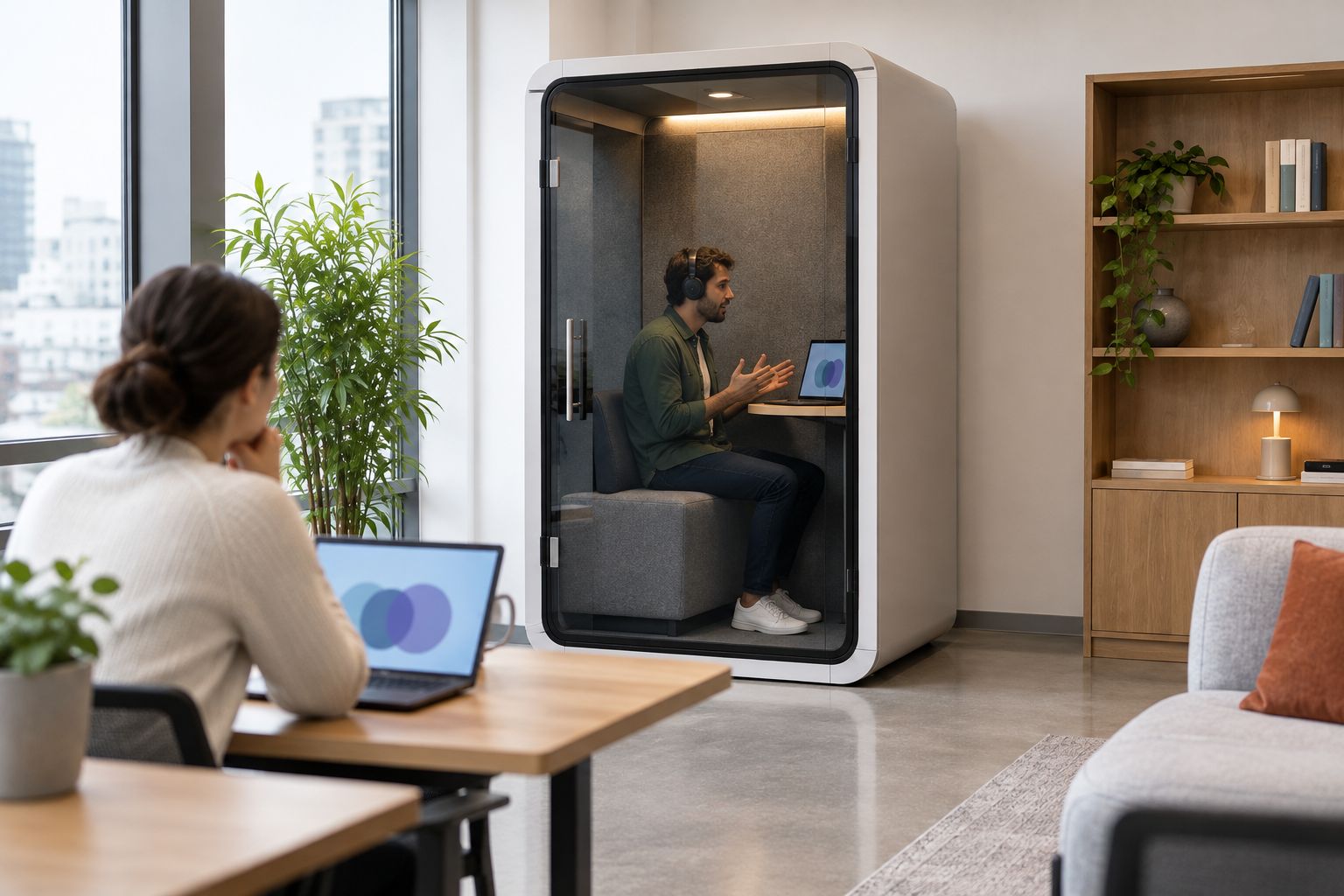
Swap the speaker and listener if different colleagues will use the pod. Voices and speaking habits differ, so a demonstration based on one unusually quiet speaker gives a narrow picture. Keep the exercise focused on ordinary speech rather than trying to create a universal pass mark.
For interviews and sensitive business discussions, record understandable words as a concern even when the voice sounds quiet. That observation does not establish a formal privacy guarantee, but it gives you a concrete issue to investigate before purchasing.
Test incoming noise and call clarity separately
Inside the pod, recreate the task that prompted the purchase. For concentrated work, try reading or drafting while someone talks outside. For calls, speak to a remote colleague using the equipment you intend to use at work.
Ask what interrupts the task. Is outside speech understandable, merely noticeable, or absent during the exercise? Record those distinctions rather than describing every result as quiet or noisy.
Then assess the outgoing call audio. Ask the remote participant to listen for background conversation, distracting internal sound and changes in your voice. Keep the headset, microphone position and call settings consistent if you compare demonstrations.
A clear remote call does not prove that nearby colleagues cannot hear you. Call software and microphones can change what the remote participant receives. Someone outside the pod hears the physical conversation, not the processed call audio.
The reverse distinction matters too: a listener outside might struggle to understand your words while the remote participant still notices distracting sound. Treat outside speech privacy, inside distraction and remote call clarity as separate results in your purchase notes.
What acoustic figures do—and do not—tell you
Soundbox Store describes noise reduction across its acoustic pod range as 30–35 dB. That range is useful context, not a model-specific promise for every demonstration. Establish which figure applies to the exact pod under consideration before attaching it to your shortlist.
A 30 dB claim and a 35 dB claim need a measurement description before they become a meaningful comparison. Ask what sound was measured, where it was measured and which configuration the result covers. Do not assume that similar-looking figures describe the same acoustic property.
Decibels use a logarithmic scale. A noise-reduction figure is not a percentage of sound removed, and it does not mean that all sounds become inaudible. Avoid translating a rating into a simple promise such as nobody outside will hear anything.
Keep your requests focused on the stated claim:
- Identify the exact model covered by the acoustic evidence.
- Ask for the name and meaning of the measured quantity.
- Establish whether the result concerns sound travelling outside, inside or another acoustic characteristic.
- Check the configuration and operating conditions described with the result.
- Separate a documented measurement from a listener's subjective impression.
The purpose is to understand evidence, not to demand an unrelated specification checklist. Compare like measurements and test the working task alongside them. If two figures describe different things, do not rank the pods by those figures alone.
Why a pod sounds different across demonstrations
Sound travels through an environment, not just through a product description. These factors explain why you should record the demonstration conditions rather than relying on a single impression:
- Speaking level: a softly spoken sentence is a different test from an ordinary animated conversation.
- Listener position: what someone hears beside the pod differs from what they hear farther away.
- Background noise: surrounding sound can mask speech that is easier to notice in a quieter room.
- Door state: an open-door exercise and a closed-door exercise do not describe the same enclosure condition.
- Sound source: speech, music and low-frequency mechanical noise have different characteristics.
- Call equipment: a headset or microphone changes what a remote participant hears, not what the outside listener hears directly.
Use these factors as controls, not excuses. If the speaker gets quieter or the listener moves farther away during a comparison, repeat the exercise under matching conditions before drawing a conclusion.
A quiet-room demonstration and a busy-room demonstration answer different questions. Record both settings if you experience them, but do not combine their observations into an invented single performance score.
Keep a purchasing record that separates evidence from impressions
Create a short record while the demonstration is fresh. Include the model, task, speaker, listener positions, background activity and equipment used. Then write separate observations for speech outside, noise inside and remote call audio.
Useful notes describe an event rather than an adjective. Record whether the outside listener understood particular words, whether nearby speech interrupted reading, and whether the remote participant noticed background conversation. Avoid conclusions such as excellent acoustics without explaining what produced that judgement.
Add the acoustic documentation as a separate entry. Record what its figure describes and whether it matches the demonstrated model. Do not convert your listening notes into a measured dB reduction or present a casual demonstration as formal testing.
Shortlist the pod when the relevant task works and the evidence matches the model. Investigate further when the demonstration and the stated performance appear to answer different questions. That keeps the decision tied to your workplace need without inventing a universal buying threshold.
If you cannot attend a live demonstration
Ask whether a live remote demonstration is possible, but recognise what it leaves unresolved. A video call lets you ask questions and see the setup; it still sends audio through microphones, processing and playback equipment.
Request acoustic evidence for the exact model and ask the seller to explain its scope. Treat a recorded video as preparation for a conversation, not proof of speech privacy. Do not assume a trial, return arrangement or demonstration service exists without checking the current terms directly.
For a purchase driven by sensitive conversations, identify the unresolved speech-privacy question before placing the order. A polished recording should not replace the evidence needed for that decision.
FAQ
Can I test a pod's soundproofing before buying it?
Yes, if access to a demonstration can be arranged, you can test speech privacy outside, incoming noise inside and call clarity. Confirm the exact model and review the acoustic evidence separately; a listening exercise does not establish a laboratory rating.
What should I listen for outside an office pod?
Listen for understandable words and sentences, not just an audible voice. Use unfamiliar, non-sensitive speech and record what you understand from positions representing nearby colleagues.
Can a phone app prove an office pod's noise-reduction rating?
No, a casual phone-app comparison does not establish a laboratory noise-reduction rating. Keep it separate from documented measurements and do not turn an informal reading into a verified product claim.
Does a noise-reduction figure mean the pod is completely silent?
No, a noise-reduction figure does not establish complete silence. Soundbox Store describes a 30–35 dB range across its acoustic pods; check the evidence for the particular model and assess speech privacy during a demonstration.
Is a demonstration video enough to judge speech privacy?
No, a demonstration video alone cannot establish what a nearby listener hears outside the pod. Microphones, processing and playback affect the recording, so use it to prepare questions rather than confirm acoustic performance.
Should I test a pod with my usual headset?
Yes, use your usual headset when assessing remote call quality. Also test with a listener outside the pod, because clear call audio and physical speech privacy are separate outcomes.
One last thing
Do not show the outside listener the script before testing. Recognising a sentence you already know is not the same as understanding unfamiliar speech through the enclosure. Compare the listener's written notes with the script only after the exercise; that small change makes the result more useful.


