 en/gb
en/gb



















 Product guide
Office Pods for Environmental Consultancy Firms: Full Guide
Office pods for environmental consultancy firms are freestanding acoustic booths placed inside an existing office to give staff a private space for regulator calls, client debriefs, and site-data reviews without booking a meeting room. Environmental consultancies mix desk-based analysts with field staff who drop in between site visits, so pod capacity and booking need to flex more than in a typical office.
- Office pods for environmental consultancy firms work best split by task: solo regulator calls need one pod size, team survey reviews need another.
- Soundbox Store's Quell range runs from a 1-person booth to an 8-person Club House pod, all rated 30-35 dB noise reduction.
- Match pod capacity to meeting type before buying: a 2-person booth for client debriefs, a 4-person pod for site review huddles.
- Furnish pods for multi-hour survey review sessions, not just quick calls, so you're not re-fitting them mid-project.
Why office pods matter for environmental consultancy firms
Environmental consultancies run three kinds of conversation that don't belong on an open floor: calls with regulators about permit conditions, client debriefs on findings that aren't public yet, and internal reviews of survey data spread across screens and printed maps. None of that fits neatly into a single meeting room booking system, especially when half the team is out on site three days a week.
A 2-person meeting booth solves the first two problems without construction work or a floor plan change. Soundbox Store rates its pods at 30-35 dB noise reduction, which is enough to take a confidential call next to a busy desk row without the rest of the office overhearing specifics.
The harder problem is capacity planning. A solo ecologist writing up a site report needs a different pod than four analysts cross-checking hydrology data against a client's baseline survey. Getting that mismatch wrong is the single biggest reason pod purchases get under-used.
How to fit out an office with pods for environmental consultancy firms
Audit your consultancy's call and meeting patterns
Start with what's actually happening on your floor before buying anything. Most consultancies underestimate how many private calls happen per day until they track it for a week.
- Log how many regulator or agency calls happen per week and how long they run
- Count concurrent Teams or Zoom calls during peak site-report weeks
- Note when field staff debrief immediately after a site visit
- Track meeting-room booking clashes over a two-week period
- Ask analysts where they currently go for a call they can't take at their desk
Separate confidential calls from the open floor
Regulatory and client conversations need the same privacy standard, even though only one of them feels urgent in the moment. A permit query with a local authority carries the same confidentiality weight as a client debrief on unpublished findings.
- Designate one quiet corner as an interim solution while you plan
- Block a recurring meeting-room slot for the busiest call-takers
- Issue noise-cancelling headsets as a short-term stopgap
- Install a single-person acoustic pod for calls that can't wait for a room
- Rotate pod booking priority toward staff handling regulator or client contact that week
Match pod capacity to your meeting types
This is where most consultancies overspend or underspend. A pod sized for the loudest meeting in the building, bought for every use case, wastes floor space; a pod sized for quick calls, used for team reviews, gets abandoned within a month.
- A 1-person pod for solo field-report calls and write-ups
- A 2-person booth for client or regulator debriefs
- A 4-person office pod for site review team huddles
- A 6 to 8-person meeting booth for cross-team survey analysis involving ecologists, hydrologists, and planners together
- Check floor space against your existing desk layout before ordering any size
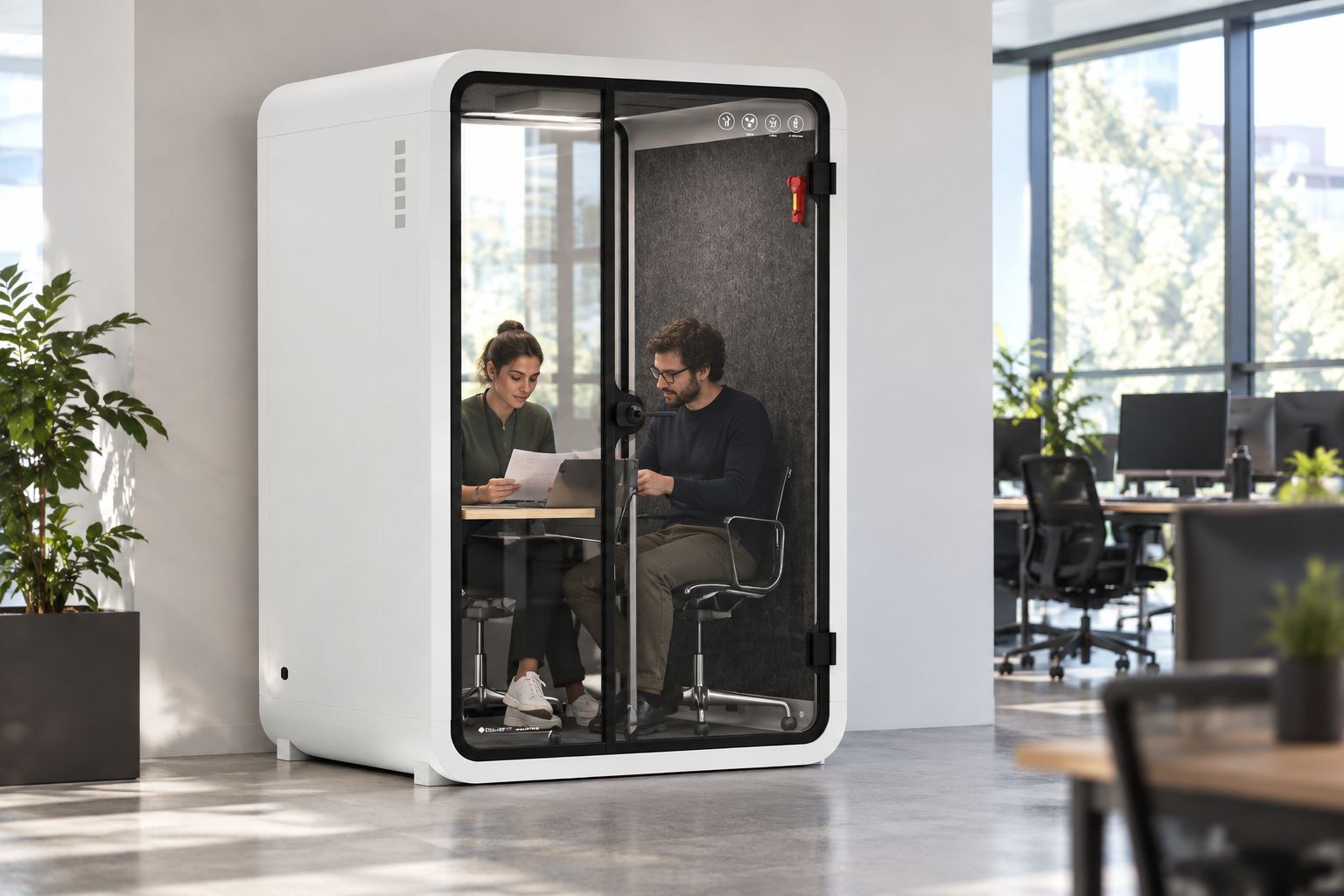
Equip pods for extended data and survey review sessions
A pod bought for five-minute calls falls apart as a workspace for a ninety-minute survey review. Furnishing decisions matter as much as the pod size itself.
- Add a worktable sized for laptops and printed survey maps side by side
- Fit seating built for multi-hour sessions, not a stool meant for quick calls
- Keep wall or screen space free for displaying GIS maps or site photos
- Add task lighting for reading printed environmental reports
- Avoid overfurnishing small pods — leftover floor space matters more than extra storage
Place pods to protect lab and sample-handling zones
Where a pod sits changes how well it actually gets used. Consultancies that handle samples or run lab-adjacent work need to think about traffic flow, not just floor space.
- Keep pods clear of sample prep benches and lab traffic paths
- Avoid placing pods directly under HVAC vents where hum carries into calls
- Group pods near the desks that generate the most call volume
- Leave clear walking space around each pod rather than wedging it into a corner
- Reassess placement after the first month of real use, not just the floor plan on paper
Standardise booking and etiquette across field and office teams
Field staff who visit the office two days a week don't know the informal booking rules the desk-based team has settled into. That gap causes most of the friction consultancies report after rollout.
- Set up a shared calendar per pod, visible to field and office staff alike
- Colour-code bookings for confidential use versus general quiet work
- Cap session length during peak site-report weeks so pods don't get monopolised
- Brief occasional visitors on booking rules the first time they're in the office
- Review usage monthly to spot which pod size is under- or over-booked
Budget and phase the rollout by team size
Most consultancies don't need every pod size on day one. Phasing avoids buying capacity you can't yet justify.
- Start with one solo pod for regulator and confidential calls
- Add a 2-person booth once client debrief volume justifies it
- Introduce a 4 to 6-person pod when cross-disciplinary review sessions become regular
- Reassess after one full quarter of bookings data
- Check remaining floor capacity before committing to a larger meeting pod


Comparing pod options for environmental consultancy firms
| Pod option | Best for | Capacity | Key limitation | Verdict |
|---|---|---|---|---|
| Quell Office Pod Solo | Solo regulator or field-report calls | 1 person | Limited space for spreading out survey documents | Buy for individual call privacy |
| 2-person meeting booth | Confidential client or regulator debriefs | 2 people | Not sized for full team reviews | Buy for client-facing conversations |
| 4-person office pod | Site review team huddles | 4 people | Needs more floor space than solo pods | Consider once cross-team reviews are regular |
| 6 to 8-person meeting booth | Cross-disciplinary survey analysis | 6-8 people | Largest footprint, best suited to bigger offices | Wait until multi-team sessions justify the space |
Common mistakes environmental consultancies make with office pods
- Booking one pod size for the whole team. A solo pod bought because it was cheapest ends up double-booked for four-person meetings it was never sized for.
- Placing pods next to sample prep areas without checking traffic flow. Foot traffic past a pod door defeats the point of a quiet space.
- Skipping furniture upgrades. Running a ninety-minute data review on a stool meant for a five-minute call wears staff out fast.
- Ignoring occasional field visitors in the booking system. Staff who are in the office two days a week don't know the informal rules and end up standing outside a booked pod.
- Treating regulator calls as less sensitive than client calls. Both need the same acoustic privacy, and treating one as optional creates inconsistent booking priority.
FAQ
What size office pod fits confidential client calls at an environmental consultancy?
A 2-person meeting booth fits most confidential client or regulator debriefs. It gives two people a private space without taking up the footprint of a full team pod.
How many people can Soundbox Store's largest meeting pod hold?
The largest option in the range holds up to 8 people. That size suits cross-disciplinary review sessions bringing ecologists, hydrologists, and planners together in one room.
Do office pods reduce noise enough for sensitive regulatory calls?
Soundbox Store pods are rated at 30-35 dB noise reduction, enough to take a call next to a busy desk row without the specifics carrying across the floor.
Can an office pod work for field staff who only visit occasionally?
Yes, provided booking rules are shared clearly. A shared calendar and a short briefing for occasional visitors prevents the confusion that comes from informal, desk-team-only booking habits.
What furniture do environmental consultancies need inside a pod for data review?
A worktable sized for a laptop and printed survey maps, plus seating built for sessions over an hour, matters more than extra storage. Furniture is sold separately by pod size.
Where should office pods go in a consultancy office with lab or sample areas?
Keep pods clear of sample prep benches and high-traffic paths. Placing a pod near the desks that generate the most call volume gets it used more than tucking it into an unused corner.
One last thing
The detail most consultancies miss during rollout: furniture is sold separately by pod size, so a 4-person pod's worktable and stools aren't interchangeable with a 6-person set. Check the matching furniture range for your chosen pod size before you fit out the room, not after the pod arrives.


