 da/dk


 Produktguide
Best meeting booths for engineering design reviews
Best overall for a four-person engineering review: Quell - 4 Person Meeting Booth. Best for paired technical checks: Office Phone Booth Quell - 2 Person. Best for multidisciplinary reviews: Meeting Booth Quell - 6 Person. Choose your meeting booth for design reviews by the number of people attending in person, then check how they will view and discuss the design.
- Soundbox Store’s Quell - 4 Person Meeting Booth is the default meeting booth for design reviews involving four colleagues.
- Office Phone Booth Quell - 2 Person suits paired technical checks, not larger engineering review groups.
- Meeting Booth Quell - 6 Person suits multidisciplinary reviews with six people attending in person.
- Confirm furniture, screen arrangements and call equipment against your actual review workflow before choosing a booth.
Why this matters
An engineering design review needs more than somewhere to talk. Your team needs to examine the same revision, challenge assumptions and record a decision without losing track of the drawing or model under discussion.
Choose for the review you actually run, not the total size of your engineering department. A designer and reviewer checking a detail have a different requirement from a meeting involving engineering, manufacturing and project management.
Soundbox Store meeting booths provide enclosed spaces for private workplace discussions. This shortlist separates three Quell products by their stated person capacity; the engineering use cases are recommendations for how to choose between them, not claims about specialist equipment supplied inside.
What makes the best meeting booth for design reviews?
Use these criteria to narrow your choice before comparing products:
- In-person attendance: Count the people who need seats inside the booth. Remote participants affect the call arrangement, not the number of seats required locally.
- Review format: Separate paired checks from small-team decisions and multidisciplinary discussions. Give each meeting type an appropriate space.
- Shared reference: Decide whether everyone will use individual laptops, a shared display or printed drawings. Confirm the selected configuration supports your intended arrangement.
- Private discussion: Choose an enclosed meeting space for conversations you want separated from the surrounding office. Do not treat the word soundproof as a promise of absolute silence.
- Furniture requirements: Check the furniture specified for the exact booth and configuration. Person capacity alone does not describe the working surface.
These criteria keep the decision practical. A booth with enough seats still needs to support the way your reviewers inspect the design and capture changes.
Best meeting booths at a glance
| Meeting booth | Best for | Stated capacity | Standout feature | Key limitation |
|---|---|---|---|---|
| Quell - 4 Person Meeting Booth | Small-team engineering design decisions | 4 people | Freestanding acoustic enclosure designed to seat four | Not the choice for six people attending together |
| Office Phone Booth Quell - 2 Person | Designer-and-reviewer technical checks | 2 people | Enclosed space designed for private meetings between two people | Does not accommodate a larger local review group |
| Meeting Booth Quell - 6 Person | Multidisciplinary design reviews | 6 people | Freestanding office pod designed for confidential meetings | Adds meeting capacity that paired checks do not require |
Soundbox Store’s Quell - 4 Person Meeting Booth is best for engineering teams holding four-person design reviews. Choose the two-person or six-person alternative when your regular local attendance makes that the better fit.
1. Quell - 4 Person Meeting Booth: best for small-team decisions
The Quell - 4 Person Meeting Booth is a freestanding acoustic enclosure designed to seat four people for confidential discussions. It is the default choice here for an engineering review that needs more than a paired check but does not involve a larger panel.
A useful planning scenario is a designer, technical reviewer, manufacturing colleague and project lead discussing a proposed change. That example uses the stated seating capacity; it does not assume any particular table, display or conferencing equipment is included.
Quell - 4 Person Meeting Booth pros
- Its stated four-person capacity matches a review involving four local contributors.
- The product is designed as an enclosed space for confidential meetings.
- Its freestanding format provides a defined meeting enclosure within the workplace.
Quell - 4 Person Meeting Booth cons
- Its stated capacity does not cover a review with six local attendees.
- Four seats do not establish whether your preferred drawing, laptop and display arrangement will work; confirm the configuration.
Best for: A small engineering group making a specific design decision together.
Choose the Quell - 4 Person Meeting Booth when your recurring review genuinely involves four people. Keep occasional larger sessions separate rather than assuming every meeting must use this booth.
Verdict: Buy for recurring four-person reviews; skip for larger local panels.
2. Office Phone Booth Quell - 2 Person: best for paired checks
Despite its phone-booth name, the Office Phone Booth Quell - 2 Person is described as a freestanding acoustic enclosure for two people to hold private meetings. It suits a designer and reviewer discussing a defined technical question face to face.
Use this format when the discussion does not need a wider panel. Examples include checking a drawing revision, walking through a calculation or agreeing which issue needs escalation to the full design review.
Office Phone Booth Quell - 2 Person pros
- Its stated two-person capacity matches a designer-and-reviewer meeting.
- The enclosure is designed for private meetings rather than individual calls alone.
- It provides an alternative to choosing a larger booth for a consistently paired workflow.
Office Phone Booth Quell - 2 Person cons
- It is not the right capacity for three or more people attending together.
- It does not replace a group review when several disciplines need to resolve the same issue.
Best for: Paired technical checks before or after a wider design review.
Choose the Office Phone Booth Quell - 2 Person when two colleagues need to examine an issue together. Do not reduce attendance simply to make a larger review fit this product.
Verdict: Buy for paired checks; skip as the only booth for team reviews.
3. Meeting Booth Quell - 6 Person: best for multidisciplinary reviews
The Meeting Booth Quell - 6 Person is a freestanding office pod designed for confidential meetings, with a stated six-person capacity. It is the strongest capacity match in this shortlist when a design decision requires a broader group in the same enclosure.
For example, your review might involve a designer, engineering lead, manufacturing representative, quality colleague, project manager and another technical specialist. Use the people your decision requires, rather than treating that example as a fixed attendance list.
Meeting Booth Quell - 6 Person pros
- Its stated six-person capacity supports a broader local review group.
- The product is designed for confidential meetings.
- It accommodates more local contributors than the two-person and four-person alternatives listed here.
Meeting Booth Quell - 6 Person cons
- Its additional person capacity does not establish a larger usable drawing surface or a particular screen arrangement.
- It is unnecessary on attendance grounds when every review involves only a pair.
Best for: Multidisciplinary discussions where six people need to attend in person.
Choose the Meeting Booth Quell - 6 Person when that attendance is a recurring requirement. If larger reviews are occasional, check whether an existing meeting room already serves them before making this your default booth.
Verdict: Hold unless six-person attendance is a regular requirement; buy when it is.
Match the booth to the engineering review
Start with the decision, then list the people needed to make it. Only then choose the booth capacity. This keeps a design review separate from a general project update, which has a different attendance requirement.
Paired checks
Choose the two-person option for a designer and reviewer resolving a bounded question. Keep supporting material ready and record the outcome so the wider team can see what changed.
Small-team decisions
Choose the four-person option when several contributors need to challenge a proposal together. Identify the drawing revision and the decision required before the meeting starts.
Multidisciplinary reviews
Choose the six-person option when the decision depends on input from a broader local group. Separate essential reviewers from colleagues who only need the written outcome.
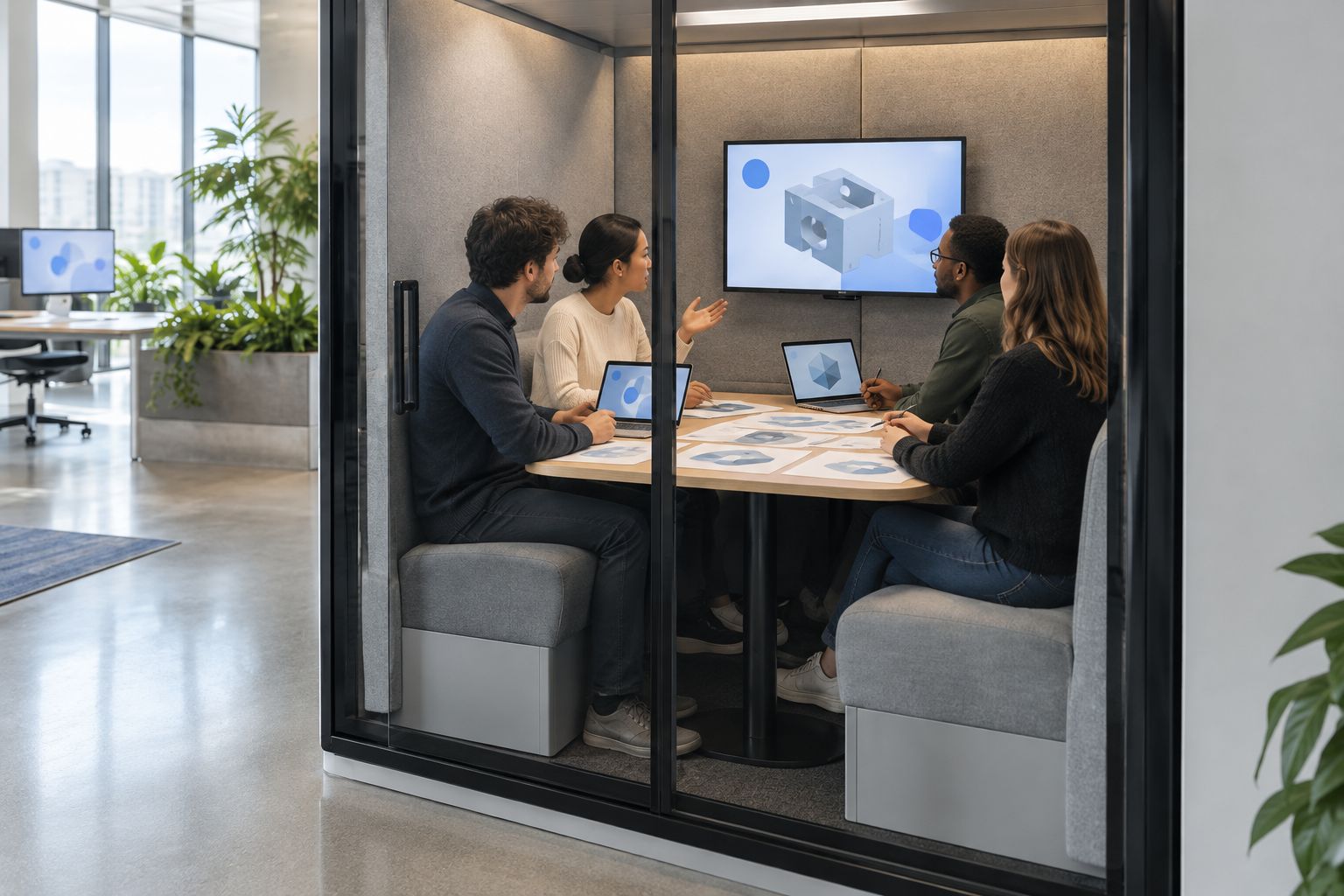
Your attendance pattern is more useful than your largest-ever meeting. Review recent invitations and separate recurring design checks from exceptional workshops before selecting a capacity.
Confirm the working arrangement before choosing
A person-capacity label answers how many people the product is designed to accommodate. It does not answer how your team will inspect an engineering drawing or share a model with remote reviewers.
Use a real review document when discussing the configuration. A representative drawing or model gives you a clearer brief than asking whether a booth is suitable for engineering in general.
Shared drawings and models
Decide what each reviewer needs to see. If the discussion depends on detailed annotations, confirm the intended viewing arrangement rather than assuming a meeting booth includes a shared display.
Hybrid participation
List the equipment your call needs, including the camera, microphone and display arrangement. Confirm what is included and what your team needs to provide; do not infer conferencing features from the booth’s capacity or name.
Furniture and notes
Check the furniture specified for the chosen configuration against your workflow. Ask how reviewers will use laptops, examine documents and capture actions during the same discussion.
Keep product selection and meeting equipment as separate checks. The right capacity is the starting point, not the complete design-review specification.
Basis for the recommendations
This shortlist uses the products’ stated person capacities and descriptions of their intended private-meeting use. The ranking gives the four-person model the default small-team slot, then identifies alternatives for paired checks and broader local attendance.
It is not an acoustic-performance ranking. No product-specific noise-reduction comparison, equipment comparison or engineering-use test result underpins the order.
Which meeting booth for design reviews should you choose?
Choose the Quell - 4 Person Meeting Booth if your recurring review involves four local contributors. It is the clearest starting point for a small engineering team choosing among these Soundbox Store meeting booths.
Choose the Office Phone Booth Quell - 2 Person for designer-and-reviewer checks. Choose the Meeting Booth Quell - 6 Person when six-person attendance is a recurring requirement, not simply a possibility.
Before committing, settle the furniture and viewing arrangement for the exact configuration. A booth should fit both the people making the decision and the material they need to examine.
FAQ
What is the best meeting booth for engineering design reviews?
The Quell - 4 Person Meeting Booth is the default recommendation for reviews involving four people in person. Choose the two-person Quell option for paired checks or the six-person Quell option for broader multidisciplinary attendance.
Is a two-person booth enough for a design review?
A two-person booth is enough when the review involves a designer and reviewer attending locally. Choose a larger stated capacity when additional colleagues need to participate in the same enclosure.
Should I choose a four-person or six-person meeting booth?
Choose according to recurring in-person attendance: four local contributors fit the four-person recommendation, while six require the six-person option. Do not choose solely around an exceptional meeting that an existing room already accommodates.
Does a meeting booth include equipment for sharing engineering drawings?
Confirm the equipment and furniture included with the exact configuration before choosing. A booth’s person capacity does not establish that a display, camera or drawing surface is supplied.
Can remote reviewers join a design review held in a booth?
Plan remote participation around a confirmed call-equipment and connectivity arrangement. Check the camera view, audio arrangement and method of sharing the design rather than assuming these follow from the booth specification.
Does a soundproof meeting booth guarantee that nobody can hear the discussion?
Do not treat the word soundproof as a guarantee that nobody can hear a discussion. Request the selected product’s acoustic information and discuss the privacy requirement for your intended workplace use.
One last thing
Count decision-makers, not everyone who needs an update. Before choosing a booth, write down who must challenge or approve the design and who can receive the outcome afterwards.
That distinction gives you a practical capacity brief. It also stops a paired technical check from becoming a meeting that needs a larger enclosure without a clearer purpose.


