 da/dk
da/dk



















 Produktguide
Can you paint or refinish an office pod's exterior?
You should paint or refinish an office pod’s exterior only after the manufacturer confirms a suitable treatment for that model’s existing finish. A change of colour is not evidence of compatibility: identify the surface first, and distinguish repainting from an exterior wrap before commissioning work.
- Can you paint an office pod exterior? Confirm the existing finish and a suitable treatment with the manufacturer first.
- Soundbox Store’s office pod wrap is best for teams seeking branded Quell booth exteriors.
- Repainting and exterior wrapping are different treatments; neither should be specified from appearance alone.
- For office refurbishment, separate colour changes, surface repairs and acoustic performance into distinct requirements.
Can you paint or refinish an office pod’s exterior?
Do not treat an office pod as a paintable wall or a standard piece of furniture. Whether repainting is appropriate depends on the existing exterior finish and the proposed coating. A photograph can show the colour, but it does not identify the complete surface specification.
Start by deciding what you actually want to change. A colour update, a branded graphic and a repair to a marked panel are different briefs. Calling all of them refinishing leaves the supplier guessing about the result you expect.
For Quell booth branding, the Office Pod - Wrap Option is a relevant commercial route to investigate. It is described as a custom exterior wrap for personalising Quell booths, across all booth sizes; that description does not establish that their exteriors can be repainted.
Use this comparison to frame the enquiry, rather than choosing a treatment before you know the surface.
| Approach | Best for | Advantage | Limitation | What to confirm |
|---|---|---|---|---|
| Retain the existing finish | Teams whose current exterior still meets the design brief | Avoids an unnecessary finish change | Does not provide a new colour or graphic | Whether cleaning or a different surrounding palette addresses the concern |
| Repaint or refinish | A colour change or surface repair with a model-specific treatment confirmed | Addresses the finish itself | Requires a suitable coating specification for the existing surface | The exact surface and treatment recommended by the manufacturer |
| Custom exterior wrap | Teams seeking exterior branding or graphics | Provides a separate route for visual personalisation | Coverage, compatibility and future removal need confirmation | The model, intended coverage and artwork requirements |
Why this matters
An office refurbishment brief often starts with a visual mismatch: the pod no longer fits the surrounding furniture, the company identity has changed, or a reception area needs a more consistent appearance. Those are design problems. They do not automatically require painting.
Separate the visual objective from the physical treatment. You can then ask a precise question about the pod instead of asking a decorator to solve an unidentified surface problem.
The same distinction matters for acoustic expectations. A new exterior colour is a design change, not evidence of improved speech privacy. Keep appearance and acoustic performance as separate parts of your brief, with separate supporting information.
Before repainting: prepare a model-specific enquiry
The useful process is a specification enquiry, not a generic painting tutorial. Give the manufacturer enough information to identify the pod and respond to the particular change you want.
1. Identify the exact pod
Record the model name and any reference on your purchase documents. Include clear photographs showing the whole exterior and close-ups of the area you want to change.
Do not identify the finish from the photograph alone. Similar-looking surfaces do not establish identical coating compatibility, and a product family name is not a substitute for identifying your particular pod.
2. Describe the existing condition
Distinguish between an intact finish that needs a new colour and a finish with visible marks or damage. Photograph the affected area separately so the supplier can understand the repair question without confusing it with the overall design brief.
Describe what you can observe. A scratch, discolouration or an uneven appearance is useful information; guessing the underlying material is not.
3. Define the desired result
State whether you want a plain colour, a branded graphic or a local repair. Identify the exterior faces involved and explain whether the result should match an existing workplace palette.
Be specific about the visual objective. A brief asking for a consistent appearance across reception-facing panels is more useful than a request to make the whole pod look better.
4. Request the relevant treatment information
Ask the manufacturer to identify the existing finish and confirm the appropriate route for the proposed change. For repainting, request the recommended coating specification rather than selecting a general-purpose paint yourself.
For wrapping, ask about the relevant model, coverage and artwork requirements. Do not transfer an answer about a wrap to a painting project: the treatments have different compatibility questions.
5. Record the agreed scope
Keep the model reference, photographs, supplier response and final design brief together. Your decorator or graphics provider should receive the same scope that the manufacturer reviewed.
Commission the agreed treatment, not an improvised substitute. If the colour, coverage or method changes, resolve that change before authorising the work.
Repainting: best for a confirmed colour-change brief
Repainting is the route to discuss when you want to change the finish itself rather than add a graphic treatment. It also raises a surface-specific question: which coating system is suitable for the exterior already on the pod?
Paint adhesion depends on the surface and coating combination. That is why a generic recommendation for office furniture is not enough to specify a pod exterior.
The benefit is direct control over the intended colour treatment when a suitable system has been confirmed. The limitation is that the visual brief alone cannot determine the preparation or coating specification.
Ask for the information needed to commission the work, without turning the enquiry into a product experiment. Avoid choosing a paint because its colour looks right and then trying to establish compatibility afterwards.
Your repainting brief should distinguish the required appearance from the method. Specify the desired colour reference and finish appearance; let the model-specific guidance establish whether repainting is the appropriate route.
Exterior wrapping: best for a branded Quell booth
Soundbox Store’s office pod wrap is best for teams seeking branded Quell booth exteriors. The supplied product description identifies it as an exterior personalisation option for Quell booths and states that it covers all booth sizes.
That makes the wrap relevant when your objective is branding rather than repairing the original finish. Discuss the intended artwork and the exact booth model before treating it as a replacement for repainting.
The product description does not establish a particular film composition, service life or removal outcome. Ask about those points for your project instead of assuming that every exterior wrap behaves the same way.
Soundbox Store’s office pod wrap should therefore be evaluated against a branding brief, not presented as universal permission to modify any pod. Model compatibility and the proposed coverage remain part of the enquiry.
A useful artwork brief identifies which faces people will see and what the design needs to achieve. For example, you can specify a restrained colour treatment for a client-facing area without requiring graphics across every visible surface.
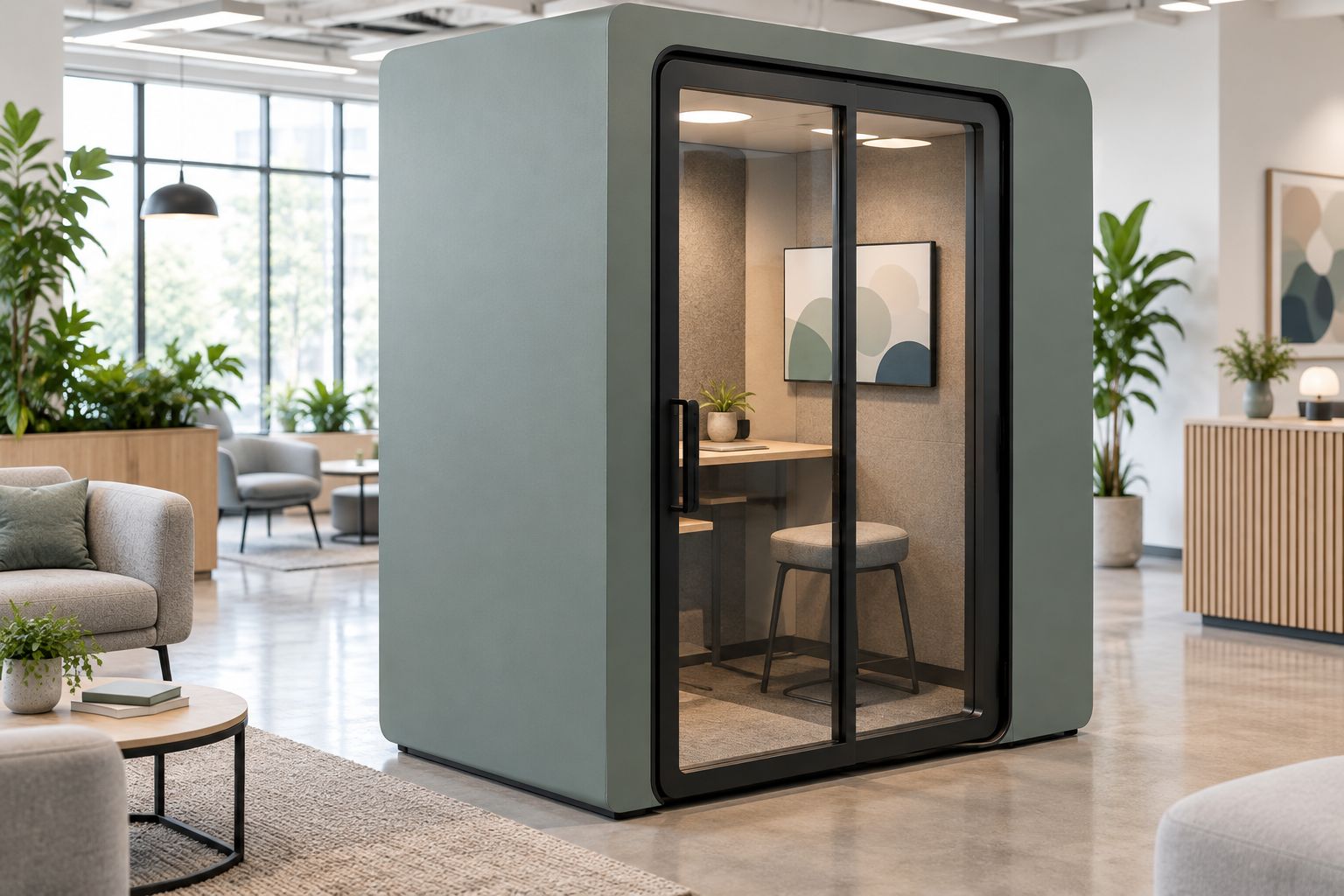
Keeping the existing finish: best for a wider palette update
Retaining the original exterior is a valid design decision when the pod itself does not need a new finish. Review the surrounding palette before commissioning a modification simply because the workplace is being refreshed.
The advantage is straightforward: you avoid a finish-change project. The limitation is equally clear: the pod’s exterior colour remains unchanged.
Compare the existing exterior with the proposed furniture and wall colours in the actual setting. Decide whether the pod is genuinely incompatible with the new scheme or merely different from the initial design concept.
This approach also helps you distinguish surface condition from presentation. If the concern is a visible mark, ask about an appropriate maintenance or repair route; if the concern is colour coordination, review the full room rather than treating the pod in isolation.
Why the right refinishing route varies
The treatment should follow the specific brief. These factors change the questions you need answered:
- Pod identity: manufacturer guidance must relate to the model you own, not a visually similar booth.
- Existing finish: the surface determines the compatibility enquiry; colour alone does not identify it.
- Surface condition: a local repair and a complete colour change require different descriptions of the problem.
- Desired appearance: plain colour, graphics and branding are distinct outcomes, even when they share a palette.
- Extent of the change: identify the exterior faces involved rather than using an undefined whole-pod instruction.
- Future design plans: explain whether the treatment is intended to remain through later workplace identity changes.
Do not translate these factors into assumptions about a particular product. They are questions for defining the work, not evidence that a finish, coating or wrap has a particular specification.
What should an office refurbishment team put in the brief?
A concise written brief prevents the design team, facilities team and finishing provider from answering different questions. It should describe the desired result and record the model-specific information supporting the chosen route.
Include the following:
- The exact pod model and identifying purchase reference.
- Photographs of the whole exterior and any affected areas.
- The reason for the change: colour coordination, branding or repair.
- A colour reference or artwork file that represents the intended appearance.
- A clear description of the exterior faces included in the project.
- The manufacturer’s response about the proposed treatment.
- The questions that still need an answer before commissioning.
Keep a visual approval separate from a treatment confirmation. Someone approving the colour scheme has not necessarily confirmed that the proposed paint or wrap is appropriate for the surface.
The brief should also name the person responsible for resolving changes. If the design provider proposes different coverage or a different treatment, that person can return the revised scope to the manufacturer rather than letting the project drift.
FAQ
Can I use ordinary wall paint on an office pod?
Do not choose ordinary wall paint without confirmation that it is suitable for the pod’s existing exterior finish. Ask the manufacturer for model-specific treatment information before commissioning repainting.
How do I find out what finish my office pod has?
Identify the exact model and ask the manufacturer to confirm its exterior finish. Supply purchase references and photographs; appearance alone does not establish the surface specification.
Is an office pod wrap the same as repainting?
No, an exterior wrap and repainting are different treatments. Compare them against your intended result, then confirm the relevant compatibility and coverage details for the pod.
Can I add branding to a Quell booth without choosing paint?
Soundbox Store lists an Office Pod - Wrap Option for exterior personalisation of Quell booths across all booth sizes. Discuss the exact model and artwork brief before selecting the treatment.
Does changing the exterior colour improve soundproofing?
A colour change is not evidence of improved soundproofing. Keep the visual treatment separate from acoustic performance requirements and their supporting product information.
What should I ask about if I expect to change the branding later?
Ask how the proposed treatment can be changed or removed and what that means for the existing finish. Do not assume that a wrap is removable without affecting the surface or that repainting is readily reversible.
One last thing
Write the desired outcome before naming the treatment. A brief that starts with a reception colour scheme leaves room to consider the existing finish, a confirmed repainting route or an exterior wrap. A brief that starts with paint has already narrowed the decision before the surface question is answered.
Take the same approach to repairs. Identify the visible defect first, then request the appropriate response; do not use a complete exterior makeover as the default answer to a local problem.
The next move is simple: send the exact model, photographs and intended appearance to the manufacturer. Choose the treatment after that enquiry, not before it.


