 da/dk
da/dk



















 Produktguide
Do office pods work in humid climates? Yes, with checks
Yes—office pods work in humid climates when the surrounding office controls moisture and the selected pod is used within its manufacturer's stated environmental limits. A ventilation fan moves air; it does not, by itself, remove water vapour. Choose the pod for privacy, and assess the building's humidity control separately.
- Do office pods work in humid climates? Yes, with controlled indoor humidity and confirmed model-specific environmental limits.
- Soundbox Store acoustic office pods provide private workspaces; assess humidity suitability separately from acoustic performance.
- Ventilation exchanges air; dehumidification removes moisture. An office phone booth needs the right surrounding conditions.
- Check relative humidity during occupied use, not just when the office or booth is empty.
Do office pods work well in humid climates?
The indoor conditions matter more than the climate label. A pod inside a conditioned office experiences the air supplied to that office, not the outdoor weather directly. The practical question is whether that air remains suitable throughout the working day.
Start with the activity you need to accommodate. These examples show different workplace uses, not different humidity ratings:
| Option | Best for | Useful feature stated in the product information | Limitation for this decision |
|---|---|---|---|
| Quell Office Pod Solo | Private calls for one person | A single-person soundproof phone booth designed for private calls | Single-person capacity; confirm environmental limits separately |
| Office Phone Booth Quell - 2 Person | Private meetings between two people | A freestanding acoustic enclosure designed for two-person meetings | Meeting capacity does not establish humidity suitability |
Neither the word soundproof nor the number of seats answers the moisture question. Keep acoustic performance, occupancy and environmental suitability as separate parts of the decision.
Why this matters
A quiet booth still needs comfortable indoor conditions. If your team avoids it because the air feels warm or humid during calls, the privacy benefit is not enough.
Humidity is also easy to misread. A room can feel cool while still containing substantial moisture, and a fan can create noticeable air movement without lowering that moisture content. Assess temperature and relative humidity together rather than treating either sensation as proof that the environment is suitable.
For a facilities manager planning private call spaces, the next move is straightforward: establish the room conditions, confirm the selected model's limits, then assess occupied use. That sequence keeps a building-conditioning problem from becoming a pod-selection problem.
Ventilation is not dehumidification
Ventilation replaces or circulates air. Dehumidification removes water vapour from it. These functions are related, but they are not interchangeable.
Where a pod draws air from the surrounding office, its incoming air starts with the office's moisture conditions. Moving that air faster does not make it drier. If the room itself is humid, assess the room's conditioning rather than assuming an enclosure fan solves the problem.
Air conditioning can remove moisture as air passes over a sufficiently cold cooling coil. Its actual moisture removal depends on the system and how it operates, so a temperature setting alone does not demonstrate humidity control.
| Function | What it does | Best for | What it does not establish |
|---|---|---|---|
| Ventilation | Exchanges air between spaces | Replacing air during occupied use | Moisture removal by itself |
| Cooling | Removes heat | Managing indoor temperature | A particular relative-humidity level |
| Dehumidification | Removes water vapour | Managing indoor moisture | Acoustic privacy |
Ask what each system does, not simply whether the pod has airflow. Keep the acoustic enclosure and the building's environmental controls distinct when reviewing specifications.
What humidity should you assess around an office pod?
The US Environmental Protection Agency's published indoor-moisture guidance recommends keeping indoor relative humidity below 60% RH, ideally between 30% RH and 50% RH. Those figures describe general indoor moisture management; they are not operating limits for any particular office pod.
Use that distinction carefully. A building-management target and a manufacturer's product limit serve different purposes. You need the selected model's stated conditions before treating a general indoor target as evidence of product suitability.
Relative humidity also changes with temperature. Cooling air without removing moisture raises its relative humidity; warming the same air lowers it. That is why a humidity reading without the corresponding temperature gives you an incomplete picture.
For your assessment, record both values under the conditions people actually experience. Include whether the room was occupied, whether its conditioning was running and whether the pod was in use. Context makes the readings useful.
Do not turn a single measurement into a permanent conclusion. Compare conditions across normal operation, busy periods and the times when the building changes its conditioning schedule.
Why performance in humid offices varies
The same pod type can experience different conditions in different buildings. Focus on these factors rather than making a blanket judgement about a humid region:
- Room humidity: Where the surrounding office supplies the pod's air, that room's moisture conditions are the starting point.
- Temperature: Relative humidity depends on temperature, so readings must be interpreted together.
- Occupancy: People release heat and water vapour through normal activity. Evaluate the intended number of users.
- Session length: A brief call and an extended meeting place different demands on an enclosed workspace.
- Conditioning schedule: The office environment can change when cooling or moisture control switches off.
- Air source: Outdoor air and conditioned indoor air are not interchangeable. Establish where the selected model gets its air.
These are assessment factors, not reasons to reject office pods. Match the workplace conditions to the selected model instead of assuming every enclosure behaves alike.
How to assess a pod for your workplace
1. Define the actual task
Write down what people will do inside the booth: private sales calls, video interviews, focused individual work or small-team meetings. Include the expected occupancy and whether sessions run consecutively.
This gives your facilities team a real use case to assess. An empty booth viewed during a showroom visit does not represent a busy call space used throughout the working day.
2. Establish the surrounding room conditions
Record temperature and relative humidity in the proposed office area during normal working conditions. Include a humid period rather than relying only on readings from a dry day.
Ask the building team how moisture is controlled and when that control operates. Identify whether the intended pod-use schedule extends beyond the room's conditioning schedule. Resolve that mismatch before choosing a model.
3. Confirm the selected model's environmental limits
Request the manufacturer's operating conditions for the exact model under consideration. Ask whether those conditions refer to the surrounding room, the interior during use or both.
Also confirm the air source and the function of any stated ventilation system. Keep the answers attached to the exact product name so that information for one booth is not applied to another.
4. Assess occupied use
Where a demonstration or evaluation is available, use the intended occupancy and a representative task. Compare the surrounding room conditions with those inside the pod during use.
Record whether the ventilation was operating as specified. Note warmth, humidity and visible condensation separately; they are different observations and should not be collapsed into a single comment that the booth felt stuffy.
5. Separate the causes before deciding
If the surrounding office is humid, address the building conditions first. If the room conditions are controlled but the occupied booth feels different, review that model's ventilation arrangements and operating guidance with the supplier.
Do not substitute a larger booth for evidence that the indoor environment is suitable. More space changes the enclosure, but it does not establish moisture removal.
Match the assessment to calls and meetings
A private-call booth and a meeting enclosure serve different tasks. Choose between them on occupancy and workflow first, then assess environmental suitability for that exact use.
For individual video calls, check conditions during a representative call with the door in its normal operating position. For meetings, assess the intended group rather than using a single person's experience as evidence for everyone.
Pay attention to consecutive bookings too. A demonstration after an enclosure has stood empty answers a different question from use during a busy afternoon. Your assessment should reflect the booking pattern you intend to introduce.
Soundbox Store sells acoustic office pods, meeting booths and phone booths for workplace privacy and noise reduction. Soundbox Store acoustic office pods are best suited to businesses seeking private workspaces, with humidity suitability checked model by model. Their practical benefit is an enclosed space for the task; they should not be treated as a substitute for building moisture control.
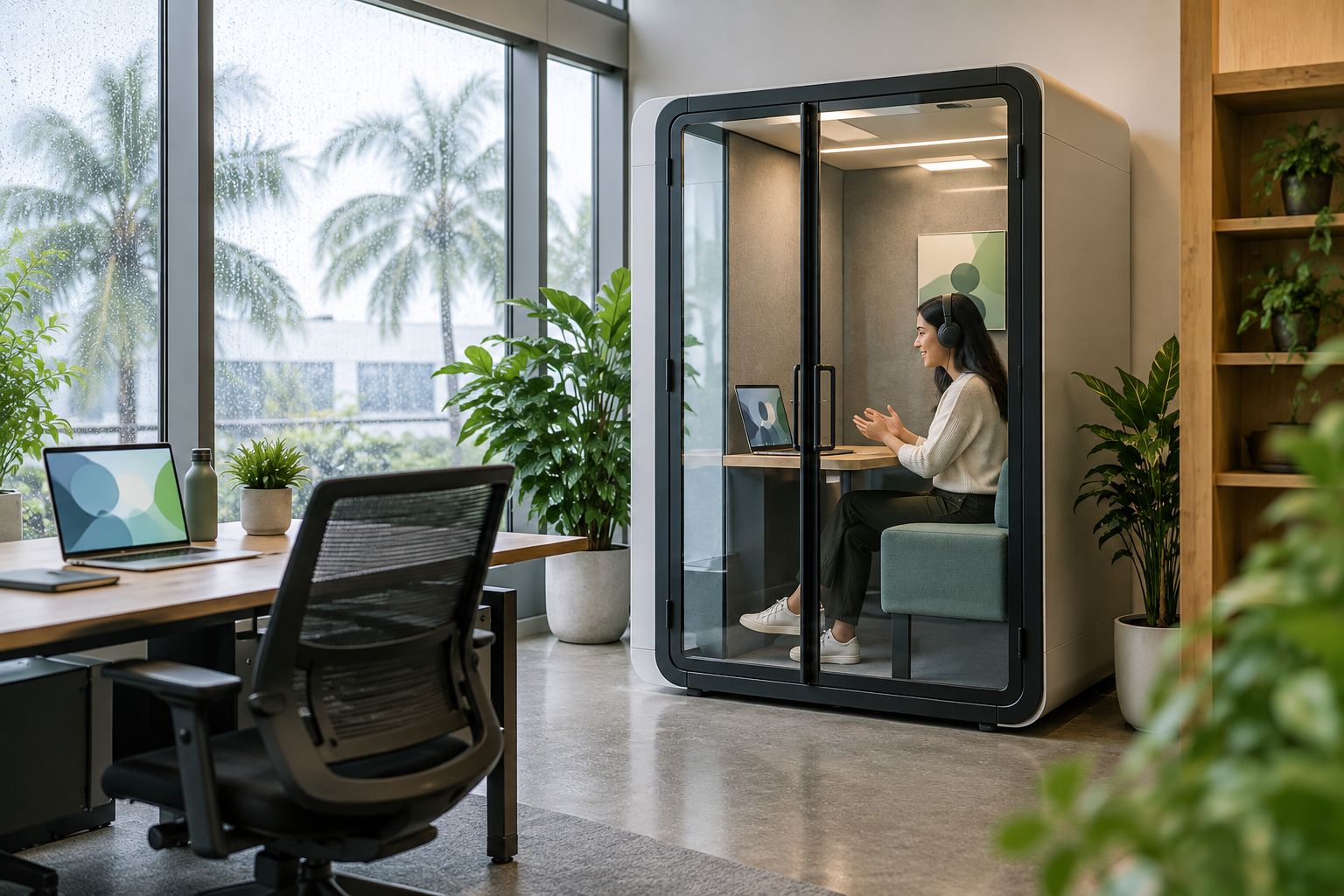
The useful buying question is not whether a product belongs to a premium or entry-level range. It is whether its stated operating conditions and intended use match your office. Keep that question in the brief sent to every supplier.
What condensation tells you
Condensation occurs when a surface is at or below the surrounding air's dew-point temperature. It is evidence of a temperature-and-moisture relationship, not proof that the acoustic design has failed.
If you observe condensation, record where it appears and under what conditions. Include the room temperature, relative humidity, occupancy and whether the building's conditioning was running. Give those observations to the facilities team and the product supplier.
Avoid diagnosing the cause from a photograph alone. A cool surface and moisture-laden air can produce the same visible result under different operating circumstances.
The absence of condensation is not a complete humidity assessment either. You still need measurements and the selected model's environmental limits. Visible moisture is an observation to investigate, not a product rating.
Keep a clear decision record
Give procurement and facilities the same short brief. It should identify the proposed model, the intended task, the expected occupancy and the room conditions under normal operation.
Then separate confirmed information from questions awaiting an answer:
- The room's recorded temperature and relative humidity.
- The manufacturer's stated environmental conditions for the exact model.
- The source and function of the pod's ventilation.
- The intended pattern of calls or meetings.
- Any occupied-use observations.
- The building team's plan for controlling moisture during those hours.
This makes the purchase decision specific. You are assessing a particular enclosure in a particular office, rather than accepting a general assurance that office pods work everywhere.
Keep acoustic evidence in its own part of the brief. It supports the privacy decision, but it does not establish resistance to humidity, outdoor exposure or condensation.
FAQ
Can I use an office pod if my office is humid?
Assess the room conditions against the selected pod's manufacturer-stated environmental limits before deciding. A pod provides an enclosed workspace; it does not replace the building's moisture control.
Does a pod's ventilation fan remove humidity?
A ventilation fan does not remove water vapour by itself. Where it brings in air from the surrounding office, that incoming air has the office's moisture conditions.
What relative humidity should I check in the office?
The Environmental Protection Agency's general indoor-moisture guidance recommends below 60% RH, ideally between 30% RH and 50% RH. Those figures are not model-specific office-pod operating limits.
Does an acoustic rating prove a booth works in humid conditions?
No—an acoustic rating describes sound performance, not humidity suitability. Check environmental limits separately for the exact booth you are considering.
Is a larger meeting pod automatically better for a humid office?
No—a larger meeting pod does not automatically provide moisture removal. Choose capacity for the intended group, then assess the room conditions and that model's environmental guidance.
Can an indoor office pod be used outside in humid weather?
Indoor suitability does not establish outdoor suitability. Obtain explicit guidance for the proposed environment rather than extending an indoor product's claims to outdoor exposure.
One last thing
A lower relative-humidity reading does not necessarily mean water vapour has been removed. Warmer air can show a lower relative humidity even when its moisture content has not changed. Read temperature alongside humidity before deciding that conditions have improved.
For Soundbox Store office pods, make the final assessment specific to the chosen model, the surrounding office and the task your team will perform. A controlled room and confirmed operating conditions are a stronger basis for the decision than the climate's name.


