 da/dk


 Produktguide
How to stop colleagues overhearing your phone calls
To stop colleagues overhearing phone calls, move sensitive conversations away from shared desks into an enclosed room or acoustic phone booth, close the door and use a headset rather than speakerphone. Headphones keep the other caller’s voice private, but they do not contain your own speech. Check whether words remain understandable outside the space before discussing sensitive details.
- To stop colleagues overhearing phone calls, use an enclosed space and check speech privacy from nearby desks.
- Headsets contain the remote caller’s audio, not your voice; microphone noise suppression does not soundproof your surroundings.
- Soundbox Store office phone booths suit businesses creating dedicated spaces for private workplace calls.
- Choose a single-person booth for individual calls; use a two-person enclosure when a colleague needs to join.
Why this matters
A call can sound quiet and still be understandable to the person sitting nearby. The useful test is whether colleagues can follow the words, not simply whether your voice sounds softer. That distinction matters when discussing recruitment, customer accounts or personal matters.
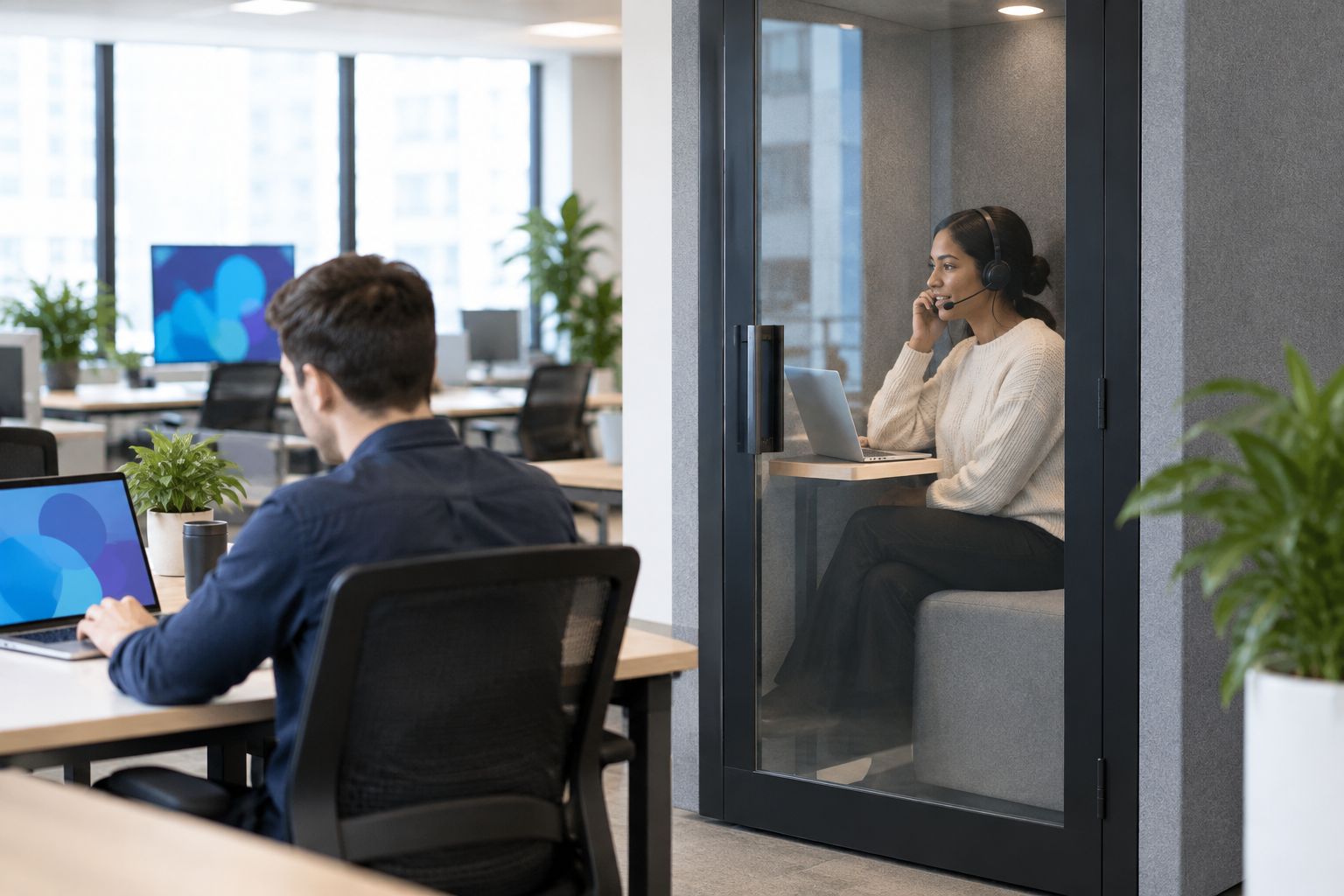
A single-person office phone booth gives you a dedicated place to leave the shared desk area. Treat the enclosure, your call settings and everyday booking habits as separate parts of the solution; none replaces the others.
How do you stop colleagues overhearing your phone calls?
Start with the conversation itself, then check the space around it. The following sequence addresses both sides of the call without relying on colleagues to wear headphones or ignore what they hear.
- Move before the sensitive discussion starts. Use an enclosed room or phone booth rather than beginning at your desk and relocating after names or details have already been spoken.
- Close the door before answering. An open doorway leaves a direct route for speech to reach the shared office. A room’s appearance alone tells you little about privacy.
- Switch from speakerphone to a headset. Keep the remote participant’s audio out of the room. Check the selected audio output, especially when changing between a laptop and a telephone.
- Use a normal conversational voice. Avoid projecting across the room or raising your voice to compete with background conversation. If the call is difficult to hear, address the audio settings rather than speaking louder.
- Check from the listener’s position. Ask a colleague to listen from the nearest occupied desk while you speak harmless sample sentences inside the enclosure.
- Choose another space if words remain clear. Do not discuss sensitive information in a location that fails that practical check. Keep the call general until you reach somewhere more suitable.
This is an informal listening check, not an acoustic measurement or a promise of confidentiality. It helps you identify an unsuitable location before a real conversation exposes information.
What each privacy measure actually does
Different measures solve different problems. A headset changes where the remote caller’s voice plays; an enclosure addresses the separation between your speaking position and the people around you.
| Measure | Best for | Main benefit | Limitation |
|---|---|---|---|
| Headset | Keeping the remote caller off the room speakers | Directs incoming audio to your ears | Does not contain your spoken replies |
| Enclosed meeting room | Occasional calls when a suitable room is available | Separates the call from shared desks | Privacy depends on the room and whether speech escapes |
| Single-person acoustic booth | Individual calls away from the desk area | Provides a dedicated enclosed call space | Requires a suitable location and a check of real-world speech privacy |
| Two-person acoustic booth | Calls involving a colleague in the same enclosure | Gives both local participants a shared enclosed space | Needs booking arrangements that reflect its use |
| Acoustic wall or ceiling treatment | Reducing reflected sound in the shared office | Addresses reverberation within the room | Is not a substitute for an enclosed private call space |
Do not buy a microphone solution to solve a room privacy problem. Microphone noise suppression concerns the audio sent to the remote participant. A colleague beside you still hears the voice you produce in the office.
Likewise, a quieter office is not automatically a more private office. Less background sound can make an isolated conversation easier to follow, even when the overall workplace feels calmer.
Check privacy from outside, not just comfort inside
Sit or stand where you would normally take the call and speak at your usual level. Ask a colleague outside to distinguish between hearing a voice, recognising occasional words and following complete sentences. Use ordinary, non-sensitive material throughout.
The listener should begin at the nearest occupied desk, not at a conveniently distant corner. Include any nearby shared seating where people regularly work; that is where the privacy question needs an answer.
Repeat the check when the office is relatively quiet as well as during normal activity. Background conversation can conceal weaknesses that become obvious when other people leave for lunch or finish work.
Write down the location and whether the listener understood the content. You do not need a recording of the conversation; a short observation is enough to inform the immediate decision about where to take the next call.
Why speech privacy varies between call spaces
No single feature determines whether someone outside can understand a call. Consider these factors together rather than treating the presence of a door as a complete answer.
- Speaking level: a projected voice puts more sound into the surrounding space than an ordinary conversational voice.
- Openings: an open door creates a direct route between the caller and nearby listeners.
- Listener position: the nearest desk or shared seat is more relevant than a distant test position chosen for convenience.
- Background sound: a conversation that disappears into office activity can become understandable when the workplace quietens down.
- Room reflections: hard, reflective surroundings affect how speech behaves within a space; absorption and sound isolation address different issues.
- Call behaviour: speakerphone adds the remote participant’s speech to the room, while talking during entry or exit bypasses the enclosure.
Keep these observations separate from product specifications. A published acoustic figure describes a stated measurement; your workplace check asks whether the particular conversation is understandable at a particular listening position.
Choose the enclosure around who joins the call
For an individual caller, start with a space intended for 1 person. If a manager or colleague regularly joins in person, consider a space intended for 2 people instead of treating a solo booth as a shared meeting room.
Soundbox Store office phone booths suit businesses creating dedicated enclosed spaces for workplace calls. Choose by the actual conversation format, then confirm the relevant product information rather than assuming every booth has identical acoustic performance or furnishings.
| Product | Best for | Supplied purpose | Practical limitation |
|---|---|---|---|
| Office Phone Booth Folio | Individual private calls | A one-person booth for private calls, video meetings and focused work | Its one-person purpose does not match calls with an in-person colleague |
| Office Phone Booth Quell - 2 Person | Calls involving two local participants | A freestanding acoustic enclosure designed for two-person private meetings | A shared meeting space needs booking rules if individual callers also use it |
Soundbox Store’s supplied range information states 30–35 dB noise reduction. That range is not a model-specific figure for either product above and does not establish that nobody outside will hear or understand a conversation.
The product descriptions establish the intended uses, not an absolute confidentiality guarantee. Check the information for the exact model you are considering and assess speech privacy in the intended workplace.


Make private call spaces usable during the working day
A suitable enclosure does not help the person who cannot access it when a sensitive call arrives. Give private calls a clear place in your office’s room-booking arrangements rather than leaving everyone to improvise.
Separate planned calls from incoming calls. You can reserve a room for a scheduled recruitment discussion, but an unexpected customer callback needs an agreed alternative if that room is occupied.
Use a short set of operating rules:
- Move sensitive calls out of shared desk areas before discussing details.
- Reserve enclosed call spaces for conversations that need them during busy periods.
- Release bookings when calls finish rather than leaving unused reservations in place.
- Keep conversations paused while entering or leaving the enclosure.
- Agree where callers should go when the preferred space is occupied.
Avoid judging the need for call space from total headcount alone. Look at which conversations overlap and which need privacy; a team taking calls at different times has a different scheduling problem from a team receiving them together.
For planned calls, check the booking before inviting the other participant. For unexpected calls, explain that you need to move somewhere private and resume only after reaching the chosen space.
Avoid fixes that address the wrong problem
Turning down headset volume helps keep incoming audio contained, but it does not make your replies private. Whispering is also a poor everyday substitute for a suitable space: it changes how you speak without establishing what colleagues can understand.
Do not assume visual screening creates acoustic privacy. A screen can hide a face or document while leaving speech audible, so judge sound and sight separately when choosing a place to talk.
Adding acoustic absorption to a shared office serves a different purpose from separating a caller from listeners. It can address reflected sound, but you should not treat wall panels, ceiling treatment or soft furnishings as a complete barrier around a conversation.
Finally, do not test privacy using real customer, employee or business information. Ordinary sample sentences let you check intelligibility without repeating the very disclosure you are trying to prevent.
FAQ
Will noise-cancelling headphones stop colleagues hearing my calls?
Noise-cancelling headphones do not contain your spoken voice. They affect what you hear, while microphone noise suppression affects the signal sent to the remote participant; neither encloses the conversation around you.
Can colleagues hear the person calling me through my headset?
Colleagues can hear incoming audio if it leaks from the headset or plays through another selected speaker. Check the audio output and use a listening volume that does not broadcast the caller into the room.
Should I whisper when taking a private call at my desk?
Whispering is not a dependable substitute for a private call space. Move to an enclosed room or booth and check whether speech remains understandable outside before discussing sensitive details.
Do acoustic wall panels make desk calls private?
Acoustic wall panels address sound absorption, not complete separation between a caller and nearby listeners. Use them to address room acoustics rather than treating them as an enclosure for private calls.
How can I check whether a phone booth gives enough privacy?
Ask a colleague at the nearest occupied desk to listen while you speak harmless sample sentences inside the closed booth. Check whether the colleague understands the words, including when the surrounding office is quiet; this is an informal check, not a measured acoustic assessment.
Which Soundbox Store booth suits a call with a colleague?
The Office Phone Booth Quell - 2 Person is designed for two-person private meetings. The Office Phone Booth Folio is intended for one person, so match the enclosure to the number of local participants rather than the number joining remotely.
One last thing
Do not resume a sensitive conversation as soon as you leave the booth. The final recap, a customer name or a comment to a colleague can reveal the subject after the enclosed part of the call has finished.
Finish the discussion before opening the door, then keep any follow-up in the same private setting. Speech privacy depends on where the conversation starts and ends, not just where you spend most of the call.


