 en/ch
en/ch



















 Product guide
Office Pods for Notary Offices: Sizes & Setup (2026)
Notary and records office pods are enclosed, soundproof booths built for private signings, ID checks and confidential file work at a counter that otherwise runs on foot traffic and overheard conversation. A law firm meeting room or a general huddle space doesn't fit this job: most notary appointments involve one or two people for a few minutes at a time, and most records queries involve one staff member reading personal details off a screen.
- Office pods for notary offices work best as one- or two-person booths near the counter, not full meeting rooms.
- The Quell Office Pod Solo suits solo notarisations; the 2-Person Meeting Booth suits notary-plus-client signings.
- Locks and privacy film matter more for records offices than extra seating capacity.
- Soundbox Store's pods are tested to ISO 23351-1:2020 with 30-35 dB of noise reduction.
Why acoustic pods matter for notary and records offices
A notary counter handles ID documents, powers of attorney, wills and financial paperwork, and reading any of that out loud is inherently personal. An open waiting area puts that conversation within earshot of the next client in the queue. Records offices carry the same risk from a different angle: pulling a file, confirming an account number over the phone, or correcting an entry next to a shared printer all involve saying someone's personal details out loud in a shared space.
Neither role needs a full meeting room. Soundbox Store's pod range spans 30-35 dB of noise reduction, tested to ISO 23351-1:2020, which is enough to keep a signing conversation from carrying to the next chair in the queue without the office giving up its open layout entirely.
“A notary desk only needs to be private enough that the next person in line can't repeat back what they just heard.”
How to set up office pods for a notary or records office
Most notary and records offices don't need a redesign. Six changes cover the shift from an open counter to a private, secured signing point.
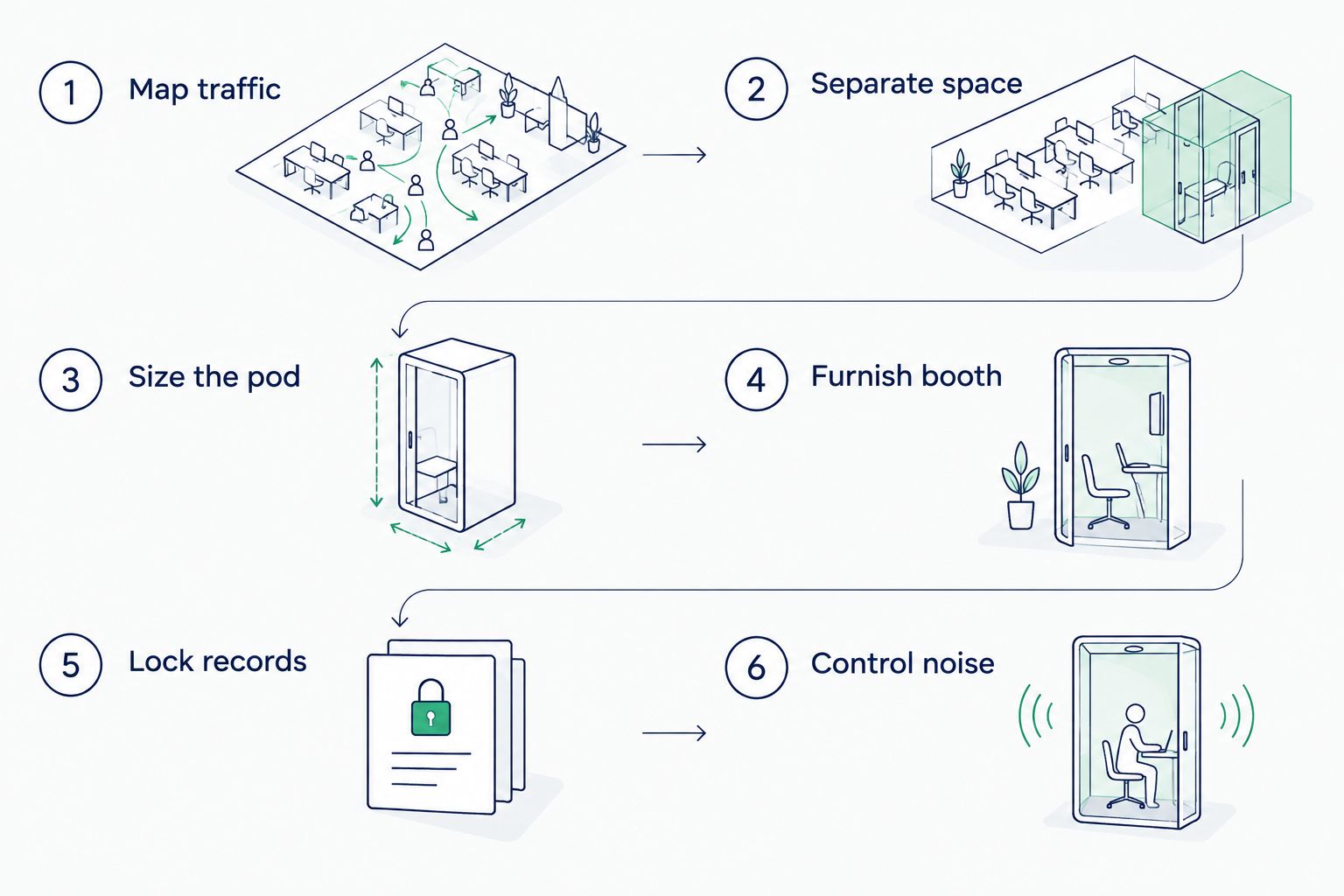
Map your walk-in and waiting flow
Before buying anything, watch how clients and paperwork actually move through the office for a week. It costs nothing and tells you whether one small booth covers the job or whether you need several.
- Time how long a typical notarisation takes at the counter, start to signature
- Note where clients wait before they're called forward
- Flag any spot where a counter conversation reaches the waiting chairs
- Count how many appointments involve one signer versus two or more
- Check whether records staff share floor space with walk-in clients
Separate the signing space from the waiting area
A signing desk sitting in the open, next to the queue, is the single biggest privacy problem in a notary office. Moving it, or boxing it in, solves most of the issue before a pod is even involved.
- Move the notary desk to a corner away from the entrance
- Put a floor-to-ceiling partition or a full bookshelf between the queue and the desk
- Hang a heavy curtain across an alcove already used for signings
- Free up a back office for two-person appointments
- Install a standalone acoustic pod between the counter and the file room for the fastest fix
Size the pod to how many people actually sign together
Pod size should match appointment size, not the biggest room the office has spare. Most notary work is one person at a desk, or one notary with a single client.
- Solo notarisations and single-signer affidavits: a one-person booth such as the Quell Office Pod Solo
- Notary plus one client: a two-person booth such as the 2-person meeting booth
- Family closings or appointments needing a witness: a four-person pod
- Records team file reviews or training sessions: a four- to six-person booth
In practice, a two-person signing looks like this:
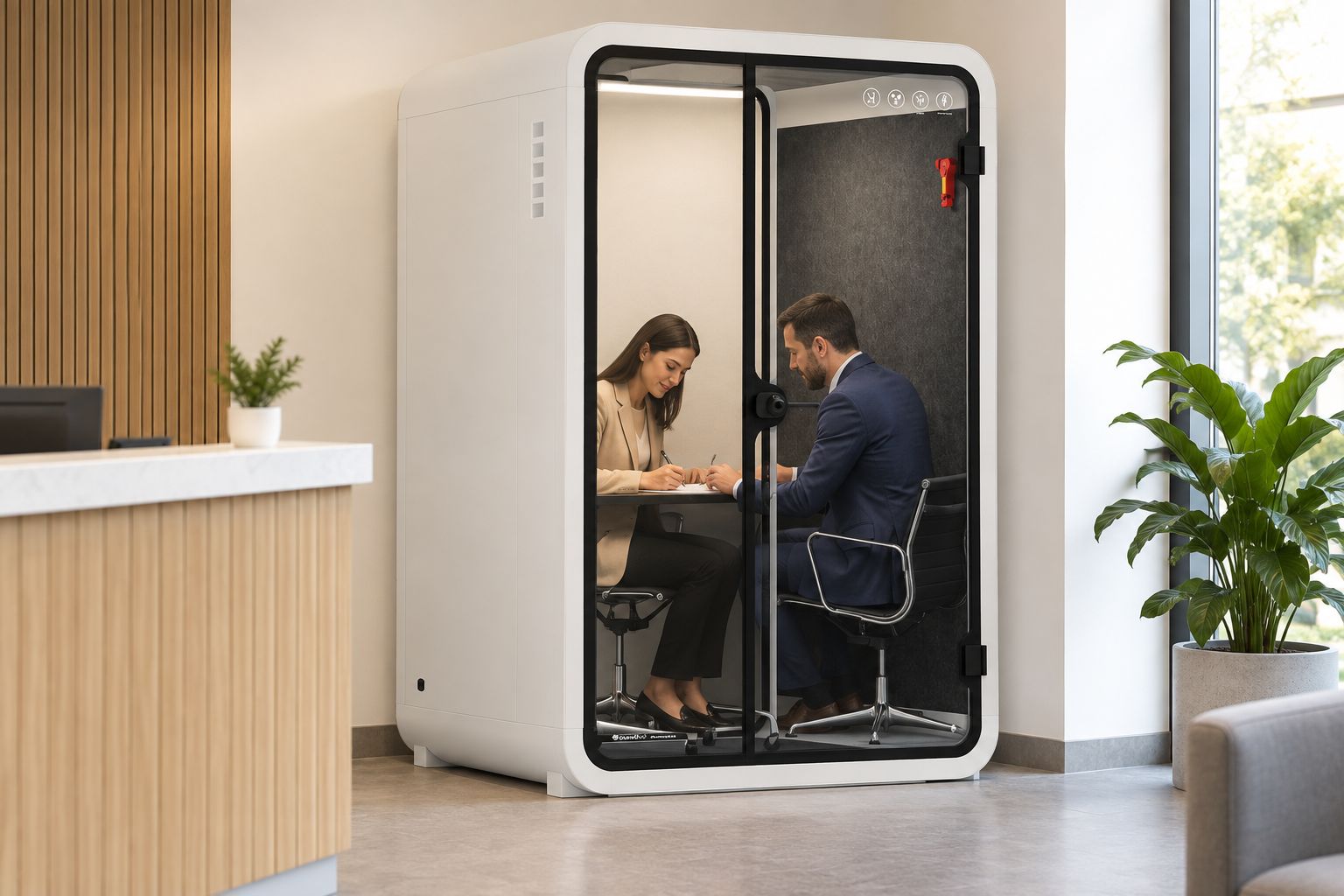
These three options from Soundbox Store cover most notary and records configurations:


Furnish the booth for paperwork, not just conversation
A pod built for phone calls isn't automatically set up for notarisation. Signing needs a stable writing surface, decent task lighting, and seating that puts the client at the same eye level as the notary.
- A desk-height writing surface, not a narrow shelf
- A task chair for the notary and a second seat for the client
- Lighting bright enough to read a signature line and check an ID photo
- A stool option if the booth is used standing for quick verifications
- Enough surface space to lay out ID, the document, and a stamp or seal side by side
Lock down sensitive records without losing daylight
Personal identification, financial statements and case files sit on the desk during a signing, sometimes for the whole appointment. A pod's glass panel gives visual privacy from a distance, but it doesn't lock a door.
- Fit a keypad or smart lock on the booth door, such as the smart lock system
- Add privacy film to glass panels for signings where documents shouldn't be visible from the corridor
- Keep a locked cabinet inside the pod for hard-copy files, rather than leaving them on the desk between appointments
- Position the booth so any screen faces away from the main walkway
- Extend existing office access logging to the pod door if the building already tracks entry elsewhere
Stop noise carrying between multiple booths
Records offices running several booths in a row have a second acoustic problem: booth-to-booth noise, not just booth-to-lobby noise.
- Add acoustic wall panels between adjacent booths, not just around the room's perimeter
- Fit ceiling panels above the row to cut reflected noise
- Avoid positioning two booth doors directly opposite each other
- Leave at least a metre of gap between adjacent pods
- Add soft flooring underneath to reduce footstep noise between appointments
Compare pod sizes for notary and records office use
| Option | Best for | Capacity | Key limitation |
|---|---|---|---|
| Quell Office Pod Solo | Single notarisations and private calls | 1 person | No room for a second signer or witness |
| 2-person meeting booth (Quell) | Notary-plus-client signings | 2 people | Tight for a third witness |
| Quell 4-Person Soundproof Office Pod | Family closings with multiple signers | 4 people | Takes more floor space than most records counters have spare |
| Quell 6-Person Meeting Booth | Records team file reviews and training | 6 people | Overkill for routine one-on-one notarisations |
Common mistakes notary and records offices make with pod setup
- Treating a general meeting room like a signing booth. A six-person room doesn't stop a hallway conversation bleeding into a one-on-one signing the way a properly sized booth does.
- Skipping locks because the pod feels private. Glass panels and a closed door don't protect files left on the desk overnight; that needs a separate lock.
- Placing the booth next to the printer or scanner used for records. Motor noise from shared equipment works against the pod's noise reduction rating.
- Buying one large booth instead of two small ones. Most notary appointments are one or two people, not four, so a single big room often sits half-empty.
- Skipping privacy film on glass panels. Visual privacy matters as much as acoustic privacy when a client's ID is sitting face-up on the desk.
FAQ
What size office pod works best for a notary and one client?
A two-person booth is the right fit for a notary meeting a single client, since it covers a desk and two chairs without space to spare. A solo one-person pod covers individual notarisations where the client signs alone or steps in briefly to countersign.
Do soundproof pods keep signing conversations private from the waiting area?
A pod rated for noise reduction keeps a signing conversation from carrying to the next chair in the queue, which is the main privacy problem at an open notary counter. Soundbox Store's range is tested to ISO 23351-1:2020 with 30-35 dB of noise reduction across its pods.
Can one pod handle both notary signings and records team work?
A single pod can cover both if appointments are staggered, but an office running signings and file reviews at the same time usually needs two booths rather than one shared space. Match the booth to whichever task has more people in it at once.
What's the difference between a phone booth and a meeting booth for notary work?
A phone booth is built for one person and suits solo notarisations or private calls, while a meeting booth seats two or more and suits a notary working directly with a client. Choose based on how many people are in the room during a typical appointment.
Does a notary office pod need its own lock?
Yes, a dedicated lock keeps documents and ID left on the desk between appointments secure, and it's a separate fitting from the booth itself, such as a smart lock system. Glass panels give visual privacy but don't stop someone opening the door.
How much space does a records office need for a two-person booth?
A two-person booth needs floor space for the enclosure itself plus clearance for the door to open and someone to queue outside it. Exact footprint depends on the model, so check the specific booth's own product page before planning the layout.
One last thing
The detail that gets missed: a one-person or two-person pod placed near the counter covers more of a notary office's daily signings than a bigger meeting room ever will, because most notary work is one person, one document, at a time. Records offices should size for the file review that actually happens, not the all-hands meeting that happens once a quarter.


