 da/dk


 Produktguide
Office pods for beauty and cosmetics brand offices: complete guide
Beauty and cosmetics office pods are enclosed workspaces for private calls and small-team meetings, with the aim of separating focused conversations from shared brand-office activity. Choose office pods for beauty and cosmetics brand offices around the work you need to accommodate: retailer calls, launch discussions and agency briefings, rather than appearance alone.
- Soundbox Store office pods suit beauty teams separating private calls from small-group meetings.
- Choose office pods for beauty and cosmetics brand offices by local attendance, task and overlapping bookings.
- Use phone booths for individual calls and meeting booths for shared launch discussions.
- Keep packaging colour approval and content production separate from the acoustic-pod brief.
Why office pods matter for beauty and cosmetics brand offices
A retailer conversation needs somewhere to speak without competing desk conversations. A packaging review needs space for colleagues to examine the same material. These are different room requirements, even when both belong to the same launch project.
Start by identifying which activity your existing rooms fail to accommodate. If the problem is simultaneous individual calls, another shared meeting space does not directly address it; if the problem is group discussion, a solo booth is the wrong format.
Use the guide to calculating how many pods your office needs alongside your own booking records. Soundbox Store offers individual phone booths and larger meeting booths, but the useful starting point is your team's actual work, not the largest enclosure you can shortlist.
This guide concerns office conversations and collaboration. It does not treat a meeting booth as a product-testing room, treatment space or specialist photography studio.
How to choose pods for a beauty brand office
Map the conversations that need a separate space
Use a shared spreadsheet before selecting products. Record the purpose of each displaced meeting, who attends in person and why the existing space does not work. Keep the notes about workspace needs rather than the contents of confidential conversations.
Separate retailer account calls from creative reviews. A person speaking to a remote buyer needs a different setting from colleagues comparing packaging artwork around a table. Record remote participants separately: someone joining online does not need a seat inside the booth.
Also distinguish a recurring requirement from a launch-week exception. An occasional large gathering should not determine every everyday workspace decision.
- Label each activity: retailer call, agency briefing, launch review or focused work.
- Record local attendance separately from remote attendance.
- Note whether participants need to share physical packaging or a screen.
- Identify simultaneous requests, not just total bookings.
- Flag tasks that already work well in existing rooms.
Separate conversation needs from visual-review needs
Book an existing enclosed room first and rehearse the intended meeting. Use the laptop, headset, presentation and packaging mock-ups your team actually works with. This gives you a practical brief before any product enters the discussion.
Treat speech, visibility and visual assessment as separate requirements. An acoustic enclosure addresses a different problem from people seeing unreleased artwork through glazing. Equally, a comfortable video-call setting does not establish that its lighting is appropriate for approving subtle packaging colours.
Write the room brief around the decision being made. A launch-status conversation and a final colour approval should not automatically share the same requirements.
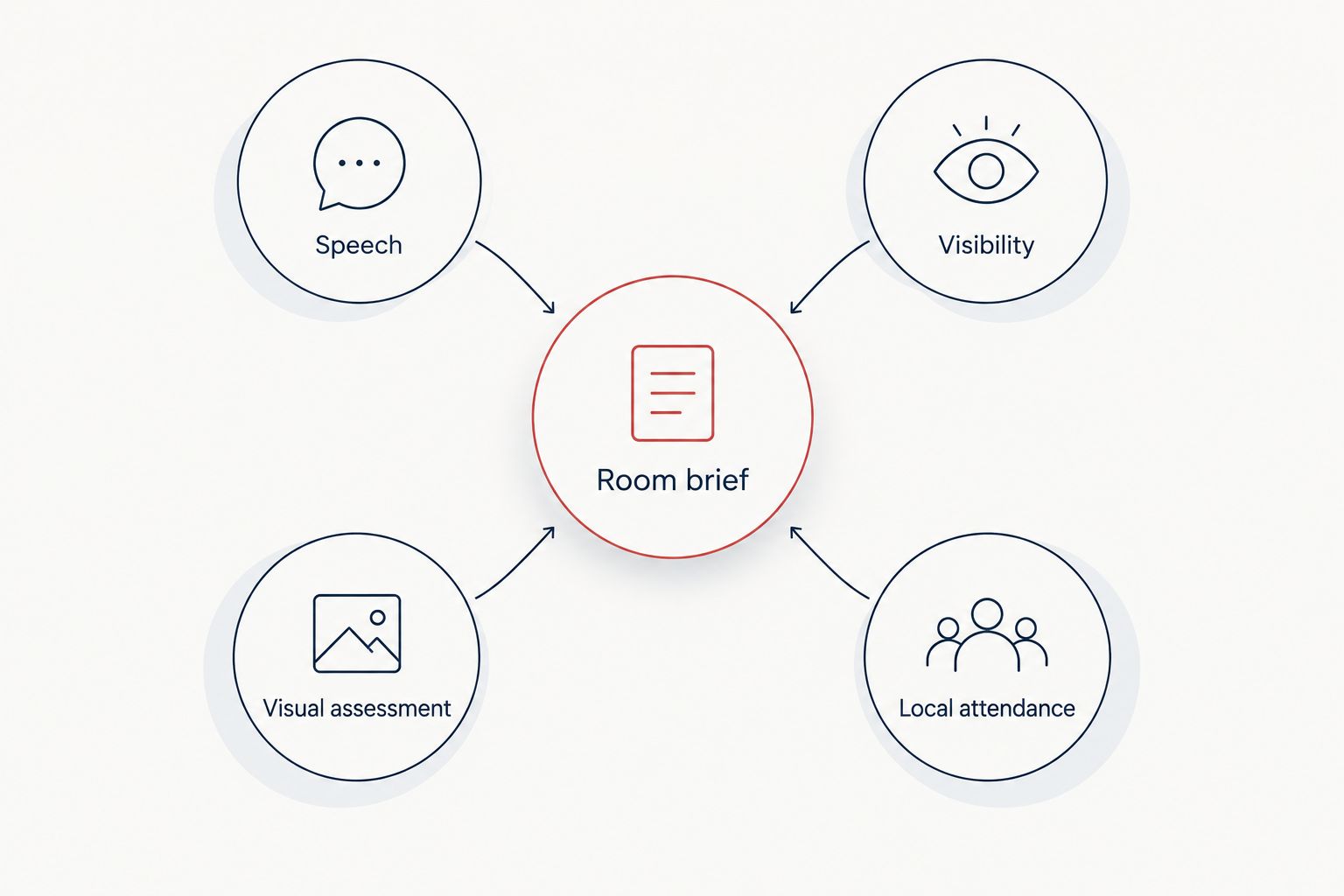
Carry the rehearsal findings into a short checklist. Describe what participants need to do, rather than prescribing features unrelated to their work.
- Check whether remote colleagues can follow the discussion.
- Review what appears behind the speaker on camera.
- Identify artwork and screens that need visual discretion.
- Keep final colour approval within your established review process.
- Distinguish a routine video call from recorded content production.
Match the enclosure to local attendance
Try improving room allocation before adding another enclosure. Reserve smaller existing rooms for individual calls where appropriate, and stop routinely assigning a large meeting room to a single laptop user. Then examine the requests that still cannot be accommodated.
Soundbox Store office pods are best for beauty teams needing separate spaces for calls and small-group meetings. The supplied range includes a 1-person phone booth, a 2-person meeting booth and a 4-person meeting booth. Those capacities provide distinct starting points; they are not reasons to move every activity into a pod.
For example, a retailer account manager joining a remote buying meeting alone has a solo requirement. A brand manager and account manager attending together have a two-person requirement, regardless of how many people appear online.
- Match capacity to people physically inside the booth.
- Separate individual call demand from face-to-face meeting demand.
- Shortlist a group booth only for work that needs shared attendance.
- Keep an existing room available for activities outside the pod brief.
- Ask each user group to confirm the proposed use before selection.
Check the proposed setting against the actual task
Use your existing office plan to discuss the proposed location with the people who will use it. Mark nearby work activities, visitor-facing areas and places where unreleased material is regularly discussed. This is a workspace-use exercise, not an installation plan.
For a beauty brand, the backdrop matters when the task involves external presentations. Review the camera view for ordinary retailer calls and agency briefings, but do not assume a booth is a finished filming set. A product demonstration needs its own assessment of framing, lighting and working surface.
Keep acoustic expectations tied to the particular model under consideration. Do not transfer a figure from another booth or assume the word soundproof means complete silence in every surrounding environment.
- Describe the surrounding office activity to the supplier.
- Ask for acoustic information for the exact shortlisted model.
- Review the camera view using your normal meeting equipment.
- Confirm which furniture and equipment belong to the selected configuration.
- Separate workspace-use questions from specialist installation questions.
Set booking rules around launch work
Start with your existing shared calendar and a written usage note. Give each space a clear purpose, so staff understand whether it serves individual calls, paired conversations or small-group meetings. Do not assume a particular booth includes calendar integration.
During a launch, distinguish planned project meetings from short calls that arise during the day. If every space becomes a permanently reserved project room, the people handling retailer queries still lack somewhere to speak. Agree how bookings are released when plans change.
Use calendar titles that describe the activity without exposing the discussion. A neutral label such as retailer call is more useful for space planning than a title containing unreleased product details.
- Assign a clear use to each booth format.
- Require organisers to release cancelled bookings.
- Use neutral booking titles for unreleased launch work.
- Keep samples and campaign materials out between sessions.
- Name the person responsible for resolving booking conflicts.
Review use before expanding the shortlist
Begin with a manual review of the shared calendar and brief user feedback. Compare intended use with actual use: whether solo calls remain displaced, whether group sessions fit the format and whether bookings overlap. A full calendar alone does not explain whether the space solves the right problem.
Review different working conditions, including routine activity and your next relevant launch period. Do not assume demand stays constant across both. Record why people choose another room as carefully as why they choose the booth.
Soundbox Store's range provides different occupancy options, but expansion should follow a clearly identified gap. Add the format that addresses unresolved demand, not another copy of the most visible booth.
- Compare booked attendance with actual local attendance.
- Record requests that could not find a suitable space.
- Ask whether users completed the intended task comfortably.
- Investigate unused bookings before adding capacity.
- Separate requests for better meeting space from requests for a studio.
Compare options for a beauty brand office
Use this table to connect a defined task with an enclosure format. Soundbox Store product descriptions establish the occupancy and intended uses below; the task matches are recommendations, not claims of specialist beauty-sector performance.
| Option | Best for | Main advantage | Key limitation |
|---|---|---|---|
| Existing enclosed meeting room | Larger packaging reviews or tasks already served by your rooms | Uses a space your team already knows | Does not add another place when existing rooms are occupied |
| Quell Office Pod Solo | One account manager taking private retailer calls | Described as a 1-person phone booth designed for private calls | Does not accommodate an in-person colleague |
| Office Phone Booth Quell - 2 Person | A brand manager and account manager meeting together | Described as a freestanding enclosure for two-person private meetings | Does not provide the attendance capacity of a larger meeting booth |
| Quell - 4 Person Meeting Booth | A small cross-functional launch discussion | Described as a freestanding enclosure designed to seat four people | Four seats do not establish suitability for extensive sample layouts or filming |
Choose Quell Office Pod Solo for individual call demand; choose a meeting booth when colleagues need to attend together. Keep the existing meeting room in the comparison rather than treating a pod as an automatic replacement.
Before deciding, give the supplier the task description and the proposed local attendance. Ask about the selected configuration without assuming that furniture, screens or other accessories are included. Confirm the details that affect your work rather than importing specifications from another model.
Common mistakes beauty and cosmetics teams make
Choosing for the brand presentation before the meeting
A booth that looks appropriate for a brand office still needs to support its assigned task. Define whether the space serves retailer calls, agency briefings or shared reviews before considering its presentation. Appearance cannot resolve a mismatch between individual and group use.
Treating acoustic privacy as visual discretion
A quieter conversation does not stop someone outside seeing a screen or packaging mock-up. Consider sightlines separately when your team discusses unreleased campaigns. Use your existing handling process for confidential materials rather than assuming enclosure alone addresses every form of privacy.
Turning the booth into a sample cupboard
Leaving packaging, campaign props and samples inside changes a shared meeting space into informal storage. Clear materials after each session and keep the booth assigned to its stated purpose. A colleague should not have to move another team's launch materials before taking a call.
Assuming a video-call booth is a beauty studio
A private place to join a video meeting is not automatically appropriate for shade comparison, close-up demonstrations or campaign recording. Assess those activities separately. If your requirement is predominantly content production, write that brief before choosing a meeting enclosure.
Buying for the busiest exceptional meeting
A large launch gathering and everyday account calls create different requirements. Retain a suitable space for exceptional group work while selecting pod capacity around recurring tasks. Otherwise, individual callers and group organisers remain in competition for the same enclosure.
FAQ
What's the best office pod format for a beauty brand's retailer calls?
A single-person phone booth is the appropriate format when one person in the office joins the retailer call. Quell Office Pod Solo is described as a 1-person booth designed for private calls; use a meeting booth when colleagues need to join from the same enclosure.
Should we choose a two-person or four-person meeting booth?
Choose by the number of people attending inside the booth and the work they need to share. A paired account discussion differs from a cross-functional launch review, so record local attendance separately from remote participants.
Can a beauty team use an office pod for product demonstrations?
Assess product demonstrations as a separate task before selecting an office pod. A booth described for calls or meetings does not establish its suitability for close-up filming, packaging colour approval or a demonstration setup.
Will an acoustic booth keep unreleased packaging out of sight?
Acoustic performance does not establish visual discretion. Review sightlines to screens and mock-ups separately, and continue using your normal process for handling unreleased materials.
How many pods does a cosmetics office need?
Base the number on simultaneous requests that your existing rooms cannot accommodate. Record individual calls and group meetings separately, then identify which type of space remains unavailable when staff need it.
Can we manage pod bookings with our existing calendar?
You can start with a shared calendar and written booking rules. Do not assume the selected pod includes calendar integration; confirm any technology requirements separately and require staff to release cancelled bookings.
One last thing
Keep the meeting title out of the privacy problem. A booth can separate a conversation from the shared office while a public calendar entry reveals the unreleased campaign name to everyone with access.
Use neutral activity labels, clear materials after meetings and choose capacity by local attendance. These decisions connect the enclosure to the work it is meant to support.


